Ch.6 Ionic and Molecular Compounds
Timberlake - Chemistry: An Introduction to General, Organic, and Biological Chemistry 14th Edition
Timberlake14th EditionChemistry: An Introduction to General, Organic, and Biological ChemistryISBN: 9781292472249Non è quello che usi tu?Cambia libro di testo
Capitolo 6, Problema 154c

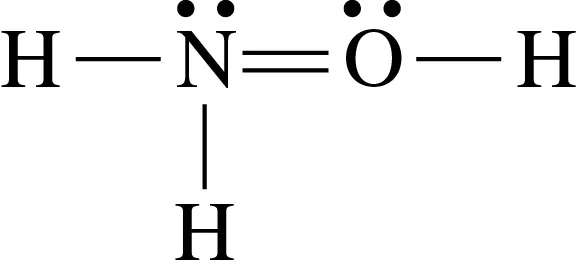
Identify the errors in each of the following Lewis structures and draw the correct formula:
c. Lewis structure showing hydrogen, nitrogen, and oxygen atoms with incorrect bonding; includes instructions for error identification.

Guida verificata passo dopo passo
1
Step 1: Analyze the Lewis structure provided. The structure shows a molecule with a carbon atom bonded to hydrogen atoms, an oxygen atom, and a nitrogen atom. The oxygen and nitrogen atoms have lone pairs of electrons depicted.
Step 2: Check the valence electrons for each atom. Carbon should have 4 bonds (4 valence electrons), oxygen should have 2 bonds and 2 lone pairs (6 valence electrons), and nitrogen should have 3 bonds and 1 lone pair (5 valence electrons). Hydrogen should have 1 bond (1 valence electron).
Step 3: Identify errors in the structure. In the provided structure, the nitrogen atom has 4 bonds, which exceeds its typical bonding capacity of 3. This violates the octet rule for nitrogen. Additionally, the oxygen atom appears correctly bonded but ensure its lone pairs are consistent with its valence electrons.
Step 4: Correct the structure by adjusting the bonds. To fix the nitrogen atom, reduce its bonding to 3 bonds and ensure it has one lone pair. This can be achieved by removing one bond between nitrogen and hydrogen.
Step 5: Verify the corrected structure. Ensure all atoms satisfy the octet rule (or duet rule for hydrogen) and that the total number of valence electrons matches the sum of the valence electrons for all atoms in the molecule.

Risposta video verificata per un problema simile:

Questa soluzione video è stata consigliata dai nostri tutor come utile per risolvere questo problema.
Durata del video:
10m

Concetti chiave

Ecco i concetti essenziali che devi comprendere per rispondere correttamente alla domanda.

Lewis Structures

Lewis structures are diagrams that represent the bonding between atoms in a molecule and the lone pairs of electrons that may exist. They use dots to represent electrons and lines to represent bonds, allowing chemists to visualize the arrangement of atoms and predict molecular geometry and reactivity.
Video consigliato:
Percorso guidato
03:11
Lewis Dot Structures: Ions (Simplified) Concept 1

Formal Charge

Formal charge is a concept used to determine the distribution of electrons in a molecule. It is calculated by taking the number of valence electrons in an atom, subtracting the number of non-bonding electrons, and half the number of bonding electrons. A molecule is generally more stable when the formal charges are minimized and closer to zero.
Video consigliato:
Percorso guidato
02:22
Periodic Table: Transition Metals Charges Concept 1

Resonance Structures

Resonance structures are different ways of drawing the same molecule that illustrate the delocalization of electrons. They are used when a single Lewis structure cannot adequately represent the molecule's electron distribution. The actual structure is a hybrid of these resonance forms, contributing to the molecule's stability and reactivity.
Video consigliato:
Percorso guidato
01:59
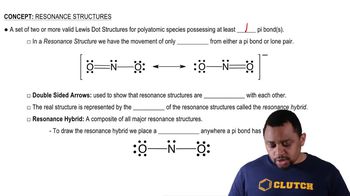
Resonance Structures (Simplified) Concept 1