 Indietro
Solving Linear Equations: Intermediate Algebra Study Guide
Guida di studio - Note intelligenti
 Appunti personalizzati basati sui tuoi materiali, ampliati con definizioni chiave, esempi e contesto.
Solving Linear Equations
Introduction to Linear Equations
Linear equations are fundamental in algebra and represent statements where two algebraic expressions are equal. The solution to a linear equation is the value of the variable that makes the equation true when substituted.
Equation: A statement that two algebraic expressions are equal.
Linear Equation in One Variable: An equation of the form , where , , and are real numbers and is the variable.
Solution Set: The set of values that satisfy the equation, written in set brackets { }.
Example: Determine whether a given value is a solution to the equation .


Identifying Linear Equations
Not all equations are linear. Linear equations have variables raised only to the first power and do not involve products of variables or higher powers.
Linear Equation:
Nonlinear Equation: or
Example: is linear; is not.

Expressions vs. Equations
It is important to distinguish between expressions and equations. An expression does not have an equal sign, while an equation does.
Expression:
Equation:


Solving Linear Equations
Solving linear equations involves isolating the variable using properties of equality. The main properties are addition, subtraction, multiplication, and division.
Addition Property: If , then
Subtraction Property: If , then
Multiplication Property: If , then
Division Property: If , then (for )
Example: Solve
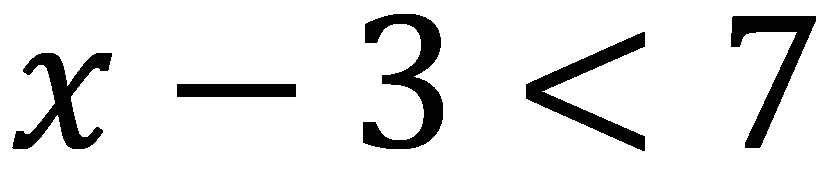
Checking Solutions
Always check your solution by substituting the value back into the original equation to verify it makes the statement true.
Example: For , is a solution because .

Solving Equations with Fractions and Decimals
When equations involve fractions or decimals, clear them by multiplying both sides by the least common denominator (LCD) or a power of 10.
Example:
Example:


Summary Table: Properties of Equality
The properties of equality are essential tools for solving equations. The table below summarizes their use:
Property | Operation | Example |
|---|---|---|
Addition | Add to both sides | |
Subtraction | Subtract from both sides | |
Multiplication | Multiply both sides | |
Division | Divide both sides |

Solving Linear Equations: Step-by-Step
Follow these steps to solve any linear equation:
Simplify both sides of the equation (distribute, combine like terms).
Use addition/subtraction properties to collect variable terms on one side and constant terms on the other.
Use multiplication/division properties to isolate the variable.
Check your solution by substituting back into the original equation.

Examples of Linear Equations



Practice Problems
Solve
Solve
Solve ;
Solve ;



Additional info:
These notes cover the foundational concepts and procedures for solving linear equations, which are essential for intermediate algebra students. The included images visually reinforce the algebraic concepts and steps described.
