Indietro
Solving Word Problems: Consecutive Even Integers
Guida di studio - Note intelligenti
 Appunti personalizzati basati sui tuoi materiali, ampliati con definizioni chiave, esempi e contesto.
Equations, Inequalities, and Problem Solving
Solving Word Problems Involving Consecutive Even Integers
Word problems involving consecutive even integers are a common application of algebraic equations. The process involves translating a real-world scenario into an algebraic equation, solving for the unknown, and interpreting the result.
Definition: Consecutive even integers are integers that follow one another in order and are each divisible by 2. For example, 26, 28, and 30.
General Strategy: Use a variable to represent the first integer, then express the next consecutive even integers in terms of this variable.
Step 1: Understand the Problem
Read and reread the problem to identify what is being asked.
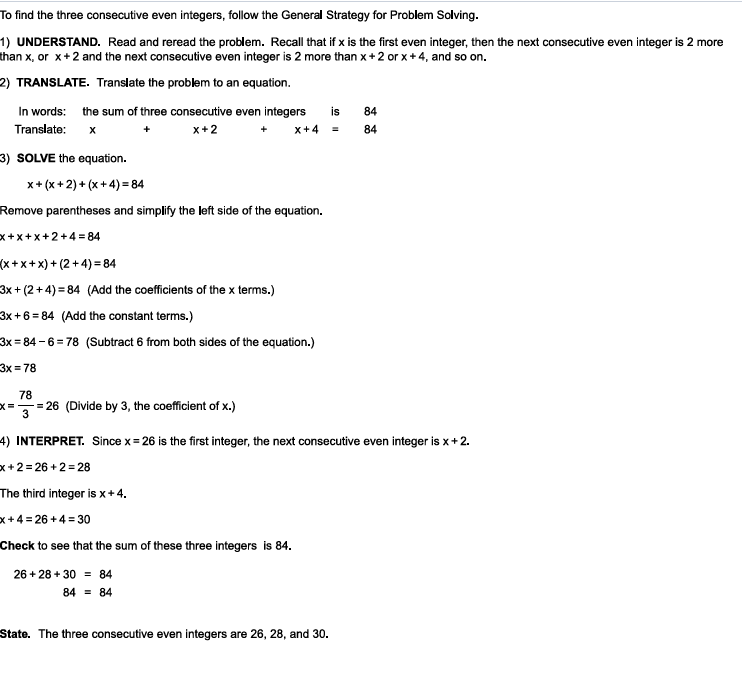
If x is the first even integer, the next consecutive even integer is x + 2, and the third is x + 4.
Step 2: Translate the Problem to an Equation
In words: The sum of three consecutive even integers is 84.
Translate:
Step 3: Solve the Equation
Remove parentheses and combine like terms:
Subtract 6 from both sides:
Divide by 3:
Step 4: Interpret the Solution
The first integer is 26.
The second integer is 28 ().
The third integer is 30 ().
Step 5: Check the Solution
Add the three integers:
Since the sum matches the original condition, the solution is correct.
Example
Problem: Find three consecutive even integers whose sum is 84.
Solution: The integers are 26, 28, and 30.
Additional info: This method can be generalized to solve for any set of consecutive even or odd integers by adjusting the increment (2 for even, 1 for odd).