 Indietro
Systems of Equations and Problem Solving in Intermediate Algebra
Guida di studio - Note intelligenti
 Appunti personalizzati basati sui tuoi materiali, ampliati con definizioni chiave, esempi e contesto.
Systems of Equations and Problem Solving
Introduction to Systems of Equations
Systems of equations are sets of two or more equations with the same variables. In Intermediate Algebra, these systems are used to model and solve real-world problems involving relationships between quantities. This chapter focuses on solving systems of two or three equations, especially in the context of word problems, cost and revenue analysis, and mixtures.
Solving Problems Modeled by Systems of Two Equations
Problem-Solving Steps
Understand the Problem: Carefully read and reread the problem. Identify the unknowns and assign variables to them. Construct a drawing if helpful. Propose a solution and check if it fits the problem context.
Translate into Equations: Express the relationships described in the problem as two algebraic equations.
Solve the System: Use methods such as substitution or addition (elimination) to solve the equations.
Interpret the Results: Substitute the solution back into the original equations to verify correctness and state the final answer in the context of the problem.
Example 1: Number Problem
Problem: One number is 4 more than twice the second number. Their total is 25. Find the numbers.
Let x = first number, y = second number.
Translate: x = 4 + 2y; x + y = 25
Solve: Substitute x from the first equation into the second: 4 + 2y + y = 25 → 3y = 21 → y = 7. Then x = 4 + 2(7) = 18.
Interpret: The two numbers are 18 and 7.
Example 2: Ticket Sales Problem
Problem: A drama club sold 311 tickets. Student tickets cost $0.50, non-student tickets cost $1.50. Total receipts were $385.50. Find the number of each ticket sold.
Let s = number of student tickets, n = number of non-student tickets.
Translate: s + n = 311; 0.5s + 1.5n = 385.50
Solve: Use elimination: Multiply the first equation by -0.5 and add to the second to eliminate s. Solve for n, then substitute back for s.
Interpret: 81 student tickets and 230 non-student tickets were sold.
Example 3: Rate Problem (Rowing)
Problem: Terry can row 10.6 km downstream and 6.8 km upstream in 1 hour each. Find his speed in still water and the speed of the current.
Let r = speed in still water, w = speed of current.
Translate: r + w = 10.6; r - w = 6.8
Solve: Add equations: 2r = 17.4 → r = 8.7; then w = 10.6 - 8.7 = 1.9
Interpret: Terry’s speed in still water is 8.7 km/hr; current is 1.9 km/hr.
Example 4: Mixture Problem
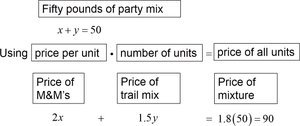
Problem: A manager mixes M&M’s ($2.00/lb) with trail mix ($1.50/lb) to get 50 lbs of party mix worth $1.80/lb. How many pounds of each are needed?
Let x = pounds of M&M’s, y = pounds of trail mix.
Translate: x + y = 50; 2x + 1.5y = 1.8(50) = 90
Solve: Use elimination or substitution to solve for x and y.
Interpret: 30 pounds of M&M’s and 20 pounds of trail mix are needed.

Solving Problems with Cost and Revenue Functions
Break-Even Analysis
Cost and revenue functions are used to determine the point at which a business neither makes a profit nor incurs a loss (break-even point).
Cost Function (C): Includes fixed costs (e.g., equipment) and variable costs (e.g., production per unit).
Revenue Function (R): Calculated as the selling price per unit times the number of units sold.
Break-Even Point: Occurs when total cost equals total revenue:
Example: A company spends $2000 on equipment and $1.50 per package produced, selling each for $4.00. To break even:
Cost:
Revenue:
Set :
Solve:
Interpret: The company must sell 800 packages to break even.
Solving Problems Modeled by Systems of Three Equations
Angle Problem in a Triangle
Systems of three equations can be used to solve problems involving three unknowns, such as the measures of angles in a triangle.
Let s = smallest angle, m = middle angle, l = largest angle.
Translate: l = s + 90; m = s + 30; s + m + l = 180
Solve: Substitute expressions for m and l into the third equation: → →
Then ,
Interpret: The angles are 20°, 50°, and 110°.
Summary Table: Methods for Solving Systems of Equations
Method | When to Use | Key Steps |
|---|---|---|
Substitution | One equation is easily solved for one variable | Solve for one variable, substitute into the other equation |
Addition (Elimination) | Equations are in standard form | Add or subtract equations to eliminate a variable |
Graphing | Visualize solutions | Graph both equations and find intersection point |
