 Indietro
Systems of Equations in Two Variables: Graphical Solutions and Classification
Guida di studio - Note intelligenti
 Appunti personalizzati basati sui tuoi materiali, ampliati con definizioni chiave, esempi e contesto.
Section 3.1: Systems of Equations in Two Variables
Introduction to Systems of Equations
A system of equations consists of two or more equations that share the same set of variables. In Intermediate Algebra, we often focus on systems with two equations and two variables, typically x and y. The solution to a system is any ordered pair that satisfies all equations in the system simultaneously.
Ordered Pair Solution: An ordered pair (x, y) that makes all equations in the system true.
Graphical Solution: The solution corresponds to the intersection point(s) of the graphs of the equations.
Determining Solutions of a System
To determine if an ordered pair is a solution to a system, substitute the values into each equation and check if both are satisfied.
Example: For the system Test the ordered pair (4, 1): (True), (True). Thus, (4, 1) is a solution.
Solving Systems Graphically
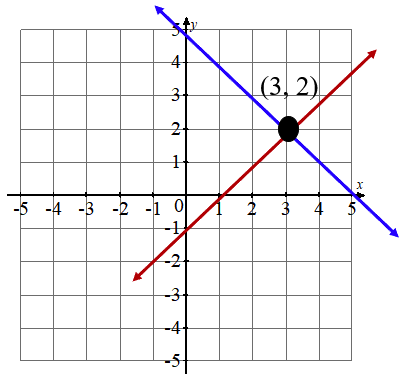
Graphical solutions involve plotting each equation on the same coordinate plane and identifying intersection points. The coordinates of each intersection represent a solution to the system.
Steps:
Graph each equation on the same axes.
Identify the point(s) where the graphs intersect.
The intersection point(s) are the solution(s) to the system.
Example: Solve the system graphically: Graph both lines and find their intersection.
Classifying Systems of Equations
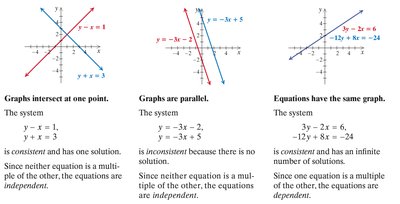
Systems of equations can be classified based on the number of solutions and the relationship between the equations:
Consistent System: Has at least one solution.
Inconsistent System: Has no solution (the lines are parallel and never intersect).
Independent Equations: Equations that are not multiples of each other; their graphs are not the same line.
Dependent Equations: Equations that are multiples of each other; their graphs coincide (are the same line).
Examples of System Types
One Solution (Consistent & Independent): The lines intersect at exactly one point.
No Solution (Inconsistent & Independent): The lines are parallel and never intersect.
Infinitely Many Solutions (Consistent & Dependent): The lines are the same (coincident).
Translating Word Problems to Systems of Equations
Many real-world problems can be modeled using systems of equations. The key is to define variables and write equations that represent the relationships described in the problem.
Example 1: The perimeter of a rectangle is 22 in. The width is one less than twice the length. Let L = length, W = width.
Example 2: T-shirt Villa sold 52 shirts, one kind at $8.25 and another at $11.50 each. In all, $464.75 was taken in for the shirts. Let x = number of $8.25 shirts, y = number of x + y = 52
Practice Problems
Determine whether the ordered pair is a solution of the given system of equations: Test (−3, 1) and (1, −1).
Solve each system graphically:
Translate to a system of equations: Two angles are supplementary. The measure of one angle is 9 less than twice the measure of the other. Let x = one angle, y = other angle.
Summary Table: Types of Systems
Type | Graphical Representation | Number of Solutions | Equation Relationship |
|---|---|---|---|
Consistent & Independent | Intersect at one point | One | Not multiples |
Consistent & Dependent | Same line | Infinitely many | Multiples |
Inconsistent & Independent | Parallel lines | None | Not multiples |
Key Points to Remember
A solution to a system is an ordered pair that satisfies all equations.
Graphical solutions are visual but may be less precise for non-integer intersections.
Classify systems as consistent/inconsistent and equations as independent/dependent based on their graphs and algebraic relationships.
Translating word problems into systems is a critical skill for applications.
