 Indietro
Systems of Linear Equations in Two Variables – Intermediate Algebra Study Notes
Guida di studio - Note intelligenti
 Appunti personalizzati basati sui tuoi materiali, ampliati con definizioni chiave, esempi e contesto.
Systems of Equations
Introduction to Systems of Linear Equations
A system of equations consists of two or more equations with the same set of variables. In Intermediate Algebra, we focus on systems of two linear equations in two variables. The solution to such a system is an ordered pair (x, y) that satisfies both equations simultaneously.
Consistent system: Has at least one solution.
Inconsistent system: Has no solution.
Dependent equations: Equations that represent the same line (infinite solutions).
Independent equations: Equations that represent different lines (one or no solution).
Solving Systems of Linear Equations in Two Variables
Determining Whether an Ordered Pair Is a Solution
To check if an ordered pair is a solution to a system, substitute the values of x and y into both equations. If both equations are true, the pair is a solution.
Example: Given the system: Test (−3, 1): Substitute x = −3, y = 1: First equation: (True) Second equation: (True) Since both are true, (−3, 1) is a solution.
Example: Test (4, 2): Substitute x = 4, y = 2: First equation: (False if equation is ) Second equation: (False if equation is ) If only one equation is true, the pair is not a solution.
Solving Systems by Graphing
Graphing is a visual method to solve systems. Each equation is graphed on the same coordinate plane. The intersection point(s) represent the solution(s) to the system.
One solution: Lines intersect at one point.
No solution: Lines are parallel and never intersect.
Infinite solutions: Lines are coincident (identical).
Example: The solution appears to be the intersection point of the two lines.
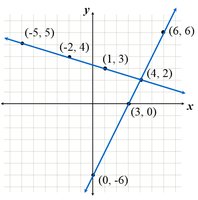
Always check the intersection point by substituting its coordinates into both equations to verify it is a solution.
Special Systems of Linear Equations
When graphing two linear equations, three outcomes are possible:
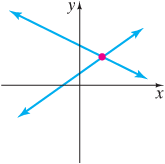
One point of intersection: The system has one solution (consistent and independent).
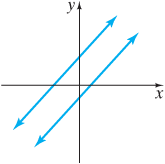
Parallel lines: No solution (inconsistent and independent).
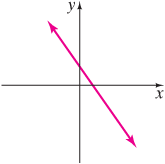
Coincident lines: Infinite solutions (consistent and dependent).
Visual representations:
Case | Description | Image |
|---|---|---|
One solution | Consistent system; independent equations |
|
No solution | Inconsistent system; independent equations |
|
Infinite solutions | Consistent system; dependent equations |
|
Solving a System by Substitution
The substitution method involves solving one equation for one variable and substituting this expression into the other equation. This reduces the system to a single equation in one variable.
Steps:
Solve one equation for one variable.
Substitute this expression into the other equation.
Solve for the remaining variable.
Substitute back to find the other variable.
Check the solution in both original equations.
Example: Solve Substitute into the first equation: This is always true for any y, so the system has infinitely many solutions if the equations are equivalent. If not, solve for y, then substitute back to find x.
Solving a System Using Elimination (Addition Method)
The elimination method (or addition method) involves adding or subtracting equations to eliminate one variable, making it possible to solve for the other variable.
Steps:
Rewrite equations in standard form ().
Multiply one or both equations (if necessary) so that the coefficients of one variable are opposites.
Add or subtract the equations to eliminate one variable.
Solve for the remaining variable.
Substitute back to find the other variable.
Check the solution in both original equations.
Example: Solve Add equations: Substitute into the first equation: Solution: (8, −1)
Special Cases in Elimination
No solution: If elimination results in a false statement (e.g., ), the system is inconsistent (parallel lines).
Infinite solutions: If elimination results in a true statement (e.g., ), the system is dependent (same line).
Summary Table: Types of Solutions for Systems of Two Linear Equations
Type | Graph | Number of Solutions | System Type | Equation Relationship |
|---|---|---|---|---|
Intersecting lines | One intersection point | One | Consistent | Independent |
Parallel lines | No intersection | None | Inconsistent | Independent |
Coincident lines | Same line | Infinitely many | Consistent | Dependent |
Key Formulas and Properties
Standard form of a linear equation:
Slope-intercept form:
Checking a solution: Substitute (x, y) into both equations and verify both are true.
