 Indietro
The Slope of a Line: Graphs and Functions in Intermediate Algebra
Guida di studio - Note intelligenti
 Appunti personalizzati basati sui tuoi materiali, ampliati con definizioni chiave, esempi e contesto.
Graphs and Functions
The Slope of a Line
The concept of slope is fundamental in algebra and analytic geometry, describing the steepness and direction of a line on the coordinate plane. Understanding slope allows us to analyze, compare, and interpret linear relationships in various contexts.
Finding the Slope of a Line Given Two Points
Definition: The slope (m) of a line passing through two points \((x_1, y_1)\) and \((x_2, y_2)\) is given by the formula:
Key Point: The numerator represents the change in y (vertical change), and the denominator represents the change in x (horizontal change).
Helpful Hint: It does not matter which point is labeled as 1 or 2, as long as the order is consistent in both numerator and denominator.
Example: Find the slope of the line through (0, 3) and (2, 5):
Example: Find the slope of the line through (4, -3) and (2, 2):
Finding Slope Given an Equation
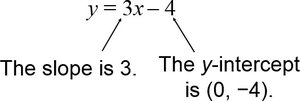
Slope-Intercept Form: A linear equation can be written as , where m is the slope and b is the y-intercept (the point where the line crosses the y-axis).
To find the slope from a standard form equation (e.g., ), solve for y to rewrite in slope-intercept form.
Example: For :
Solve for y:
Slope is , y-intercept is .
Example: For :
Solve for y:
Slope is .
Interpreting Slope-Intercept Form
The slope-intercept form allows us to interpret real-world situations where one variable depends linearly on another.
Example: The equation models the price y of a Disney World pass, where x is years since 2006. The slope (3.53) represents the annual increase in price, and the y-intercept (67.39) is the price in 2006.
Application: To predict the price in 2026 ():
Finding Slopes of Horizontal and Vertical Lines
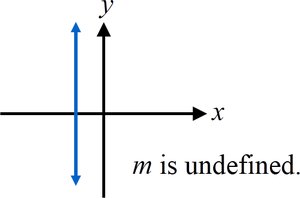
Vertical Lines: Equations of the form are vertical lines. Their slope is undefined because the change in x is zero (division by zero is undefined).
Example: The line has an undefined slope.
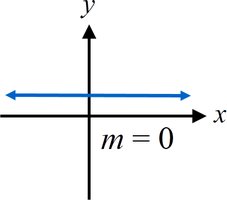
Horizontal Lines: Equations of the form are horizontal lines. Their slope is 0 because the change in y is zero.
Example: The line has a slope of 0.
Appearance of Lines with Given Slopes
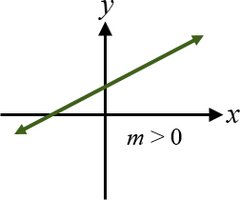
Positive Slope: Lines with rise as increases (upward to the right).
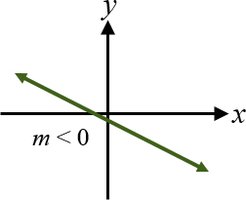
Negative Slope: Lines with fall as increases (downward to the right).
Compare the Slopes of Parallel and Perpendicular Lines
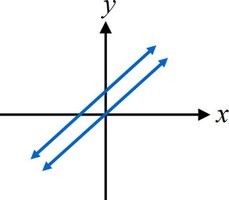
Parallel Lines: Two lines are parallel if they have the same slope (). Vertical lines are also parallel to each other.
Example: The lines and are parallel if their slopes are equal.
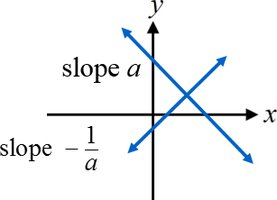
Perpendicular Lines: Two lines are perpendicular if the product of their slopes is (). Their slopes are negative reciprocals.
Example: The lines and are perpendicular if their slopes are negative reciprocals.
Horizontal and Vertical Lines: These are always perpendicular to each other.
Summary Table: Types of Lines and Their Slopes
Type of Line | Equation Form | Slope | Graphical Appearance |
|---|---|---|---|
Vertical | Undefined | Parallel to y-axis | |
Horizontal | 0 | Parallel to x-axis | |
Positive Slope | , | Greater than 0 | Rises to the right |
Negative Slope | , | Less than 0 | Falls to the right |
Parallel Lines | Same slope | Never intersect | |
Perpendicular Lines | Negative reciprocal slopes | Intersect at right angles |
