 Indietro
Animal Development and Body Symmetry
Guida di studio - Note intelligenti
 Appunti personalizzati basati sui tuoi materiali, ampliati con definizioni chiave, esempi e contesto.
Animal Development and Body Symmetry
Animal Exchange Systems
Animals must exchange gases, nutrients, and wastes with their environment to survive. The structure of their exchange systems depends on their body plan and complexity.
Single-celled organisms exchange materials directly with their environment through their cell membrane.
Simple multicellular animals (e.g., those with a gastrovascular cavity) have body plans that allow all cells to be in direct contact with the environment or with the cavity where exchange occurs.
More complex animals have specialized exchange organs and circulatory systems to transport materials between cells and the environment.
Animal Body Symmetry
Body symmetry refers to the arrangement of body parts around a central axis. It is a key feature in animal classification and development.
Radial symmetry: Body parts are arranged around a central axis, as seen in cnidarians (e.g., jellyfish). These animals can be divided into similar halves by multiple planes.
Bilateral symmetry: Body has a left and right side that are mirror images. Most animals, including humans, exhibit bilateral symmetry, which is associated with cephalization (development of a head region).
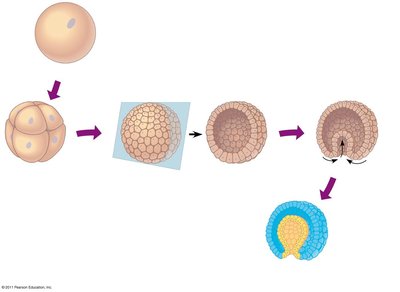
Animal Development: From Zygote to Gastrula
Animal development begins with a fertilized egg (zygote) and proceeds through a series of stages that establish the basic body plan.
Zygote: The single fertilized egg cell.
Cleavage: Rapid cell divisions without growth, producing a multicellular embryo.
Blastula: A hollow ball of cells formed after several rounds of cleavage. The cavity inside is called the blastocoel.
Gastrulation: Cells move inward, forming a structure with multiple layers. The resulting embryo is called a gastrula, with distinct germ layers:
Ectoderm: Outer layer, forms skin and nervous system.
Endoderm: Inner layer, forms the lining of the digestive tract.
Archenteron: The primitive gut formed during gastrulation.
Blastopore: The opening that forms during gastrulation, which becomes the mouth or anus depending on the animal group.
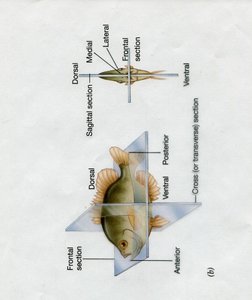
Body Plan Terminology
Understanding anatomical directions is essential for describing animal structure:
Dorsal: The back or upper side.
Ventral: The belly or lower side.
Anterior: The head or front end.
Posterior: The tail or rear end.
Medial: Toward the midline of the body.
Lateral: Away from the midline.
Frontal (coronal) section: Divides the body into dorsal and ventral parts.
Sagittal section: Divides the body into left and right parts.
Transverse (cross) section: Divides the body into anterior and posterior parts.
Summary Table: Animal Developmental Stages
Stage | Description |
|---|---|
Zygote | Single fertilized egg cell |
Cleavage | Rapid cell division without growth |
Blastula | Hollow ball of cells with a blastocoel |
Gastrula | Embryo with multiple germ layers (ectoderm, endoderm) |
Key Equations
There are no specific equations for these developmental processes, but understanding cell division and surface area-to-volume ratios is important for exchange systems.
Example: In animals with a gastrovascular cavity, such as hydra, all cells are close enough to the cavity for direct exchange of materials, eliminating the need for a circulatory system.
Additional info: The stages of animal development and body symmetry are foundational concepts for understanding animal diversity and evolution.
