Indicate whether aqueous solutions of each of the following solutes contain only ions, only molecules, or mostly molecules and a few ions:
c. fructose, C₆H₁₂O₆, a nonelectrolyte
Guida verificata passo dopo passo
1
Identify the type of solute: Fructose (C₆H₁₂O₆) is a nonelectrolyte.
Understand the behavior of nonelectrolytes in water: Nonelectrolytes do not dissociate into ions when dissolved in water.
Recognize the composition of the solution: Since fructose is a nonelectrolyte, it will dissolve in water as intact molecules.
Conclude the nature of the solution: The aqueous solution of fructose will contain only molecules.
Summarize the findings: Fructose in water remains as molecules, with no ions present in the solution.
Risposta video verificata per un problema simile:
Questa soluzione video è stata consigliata dai nostri tutor come utile per risolvere questo problema.
Durata del video:
2m
Guarda un video:
0 Commenti
Concetti chiave
Ecco i concetti essenziali che devi comprendere per rispondere correttamente alla domanda.
Electrolytes vs. Nonelectrolytes
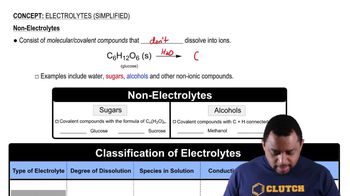
Electrolytes are substances that dissociate into ions when dissolved in water, allowing the solution to conduct electricity. In contrast, nonelectrolytes do not dissociate into ions; they remain as intact molecules in solution. Understanding this distinction is crucial for predicting the behavior of solutes in aqueous solutions.
Dissociation refers to the process by which a compound separates into its constituent ions in a solvent, typically water. This process is essential for electrolytes, as it determines the conductivity of the solution. For nonelectrolytes like fructose, there is no dissociation, and the solute exists solely as molecules.
Fructose, a simple sugar (monosaccharide), is classified as a nonelectrolyte because it does not ionize in solution. When dissolved in water, fructose molecules remain intact, resulting in a solution that contains mostly molecules rather than ions. This property affects the solution's physical and chemical behavior, including its conductivity.