Classify the solute represented in each of the following equations as a strong, weak, or nonelectrolyte:
b. NH₃(g) + H₂O(l) ⇌ NH₄⁺(aq) + OH⁻(aq)
Guida verificata passo dopo passo
1
Identify the solute in the given chemical equation. In this case, the solute is ammonia, NH₃.
Understand the nature of the solute. Ammonia (NH₃) is a molecular compound that can react with water to form ammonium ions (NH₄⁺) and hydroxide ions (OH⁻).
Recognize the type of reaction. The double arrow (⇌) indicates that this is an equilibrium reaction, meaning it does not go to completion and both reactants and products are present in solution.
Determine the classification of the solute. Since NH₃ partially ionizes in water and establishes an equilibrium, it is classified as a weak electrolyte.
Conclude that NH₃ is a weak electrolyte because it only partially dissociates in water, producing a small concentration of ions.
Risposta video verificata per un problema simile:
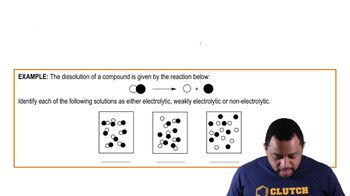
Questa soluzione video è stata consigliata dai nostri tutor come utile per risolvere questo problema.
Durata del video:
2m
Guarda un video:
0 Commenti
Concetti chiave
Ecco i concetti essenziali che devi comprendere per rispondere correttamente alla domanda.
Electrolytes
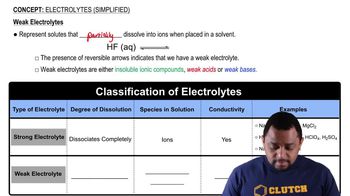
Electrolytes are substances that dissociate into ions when dissolved in water, allowing the solution to conduct electricity. They are classified into strong electrolytes, which completely dissociate into ions, weak electrolytes, which partially dissociate, and nonelectrolytes, which do not dissociate at all. Understanding the behavior of electrolytes is crucial for analyzing chemical reactions in aqueous solutions.
Strong electrolytes, such as sodium chloride, fully ionize in solution, resulting in a high concentration of ions. In contrast, weak electrolytes, like ammonia (NH₃), only partially ionize, leading to a mixture of un-ionized molecules and ions in solution. This distinction is important for predicting the conductivity and reactivity of solutions in chemical processes.
Ammonia (NH₃) is classified as a weak electrolyte because it does not fully dissociate in water. Instead, it establishes an equilibrium with water, forming ammonium ions (NH₄⁺) and hydroxide ions (OH⁻). This partial ionization is characteristic of weak electrolytes, which influences the pH and conductivity of the solution.