 Indietro
Atomic Structure and Periodicity: Study Notes for Introduction to Chemistry
Guida di studio - Note intelligenti
 Appunti personalizzati basati sui tuoi materiali, ampliati con definizioni chiave, esempi e contesto.
Atomic Structure and the Periodic Table
Subatomic Particles
Atoms are composed of three fundamental particles: protons, neutrons, and electrons. Their properties and positions within the atom are summarized below.
Proton: Located in the nucleus, relative mass = 1, relative charge = +1
Neutron: Located in the nucleus, relative mass = 1, relative charge = 0
Electron: Located in orbitals around the nucleus, relative mass = 1/1840, relative charge = -1
Atomic Number and Mass Number
Atomic Number (Z): Number of protons in the nucleus; defines the element.
Mass Number (A): Total number of protons and neutrons in the atom.
Number of Neutrons: Calculated as A - Z.
Isotopes
Isotopes are atoms of the same element (same number of protons) but different numbers of neutrons. Isotopes have similar chemical properties due to identical electronic structures, but may differ in physical properties because of their different masses.
Relative Isotopic Mass: Mass of one atom of an isotope compared to one twelfth of the mass of one atom of carbon-12.
Relative Atomic Mass (R.A.M): Average mass of one atom compared to one twelfth of the mass of one atom of carbon-12.
Relative Molecular Mass: Average mass of a molecule compared to one twelfth of the mass of one atom of carbon-12.
Mass Spectrometry
The mass spectrometer is an instrument used to determine the isotopic composition of elements and calculate their relative atomic masses. It measures the mass/charge ratio (m/z) and abundance of each isotope.
Calculation of Relative Atomic Mass: If relative abundance is used instead of percentage:
Applications: Used in planetary probes, drug testing, quality control in pharmaceuticals, and radioactive dating.
Mass Spectra of Molecules
When molecules are analyzed, the mass spectrometer produces a series of peaks due to fragments. The peak with the largest m/z corresponds to the molecular ion and represents the molecular mass (Mr).
Ionisation Energies
Definition and Patterns
Ionisation energy is the energy required to remove an electron from a gaseous atom or ion. The first ionisation energy refers to removing one electron, while the second refers to removing a second electron from the resulting ion.
First Ionisation Energy:
Second Ionisation Energy:
Factors Affecting Ionisation Energy
Nuclear Attraction: More protons increase attraction.
Distance from Nucleus: Electrons further from the nucleus are less tightly held.
Shielding: Inner electrons repel outer electrons, reducing nuclear attraction.
Successive Ionisation Energies
Each successive ionisation energy is higher because the remaining electrons experience greater attraction after each removal.
Large jumps in ionisation energy indicate removal from a new, inner shell.
Trends in Ionisation Energy
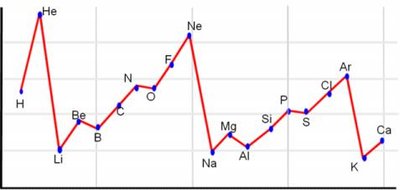
Across a Period: Generally increases due to increasing nuclear charge and similar shielding.
Down a Group: Decreases as electrons are further from the nucleus and more shielded.
Small Drops: Occur when electrons are added to higher energy sub-shells or when electron pairing causes repulsion.
Electronic Structure
Models of the Atom
Early models, such as the Bohr model, depicted electrons in fixed orbits. Modern models describe electrons in energy levels and sub-levels (s, p, d, f), with electrons occupying orbitals of specific shapes and energies.
Energy Levels: Numbered 1, 2, 3, 4 (1 is closest to nucleus).
Sub-levels: s (2 electrons), p (6), d (10), f (14).
Orbitals: Hold up to 2 electrons of opposite spin; s orbitals are spherical, p orbitals are dumbbell-shaped.
Filling Order: Electrons fill sub-shells in order of increasing energy:
Electronic Structure Notation: For oxygen: 1s2 2s2 2p4
Spin Diagrams: Arrows represent electrons with opposite spins in orbitals.
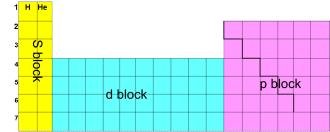
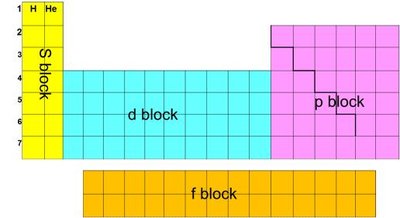
Periodic Table Blocks: Elements are classified as s, p, d, or f block based on their highest energy electrons.
Electronic Structure of Ions
Positive Ions: Electrons are lost from the atom (e.g., Mg: 1s2 2s2 2p6 3s2 → Mg2+: 1s2 2s2 2p6).
Negative Ions: Electrons are gained (e.g., O: 1s2 2s2 2p4 → O2−: 1s2 2s2 2p6).
Periodicity
Trends Across a Period
Periodicity refers to the repeating patterns observed in the properties of elements across periods in the periodic table.
Atomic Radius: Decreases across a period due to increased nuclear charge pulling electrons closer.
First Ionisation Energy: Generally increases across a period, with small drops due to sub-shell filling and electron pairing.
Melting and Boiling Points:
Na, Mg, Al: Metallic bonding, high melting/boiling points.
Si: Macromolecular structure, very high melting/boiling point.
P4, S8, Cl2: Simple molecular, low melting/boiling points due to weak London forces.
Ar: Monoatomic, very low melting/boiling point.
Classification of Elements
Elements are classified into blocks based on their electronic structure:
Block | Type of Elements | Highest Energy Electron |
|---|---|---|
s block | Groups 1 & 2, plus He | s orbital |
p block | Groups 13–18 | p orbital |
d block | Transition metals | d orbital |
f block | Lanthanides & actinides | f orbital |
Period 2 and 3 Trends
Period 2: Li, Be (metallic), B, C (macromolecular), N2, O2 (molecular gases), Ne (monoatomic gas).
Period 3: Na, Mg, Al (metallic), Si (macromolecular), P4, S8, Cl2 (simple molecular), Ar (monoatomic).
Additional info: The explanations for small drops in ionisation energy (e.g., Mg to Al, P to S) are due to sub-shell filling and electron pairing, which are important for understanding periodicity and electronic structure.
