 Indietro
Atoms, Elements, and Atomic Structure: Foundations of Chemistry
Guida di studio - Note intelligenti
 Appunti personalizzati basati sui tuoi materiali, ampliati con definizioni chiave, esempi e contesto.
Atoms: The Essential Building Blocks
Definition and Importance of Atoms
Atoms are the fundamental units of matter, forming the basis of all substances in the universe. Each atom consists of a nucleus containing protons and neutrons, surrounded by electrons in defined regions called orbitals.
Atom: The smallest unit of an element that retains the chemical properties of that element.
Element: A pure substance consisting of only one type of atom.
Example: Hydrogen, oxygen, and carbon are all elements made up of their respective atoms.
The Periodic Table of Elements
Organization and Classification
The periodic table organizes elements based on their atomic number and recurring chemical properties. Elements with similar reactivity and properties are grouped together in columns called groups or families.
Groups: Vertical columns; elements in the same group have similar chemical behaviors.
Periods: Horizontal rows; properties change progressively across a period.
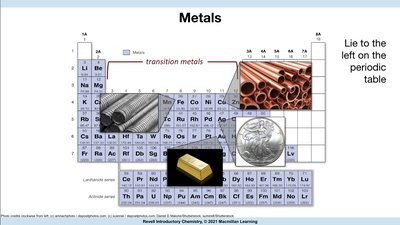
Metals: Lie to the left and center of the table, typically shiny, malleable, and good conductors of heat and electricity.
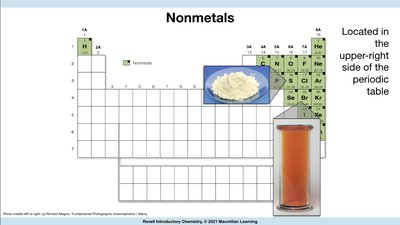
Nonmetals: Located on the upper-right side, generally poor conductors and more likely to gain electrons in reactions.
Uncovering Atomic Structure
Development of Atomic Theory
Atomic theory has evolved through key experiments and observations. Early models, such as the "plum pudding" model, were replaced by the nuclear model after experiments like Rutherford's gold foil experiment demonstrated the existence of a dense, positively charged nucleus.
Protons: Positively charged particles in the nucleus.
Neutrons: Neutral particles in the nucleus.
Electrons: Negatively charged particles orbiting the nucleus.
Example: The "plum pudding" model described electrons embedded in a positively charged sphere, but this was later disproven.
Describing Atoms: Identity and Mass
Atomic Number, Mass Number, and Isotopes
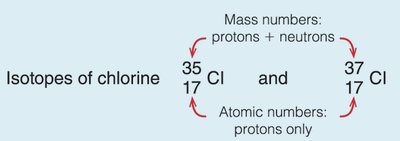
The identity of an atom is determined by its number of protons, known as the atomic number. The mass number is the sum of protons and neutrons. Isotopes are atoms of the same element with different numbers of neutrons, resulting in different mass numbers.
Atomic Number (Z): Number of protons in the nucleus; defines the element.
Mass Number (A): Total number of protons and neutrons in the nucleus.
Isotopes: Atoms with the same number of protons but different numbers of neutrons.
Calculating Average Atomic Mass
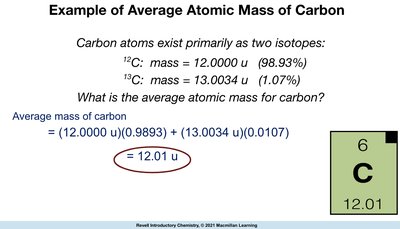
The average atomic mass of an element is calculated based on the masses and relative abundances of its naturally occurring isotopes. This value is shown on the periodic table for each element.
Formula:
Example: For carbon, the average atomic mass is calculated using the masses and abundances of 12C and 13C isotopes.
Electrons: A Preview
Electron Arrangement and Ions
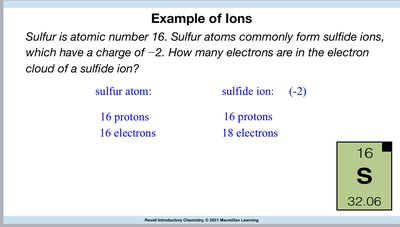
Electrons are arranged in energy levels around the nucleus. The number of electrons usually equals the number of protons in a neutral atom. Atoms can gain or lose electrons to form ions, which are charged particles.
Cation: An ion with a positive charge (fewer electrons than protons).
Anion: An ion with a negative charge (more electrons than protons).
Example: Sulfur (atomic number 16) forms a sulfide ion (S2−) by gaining two electrons, resulting in 18 electrons and 16 protons.
Summary of Atoms and Elements
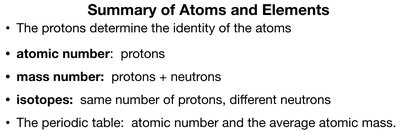
The number of protons determines the identity of an atom.
Atomic number: Number of protons.
Mass number: Number of protons plus neutrons.
Isotopes: Atoms with the same number of protons but different numbers of neutrons.
The periodic table displays the atomic number and average atomic mass for each element.
Example: Law of Conservation of Mass
Application in Chemical Reactions
The law of conservation of mass states that mass is neither created nor destroyed in a chemical reaction. The total mass of reactants equals the total mass of products.
Example: When 16.0 g of methane reacts with 64.0 g of oxygen to produce 36.0 g of water, the mass of carbon dioxide produced can be calculated as follows:
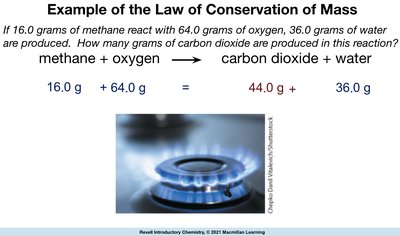
Table: Key Terms and Definitions
Term | Definition |
|---|---|
Atom | Smallest unit of an element retaining its chemical properties |
Element | Substance made of only one type of atom |
Atomic Number (Z) | Number of protons in the nucleus |
Mass Number (A) | Sum of protons and neutrons in the nucleus |
Isotope | Atoms of the same element with different numbers of neutrons |
Cation | Positively charged ion |
Anion | Negatively charged ion |
