 Indietro
Chapter 1: The Chemical World – Introduction to Chemistry
Guida di studio - Note intelligenti
 Appunti personalizzati basati sui tuoi materiali, ampliati con definizioni chiave, esempi e contesto.
The Chemical World
What is Chemistry?
Chemistry is the science that seeks to understand what matter does by studying what atoms and molecules do. Everything around us is composed of chemicals, and chemistry helps explain the properties and behaviors of these substances by examining their molecular composition.
Chemical: Any substance that has a definite composition; not limited to dangerous or artificial substances.
Molecule: A group of atoms bonded together, representing the smallest fundamental unit of a chemical compound.
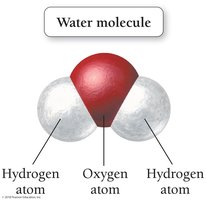
Water Molecules
Water is a common chemical composed of three atoms—one oxygen and two hydrogen—bonded together in a bent molecular shape. This structure gives water its unique properties, such as being a liquid at room temperature.
Chemical formula of water: H2O
Molecular geometry: Bent shape due to the arrangement of electron pairs around the oxygen atom.
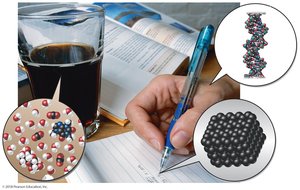
Chemicals Compose Ordinary Things
All objects and substances encountered in daily life are made of chemicals, whether they are natural or synthetic. Chemistry helps us understand the composition and properties of everyday materials, from the air we breathe to the food we eat and the products we use.
Examples include water, plastic, glass, and biological molecules like DNA.
Public Perception of Chemicals
Many people associate the word "chemical" with harmful substances, such as poisons or pollutants. However, chemicals are not inherently dangerous; they are simply substances with a defined composition, and they make up everything in the physical world.
Examples of chemicals with negative associations: paint thinner, industrial waste.
Examples of beneficial chemicals: water, vitamins, medicines.


Chemistry Explains Properties and Behavior
Chemistry provides explanations for the properties and behaviors of substances by examining the molecules that compose them. For example, the structure of water molecules explains why water is a liquid at room temperature and why it has a high boiling point compared to similar molecules.

All Things Are Made of Atoms and Molecules
The most fundamental idea in chemistry is that all matter is made of atoms. This concept, emphasized by physicist Richard Feynman, underpins all of chemistry and much of science as a whole.
Atom: The smallest unit of an element that retains the properties of that element.
Molecule: Two or more atoms bonded together.

The Scientific Method: How Chemists Think
Definition and Contrast with Ancient Philosophy
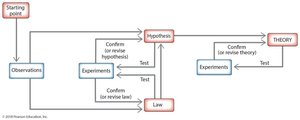
The scientific method is a systematic way of learning about the world that emphasizes observation and experimentation. Unlike ancient philosophies that relied on pure reason, the scientific method produces knowledge based on empirical evidence.
Steps of the Scientific Method
The scientific method involves several key steps:
Observation: Measuring or observing some aspect of nature, often using experiments or instruments.
Hypothesis: A tentative interpretation or explanation of the observations. A good hypothesis is falsifiable.
Law: A statement that summarizes the results of many observations and predicts future ones (e.g., the law of conservation of mass).
Theory: A model that explains and gives the underlying causes for observations and laws. Theories are broader and deeper than laws and can predict new phenomena.
Observation in Practice
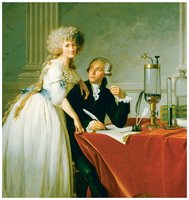
Observations can be made directly with the senses or with the aid of scientific instruments. For example, Antoine Lavoisier conducted combustion experiments in closed containers and observed that the mass did not change, leading to important scientific laws.
Hypotheses and Experiments
Observations lead to hypotheses, which are tested by experiments. Experiments are highly controlled observations designed to validate or invalidate hypotheses. A hypothesis must be falsifiable, meaning it can be proven wrong by experiment.
Law of Conservation of Mass
Repeated observations can lead to the development of scientific laws. Lavoisier's experiments led to the law of conservation of mass:
Law of Conservation of Mass: In a chemical reaction, matter is neither created nor destroyed.
Scientific Theories
One or more well-established hypotheses may form the basis for a scientific theory. Theories provide a comprehensive explanation for observations and laws and are supported by extensive experimental evidence. The atomic theory, for example, explains the law of conservation of mass by proposing that matter is composed of small, indestructible particles called atoms.
Modern Evidence for Atomic Theory
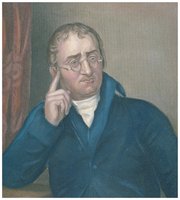
The idea that all matter is made of atoms is supported by over two centuries of experimental evidence. Modern technology allows us to visualize individual atoms, providing direct evidence for atomic theory.

How to Succeed in Chemistry
Curiosity and Imagination
Success in chemistry requires curiosity and imagination. Students should be motivated to ask questions and seek to understand the underlying reasons for observed phenomena.

Analyzing and Interpreting Data
Graphical Analysis of Scientific Data
Scientific data, such as measurements of atmospheric carbon dioxide, can be analyzed using graphs to reveal trends and relationships. For example, the concentration of atmospheric carbon dioxide has increased over time, as shown in the following graphs.
Example: In 1960, the concentration of carbon dioxide was 318 ppm; in 2000, it was 370 ppm.
Calculation of average rate of increase:
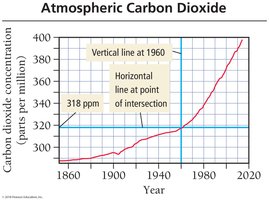
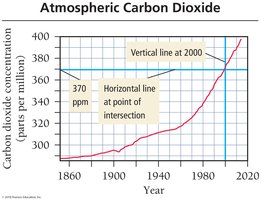
Prediction: If the rate remains constant, the concentration in 2030 can be estimated by adding the increase over 30 years to the 2000 value.
Review
Matter and Molecules: Chemistry seeks to understand what matter does by understanding what molecules do.
The Scientific Method: Chemists use observations, hypotheses, laws, theories, and experiments to build scientific knowledge.
Data Analysis: Scientific data can be graphed and analyzed to reveal trends and make predictions.
