Indietro
Chapter 3: Matter and Energy – Introduction to Chemistry Study Notes
Guida di studio - Note intelligenti
 Appunti personalizzati basati sui tuoi materiali, ampliati con definizioni chiave, esempi e contesto.
Matter and Energy
Definition and States of Matter
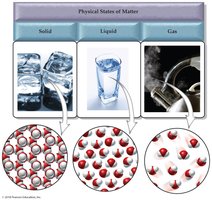
Matter is defined as any substance that has mass and occupies volume. All matter exists in one of three physical states: solid, liquid, or gas. Each state has distinct characteristics based on the arrangement and movement of its particles.
Solid: Definite shape and volume; particles are closely packed in a fixed arrangement.
Liquid: Definite volume but variable shape; particles are close but can move past one another.
Gas: Variable shape and volume; particles are far apart and move freely.
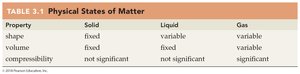
Property | Solid | Liquid | Gas |
|---|---|---|---|
Shape | Fixed | Variable | Variable |
Volume | Fixed | Fixed | Variable |
Compressibility | Not significant | Not significant | Significant |
Classification of Matter
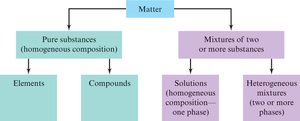
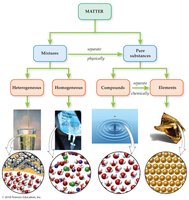
Matter can be classified as an element, compound, or mixture. This classification is based on composition and the ability to separate the substance by physical or chemical means.
Element: A pure substance consisting of only one type of atom; cannot be broken down by chemical means.
Compound: A pure substance composed of two or more different elements chemically bonded in a fixed ratio.
Mixture: A physical blend of two or more substances that can be separated by physical means. Mixtures can be homogeneous (uniform composition) or heterogeneous (distinct phases).
Homogeneous vs. Heterogeneous Mixtures
Homogeneous mixture (solution): Uniform throughout; examples include salt water and air.
Heterogeneous mixture: Contains visibly different parts or phases; examples include granite and salad dressing.
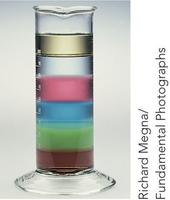
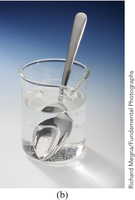
Summary Table: Classification of Matter
Practice: Classification Examples
Element: Gold (Au)
Compound: Sugar (C12H22O11), Carbon dioxide (CO2), Sodium chloride (NaCl)
Homogeneous mixture: Maple syrup
Heterogeneous mixture: Granola, granite countertop
Names and Symbols of the Elements
Each element is assigned a unique atomic number and a symbol (one or two letters, first capitalized). The periodic table is organized by atomic number. Memorizing the names and symbols of the first 36 elements and element 53 is recommended for foundational chemistry knowledge.
Occurrence and Distribution of Elements
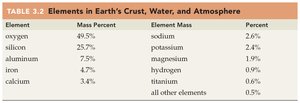
Of the 118 known elements, 88 occur naturally, and 81 are stable. Most elements are solids at room temperature; only 12 are gases and 2 are liquids. The distribution of elements in Earth's crust, water, and atmosphere is uneven, with 10 elements making up 95% of the total mass.
Element | Mass Percent |
|---|---|
Oxygen | 49.5% |
Silicon | 25.7% |
Aluminum | 7.5% |
Iron | 4.7% |
Calcium | 3.4% |
Sodium | 2.6% |
Potassium | 2.4% |
Magnesium | 1.9% |
Hydrogen | 0.9% |
Titanium | 0.6% |
All other elements | 0.5% |
Elements in the Human Body
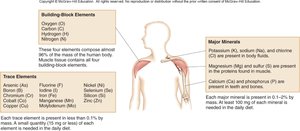
The human body is primarily composed of four elements: carbon (C), hydrogen (H), oxygen (O), and nitrogen (N), which make up about 96% of body mass. These elements are found in proteins, carbohydrates, lipids, and nucleic acids. Other elements are present as major minerals or trace elements, each with specific biological roles.
Metals, Nonmetals, and Semimetals
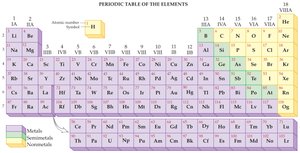
Elements are classified as metals, nonmetals, or semimetals (metalloids) based on their properties and position in the periodic table.
Metals: Good conductors of heat and electricity, malleable, ductile, usually solid with high melting points.
Nonmetals: Poor conductors, often gases or brittle solids, low melting points.
Semimetals: Properties intermediate between metals and nonmetals; often semiconductors.
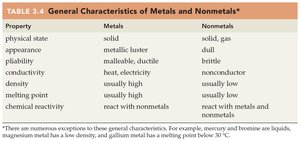
Property | Metals | Nonmetals |
|---|---|---|
Physical State | Solid | Solid, gas |
Appearance | Metallic luster | Dull |
Pliability | Malleable, ductile | Brittle |
Conductivity | Heat, electricity | Nonconductor |
Density | Usually high | Usually low |
Melting Point | Usually high | Usually low |
Chemical Reactivity | React with nonmetals | React with metals and nonmetals |
Compounds and Chemical Formulas
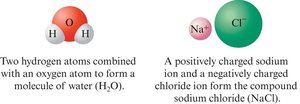
The law of definite composition states that a compound always contains the same elements in the same proportion by mass. Chemical formulas use element symbols and subscripts to indicate the types and numbers of atoms in a compound.
Example: (2 hydrogen, 1 oxygen), (6 carbon, 12 hydrogen, 6 oxygen)
Example: (1 magnesium, 2 nitrogen, 6 oxygen)
Molecular vs. Ionic Compounds
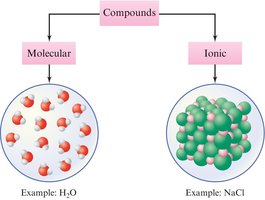
Molecular compounds: Formed between nonmetals; exist as molecules (e.g., ).
Ionic compounds: Formed between metals and nonmetals; exist as a lattice of ions (e.g., ).
Physical and Chemical Properties and Changes
Every substance has unique physical and chemical properties:
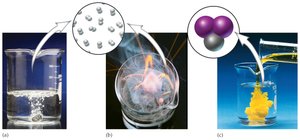
Physical properties: Observed without changing the substance's identity (e.g., color, melting point).
Chemical properties: Describe the ability to undergo chemical changes (e.g., flammability, reactivity).
Physical changes do not alter the identity of a substance (e.g., melting, grinding). Chemical changes result in new substances with different properties (e.g., burning, rusting).
Law of Conservation of Mass
The law of conservation of mass states that the mass of reactants in a chemical reaction equals the mass of the products. Matter is neither created nor destroyed in chemical reactions.
Equation:
Energy: Potential and Kinetic
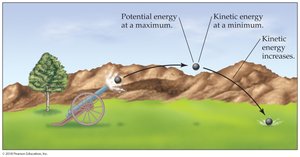
Energy is the capacity to do work. It exists as potential energy (stored energy) and kinetic energy (energy of motion). The kinetic energy of particles increases with temperature, affecting the physical state of matter.
Conservation of Energy
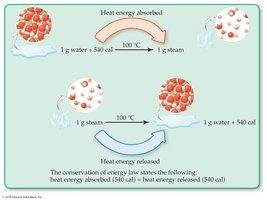
The law of conservation of energy states that energy cannot be created or destroyed, only converted from one form to another. Common forms include heat, light, chemical, electrical, mechanical, and nuclear energy.
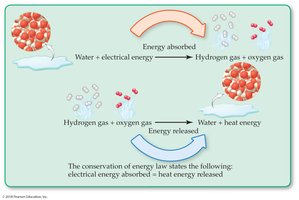
Law of Conservation of Mass and Energy
Einstein's theory of relativity () shows that mass and energy are interchangeable. The total mass and energy of the universe is constant.
Equation: