 Indietro
Chapter 5: Molecules and Compounds – Structured Study Notes
Guida di studio - Note intelligenti
 Appunti personalizzati basati sui tuoi materiali, ampliati con definizioni chiave, esempi e contesto.
Molecules and Compounds
Introduction to Compounds
Compounds are substances composed of two or more elements chemically combined in fixed proportions. The properties of compounds differ significantly from the properties of the elements that compose them. For example, ordinary table sugar (sucrose) contains carbon, hydrogen, and oxygen atoms, but its properties are distinct from those of elemental carbon, hydrogen, or oxygen.
Compound: A substance formed when two or more elements are chemically bonded.
Example: Sucrose (C12H22O11) is a compound with unique properties.
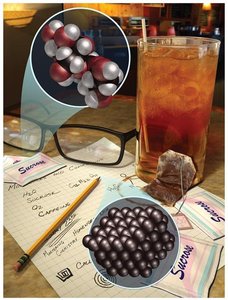
Properties of Compounds vs. Elements
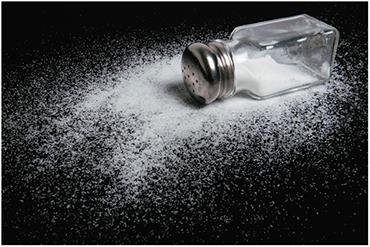
The properties of compounds are generally different from those of their constituent elements. For example, sodium chloride (table salt) is formed from sodium (a reactive metal) and chlorine (a poisonous yellow gas), yet salt is safe to eat.
Sodium (Na): Highly reactive metal.
Chlorine (Cl): Poisonous yellow gas.
Sodium chloride (NaCl): Safe, edible compound.
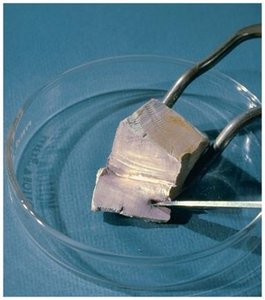
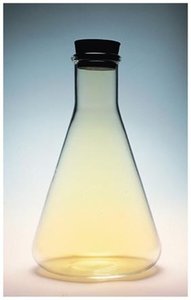
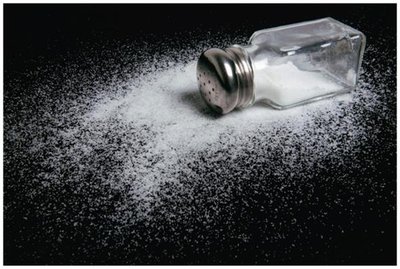
Compounds vs. Mixtures
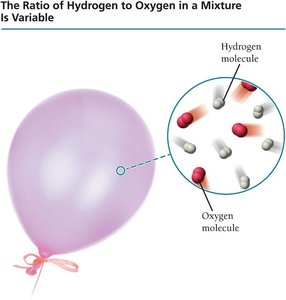
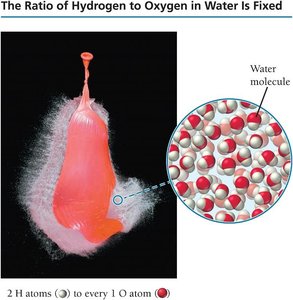
Most naturally occurring substances are compounds, not elements. Free atoms are rare in nature. Compounds differ from mixtures in that compounds have elements combined in fixed, definite proportions, while mixtures have variable proportions.
Compound: Fixed ratio of elements.
Mixture: Variable ratio of elements.
Law of Constant Composition
The law of constant composition states that all samples of a given compound have the same proportions of their constituent elements. This principle was formally stated by Joseph Proust.
Example (Water): Decomposing 18.0 g of water yields 16.0 g of oxygen and 2.0 g of hydrogen, giving a mass ratio of .
Example (Ammonia): Decomposing 17.0 g of ammonia yields 14.0 g of nitrogen and 3.0 g of hydrogen, giving a mass ratio of .
Chemical Formulas
Representing Compounds
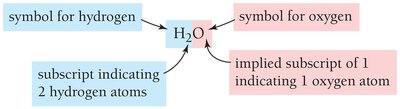
Chemical formulas indicate the elements present in a compound and the relative number of atoms of each. Subscripts show the number of atoms; a subscript of 1 is omitted by convention.
Example: H2O (water) – 2 hydrogen atoms, 1 oxygen atom.
Example: NaCl (table salt) – 1 sodium atom, 1 chlorine atom.
Example: CO2 (carbon dioxide) – 1 carbon atom, 2 oxygen atoms.
Changing Subscripts
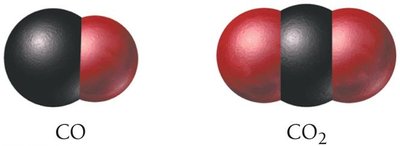
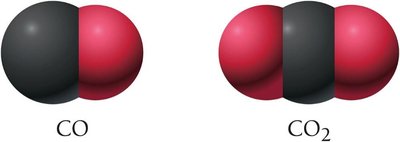
Changing a subscript in a chemical formula results in a completely different compound. For example, CO is carbon monoxide (toxic), while CO2 is carbon dioxide (relatively harmless).
CO: Carbon monoxide, air pollutant.
CO2: Carbon dioxide, product of respiration.
Order of Elements in Formulas
Chemical formulas list the most metallic elements first. In compounds without metals, the more metal-like element is listed first. Among nonmetals, those to the left in the periodic table are more metal-like and listed first.
Example: NaCl, not ClNa.
Example: NO2, not ON2.
Polyatomic Ions
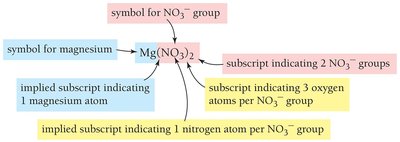
Some chemical formulas contain groups of atoms that act as a unit, called polyatomic ions. When several groups are present, their formula is set off in parentheses with a subscript indicating the number of groups.
Example: Mg(NO3)2 contains one magnesium atom and two nitrate groups.
Calculation: Mg: 1, N: 2, O: 6.
Types of Chemical Formulas
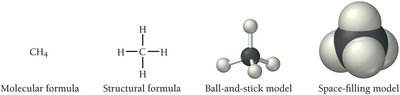
Chemical formulas can be empirical, molecular, or structural:
Empirical formula: Simplest whole-number ratio of atoms (e.g., H2O).
Molecular formula: Actual number of atoms in a molecule (e.g., C2H4).
Structural formula: Shows how atoms are connected.
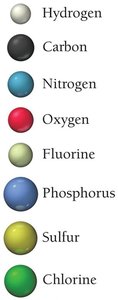
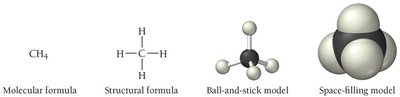
Molecular View of Elements and Compounds
Classification of Elements
Elements may be atomic or molecular. Atomic elements exist as single atoms (e.g., mercury), while molecular elements exist as diatomic molecules (e.g., chlorine).
Atomic elements: Single atoms as basic units.
Molecular elements: Diatomic molecules as basic units.
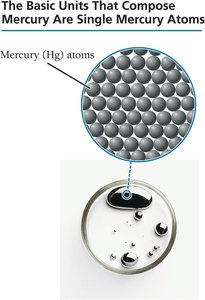
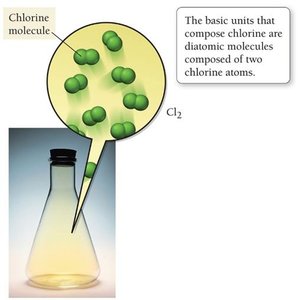
Elements That Occur as Diatomic Molecules
Name of Element | Formula of Basic Unit |
|---|---|
Hydrogen | H2 |
Nitrogen | N2 |
Oxygen | O2 |
Fluorine | F2 |
Chlorine | Cl2 |
Bromine | Br2 |
Iodine | I2 |
Classification of Compounds
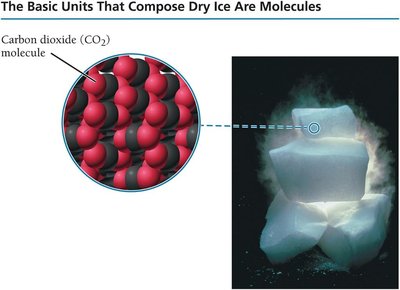
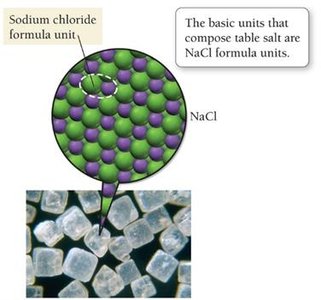
Compounds may be molecular or ionic. Molecular compounds are formed from two or more nonmetals, while ionic compounds are formed from metals and nonmetals.
Molecular compounds: Basic units are molecules (e.g., CO2).
Ionic compounds: Basic units are formula units (e.g., NaCl).
Writing Formulas for Ionic Compounds
Steps for Writing Ionic Formulas
Ionic compounds are formed when metals bond to nonmetals. The sum of the charges of cations and anions must equal zero.
Write the symbol for the metal and its charge, followed by the symbol for the nonmetal and its charge.
Make the magnitude of the charge on each ion become the subscript for the other ion.
Reduce subscripts to the smallest whole-number ratio.
Check that the sum of charges equals zero.
Polyatomic Ions in Ionic Compounds
Polyatomic ions are groups of atoms with an overall charge. When more than one polyatomic ion is present, parentheses are used in the formula.
Name | Formula |
|---|---|
Acetate | C2H3O2- |
Carbonate | CO32- |
Nitrate | NO3- |
Sulfate | SO42- |
Phosphate | PO43- |
Ammonium | NH4+ |
Hydroxide | OH- |
Naming Compounds
Naming Ionic Compounds
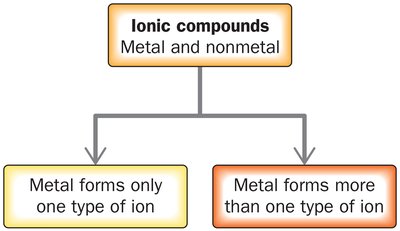
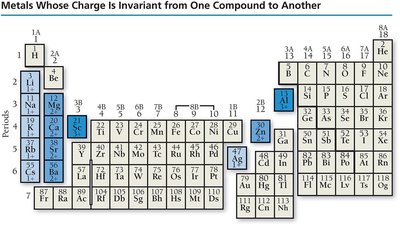
Ionic compounds are named based on the type of metal present:
Type I: Metal forms only one type of ion (main group elements).
Type II: Metal forms more than one type of ion (transition metals).

Naming Type I Ionic Compounds
Name the cation (metal) as the element.
Name the anion (nonmetal) with the base name plus -ide.
Example: NaCl is sodium chloride.
Example: Al2O3 is aluminum oxide.
Naming Type II Ionic Compounds
Metals with variable charge require a Roman numeral to indicate the charge.
Example: FeCl3 is iron(III) chloride.

Naming Ionic Compounds with Polyatomic Ions
Name the cation and the polyatomic ion.
Example: KNO3 is potassium nitrate.
Example: Fe(OH)2 is iron(II) hydroxide.
Example: NH4NO3 is ammonium nitrate.
Naming Oxyanions
Oxyanions are named based on the number of oxygen atoms.
-ate: More oxygen atoms (e.g., nitrate, sulfate).
-ite: Fewer oxygen atoms (e.g., nitrite, sulfite).
Prefixes hypo- (less than) and per- (more than) are used for series with more than two ions.

Polyatomic Ions in Everyday Chemistry
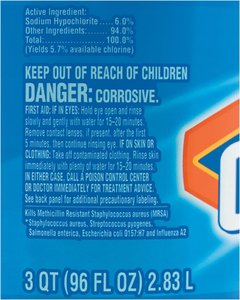
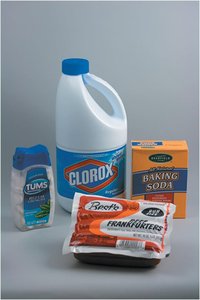
Sodium hypochlorite: Active ingredient in bleach.
Sodium bicarbonate: Found in baking soda.
Calcium carbonate: Used in antacids.
Sodium nitrite: Preserves packaged meats.
Naming Molecular Compounds
Molecular compounds are named using prefixes to indicate the number of atoms of each element. The first element is the more metal-like one.
Prefixes: mono-, di-, tri-, tetra-, penta-, hexa-, etc.
Example: N2O is dinitrogen monoxide.
If only one atom of the first element, the prefix mono- is omitted (e.g., CO is carbon monoxide).

Naming Acids
Classification of Acids
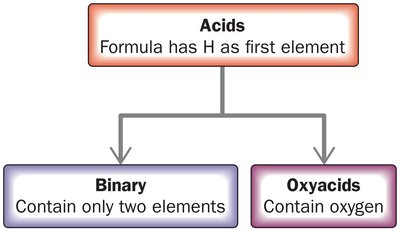
Acids are molecular compounds that form ions when dissolved in water. They are classified as binary acids (hydrogen and a nonmetal) or oxyacids (hydrogen, a nonmetal, and oxygen).
Naming Binary Acids
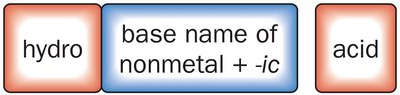
Form: hydro + base name of nonmetal + -ic + acid.
Example: HCl(aq) is hydrochloric acid.
Example: HBr(aq) is hydrobromic acid.
Example: H2S(aq) is hydrosulfuric acid.
Naming Oxyacids
Oxyacids contain oxyanions.
If the oxyanion ends in -ate, the acid name ends in -ic.
If the oxyanion ends in -ite, the acid name ends in -ous.
Example: HNO3 (nitrate) is nitric acid.
Example: HNO2 (nitrite) is nitrous acid.
Table: Names of Common Oxyacids and Their Oxyanions
Acid Formula | Acid Name | Oxyanion Name | Oxyanion Formula |
|---|---|---|---|
HNO2 | nitrous acid | nitrite | NO2- |
HNO3 | nitric acid | nitrate | NO3- |
H2SO3 | sulfurous acid | sulfite | SO32- |
H2SO4 | sulfuric acid | sulfate | SO42- |
HClO2 | chlorous acid | chlorite | ClO2- |
HClO3 | chloric acid | chlorate | ClO3- |
HC2H3O2 | acetic acid | acetate | C2H3O2- |
H2CO3 | carbonic acid | carbonate | CO32- |
Formula Mass
Calculating Formula Mass
The formula mass of a compound is the sum of the atomic masses of all atoms in its chemical formula.
Example: MgCl2 formula mass = 24.31 amu + 2(35.45 amu) = 95.21 amu.
Review and Learning Objectives
Restate and apply the law of constant composition.
Write chemical formulas and determine the number of each type of atom.
Classify elements and compounds as atomic, molecular, ionic, or molecular.
Write formulas for ionic compounds, including those with polyatomic ions.
Name binary ionic compounds, molecular compounds, acids, and oxyacids.
Calculate formula mass.
