 Indietro
Chemistry and Measurements: Measured Numbers and Significant Figures
Guida di studio - Note intelligenti
 Appunti personalizzati basati sui tuoi materiali, ampliati con definizioni chiave, esempi e contesto.
Chemistry and Measurements
Introduction to Measured Numbers and Significant Figures
In chemistry, accurate measurement and proper reporting of data are essential for scientific communication and calculation. This section introduces the concepts of measured and exact numbers, as well as the rules for determining significant figures in measurements.
Measured Numbers
Definition and Use of Measuring Tools
Measured numbers are values obtained using measuring instruments, such as rulers, balances, or thermometers. These numbers reflect the precision of the measuring tool and always include an estimated digit, which represents the uncertainty in the measurement.
Measuring tools provide the values for measured numbers.
Measured numbers are used to quantify physical properties such as length, mass, and volume.
Reporting Length Measurements
When reporting the length of an object, observe the marked values on the measuring tool and estimate the final digit by visually dividing the smallest marked interval. This estimated digit is always included in the reported measurement.
Report all certain digits plus one estimated digit.
The estimated digit reflects the uncertainty of the measurement.
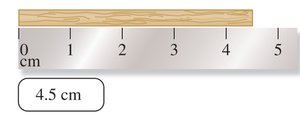
Example: If the end of an object is between the 4-cm and 5-cm marks, and appears halfway, the length is reported as 4.5 cm.
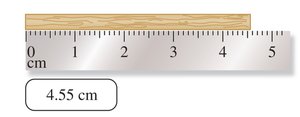
Example: If the ruler is marked at every 0.1 cm, and the object is halfway between 4.5 cm and 4.6 cm, the length is reported as 4.55 cm.
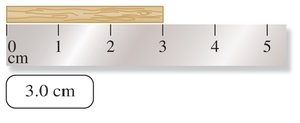
Example: If the object lines up exactly with the 3-cm mark, and the smallest division is 1 cm, the length is reported as 3.0 cm (the zero is the estimated digit).
Significant Figures
Definition of Significant Figures
Significant figures (SFs) in a measured number include all the certain digits plus the estimated digit. The number of significant figures reflects the precision of the measurement.
All nonzero digits are significant.
Zeros may or may not be significant, depending on their position in the number.
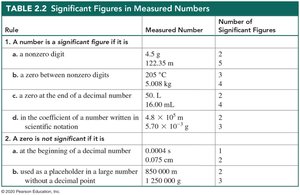
Rules for Determining Significant Figures
The following rules help determine which digits in a number are significant:
Rule | Measured Number | Number of Significant Figures |
|---|---|---|
a. A nonzero digit | 4.5 g | 2 |
122.35 m | 5 | |
b. A zero between nonzero digits | 205 °C | 3 |
5.008 kg | 4 | |
c. A zero at the end of a decimal number | 16.00 m | 4 |
d. In the coefficient of a number written in scientific notation | 4.8 × 10⁵ m | 2 |
5.70 × 10⁻³ g | 3 | |
e. A zero is not significant if it is at the beginning of a decimal number | 0.0004 s | 1 |
0.075 cm | 2 | |
f. Used as a placeholder in a large number without a decimal point | 850 000 m | 2 |
1 250 000 g | 3 |
Additional info: In scientific notation, only the digits in the coefficient are significant. Zeros used as placeholders are not significant unless a decimal point is present.
Exact Numbers
Definition and Examples
Exact numbers are values obtained by counting objects or from definitions that relate units within the same measurement system. These numbers are not measured and have an infinite number of significant figures.
Obtained by counting (e.g., 4 knives, 2 baseballs).
Obtained from definitions (e.g., 1 meter = 100 centimeters).
Do not affect the number of significant figures in calculations.

Comparison: Measured vs. Exact Numbers
Measured numbers have a limited number of significant figures and are subject to measurement uncertainty.
Exact numbers are not limited by significant figures and are considered to have no uncertainty.
Sample Problem: Identifying Measured and Exact Numbers
For each of the following, identify whether the number is measured or exact, and state the number of significant figures if measured:
a. 0.170 Liter – measured, three significant figures
b. 4 knives – exact, counted
c. (example not provided) – measured, two significant figures
d. 1 meter = 100 centimeters – exact, definition
Explanation: Measured numbers result from measurements and have a specific number of significant figures. Exact numbers are obtained by counting or definition and do not limit significant figures in calculations.
Summary Review
A measured number is obtained using a measuring device and includes all certain digits plus one estimated digit.
An exact number is obtained by counting or definition and has no uncertainty.
Significant figures include all reported digits in a measurement, reflecting the precision of the measurement.
Zeros in front of a decimal number or at the end of a nondecimal number are not significant.
