 Indietro
Fundamental Chemical Principles: Atoms, Bonds, and Biological Molecules
Guida di studio - Note intelligenti
 Appunti personalizzati basati sui tuoi materiali, ampliati con definizioni chiave, esempi e contesto.
The Structure of Atoms
Atomic Structure and Its Importance
Chemistry is the study of the interactions between atoms and molecules. The atom is the smallest unit of matter that participates in chemical reactions. Atoms interact to form molecules, which are the basis of all chemical substances.
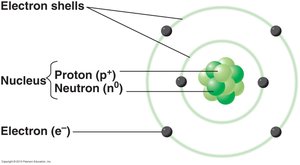
Atoms are composed of three main subatomic particles:
Electrons (e-): Negatively charged particles that move around the nucleus in electron shells.
Protons (p+): Positively charged particles located in the nucleus.
Neutrons (n0): Uncharged particles also found in the nucleus.
The arrangement of these particles determines the physical and chemical properties of elements.
Chemical Elements and Isotopes
Each chemical element is defined by its number of protons (atomic number). Isotopes are atoms of the same element with different numbers of neutrons, resulting in different atomic weights but similar chemical properties.
Element | Symbol | Atomic Number | Approximate Atomic Weight |
|---|---|---|---|
Hydrogen | H | 1 | 1 |
Carbon | C | 6 | 12 |
Nitrogen | N | 7 | 14 |
Oxygen | O | 8 | 16 |
Sodium | Na | 11 | 23 |
Magnesium | Mg | 12 | 24 |
Phosphorus | P | 15 | 31 |
Chemical Bonds and Molecules
How Atoms Form Molecules
Atoms combine to complete their outermost electron shell. The number of missing or extra electrons in this shell is called the valence. Atoms are held together in molecules by chemical bonds, which are attractive forces between atomic nuclei due to the sharing or transfer of valence electrons.
Ionic Bonds
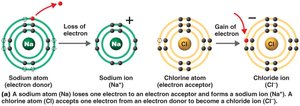
Ionic bonds are formed when one atom donates electrons to another, resulting in the formation of charged ions. Oppositely charged ions (cations and anions) attract each other to form ionic compounds.
Cation: Positively charged ion (loss of electrons).
Anion: Negatively charged ion (gain of electrons).
Covalent Bonds
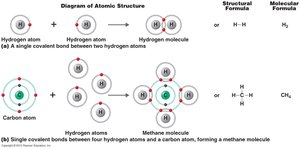
Covalent bonds form when two atoms share one or more pairs of electrons. These bonds are common in organic molecules and are generally stronger than ionic bonds.
Single, double, or triple covalent bonds can form depending on the number of shared electron pairs.

Hydrogen Bonds
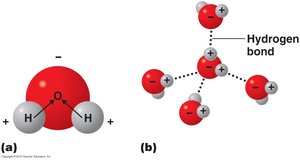
Hydrogen bonds are weak attractions between a hydrogen atom covalently bonded to an electronegative atom (such as O or N) and another electronegative atom. These bonds are crucial in stabilizing the structures of water, proteins, and nucleic acids.
Chemical Reactions
Types of Chemical Reactions
Chemical reactions involve the making or breaking of bonds between atoms, resulting in changes in chemical energy.
Synthesis (Anabolism): Atoms, ions, or molecules combine to form new, larger molecules. Example:
Decomposition (Catabolism): A molecule is split into smaller molecules, ions, or atoms. Example:
Reversible Reactions: Chemical reactions that can proceed in both directions under suitable conditions. Example:
Reactions can be endergonic (absorb energy) or exergonic (release energy).
Water, Acids, Bases, and Salts
Properties of Water
Water is an inorganic, polar molecule that acts as a universal solvent. Its polarity allows it to dissolve many substances, making it essential for life. Hydrogen bonds give water a high heat capacity, making it an effective temperature buffer.
Acids, Bases, and Salts
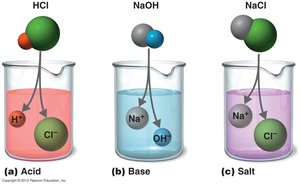
Acids, bases, and salts are important classes of inorganic compounds:
Acids: Substances that dissociate into one or more H+ ions. Example:
Bases: Substances that dissociate into one or more OH- ions. Example:
Salts: Substances that dissociate into cations and anions, neither of which is H+ or OH-. Example:
The pH Scale
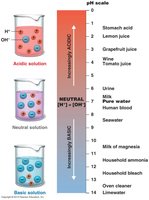
The pH scale measures the concentration of hydrogen ions in a solution, indicating its acidity or basicity. The scale ranges from 0 (most acidic) to 14 (most basic), with 7 being neutral.
Organic Compounds and Functional Groups
Organic vs. Inorganic Compounds
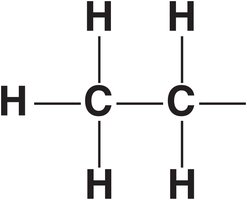
Organic compounds always contain carbon and hydrogen, often with oxygen and other elements. Inorganic compounds typically lack carbon. The carbon skeleton forms the backbone of organic molecules, and functional groups determine their chemical properties.
Functional Groups
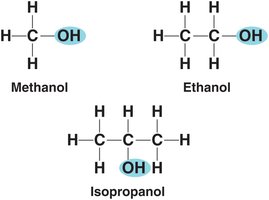
Functional groups are specific groups of atoms within molecules that are responsible for the characteristic chemical reactions of those molecules.
Structure | Name of Group | Biological Importance |
|---|---|---|
R–O-H | Alcohol | Lipids, carbohydrates |
R–CHO | Aldehyde | Reducing sugars, polysaccharides |
R–CO–R' | Ketone | Metabolic intermediates |
R–CH3 | Methyl | DNA, energy metabolism |
R–NH2 | Amino | Proteins |
R–COO–R' | Ester | Membranes |
R–O–R' | Ether | Membranes |
R–SH | Sulfhydryl | Energy metabolism |
R–COOH | Carboxyl | Organic acids, lipids, proteins |
R–PO4 | Phosphate | ATP, DNA |
Macromolecules: Carbohydrates, Lipids, Proteins, and Nucleic Acids
Carbohydrates
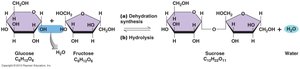
Carbohydrates serve as cell structures and energy sources. They consist of carbon, hydrogen, and oxygen, typically with the formula .
Monosaccharides: Simple sugars with 3 to 7 carbon atoms (e.g., glucose).
Disaccharides: Formed by joining two monosaccharides via dehydration synthesis (e.g., sucrose).
Polysaccharides: Large molecules consisting of tens or hundreds of monosaccharides (e.g., starch, glycogen, cellulose).
Lipids
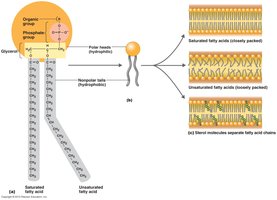
Lipids are primary components of cell membranes. They are nonpolar, insoluble in water, and consist mainly of carbon, hydrogen, and oxygen.
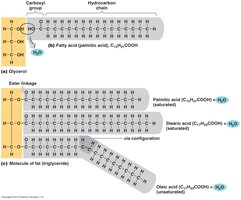
Simple lipids (fats/triglycerides): Contain glycerol and fatty acids, formed by dehydration synthesis.
Saturated fats: No double bonds in fatty acids.
Unsaturated fats: One or more double bonds; can be cis or trans configuration.
Complex lipids: Contain additional elements such as phosphorus, nitrogen, or sulfur (e.g., phospholipids in membranes).
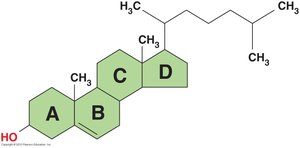
Steroids: Four carbon rings with an –OH group; important in membranes and as hormones.
Proteins
Proteins are essential for cell structure and function. They act as enzymes, transporters, structural components, and toxins.
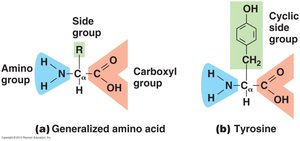
Proteins are polymers of amino acids, which contain an amino group, a carboxyl group, and a unique side chain (R group).
Amino acids exist as D- or L-stereoisomers; L-forms are most common in nature.
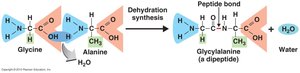
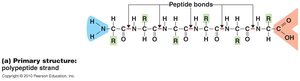
Amino acids are joined by peptide bonds formed via dehydration synthesis.
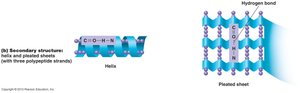
Protein structure has four levels: primary (sequence), secondary (helix/pleats), tertiary (3D folding), and quaternary (multiple polypeptides).
Nucleic Acids
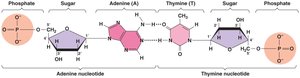
Nucleic acids store and transmit genetic information. They are polymers of nucleotides, each consisting of a pentose sugar, a phosphate group, and a nitrogenous base.
DNA (deoxyribonucleic acid): Double helix, deoxyribose sugar, bases A, T, C, G. A pairs with T, C pairs with G.
RNA (ribonucleic acid): Single-stranded, ribose sugar, bases A, U, C, G. A pairs with U, C pairs with G.
ATP: The Energy Currency of the Cell
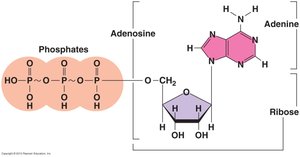
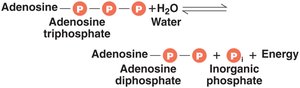
Adenosine triphosphate (ATP) is the primary energy carrier in cells. It consists of ribose, adenine, and three phosphate groups. ATP is synthesized by dehydration synthesis and broken down by hydrolysis to release energy for cellular activities.

Additional info: This guide covers foundational topics in introductory chemistry, including atomic structure, chemical bonding, types of reactions, properties of water, acids, bases, salts, organic molecules, and the structure and function of biological macromolecules. These concepts are essential for understanding chemical principles in biological and physical sciences.
