 Indietro
Introduction to Chemistry: Essential Concepts and Study Guide
Guida di studio - Note intelligenti
 Appunti personalizzati basati sui tuoi materiali, ampliati con definizioni chiave, esempi e contesto.
Chapter 1: The Chemical World
Structure and Properties of Matter
Understanding chemistry begins with recognizing how particles and atoms form substances and how these substances behave at a macroscopic level. The structure of matter refers to the arrangement of atoms, while properties describe their observable behaviors.
Structure: Atoms are the fundamental building blocks of matter.
Property: Physical and chemical properties are determined by atomic structure and composition.
Example: Water (H2O) is composed of two hydrogen atoms and one oxygen atom, giving it unique properties such as high surface tension.
Chapter 2: Measurement and Problem Solving
Measurements, Estimation, and Uncertainty
Measurements in chemistry involve estimation and uncertainty, often due to human error or instrument limitations. Significant figures (sig figs) are used to express the precision of measurements.
Significant Figures: The last digit in a measurement is uncertain.
Rules: Leading zeros do not count; zeros between digits count; trailing zeros count if there is a decimal.
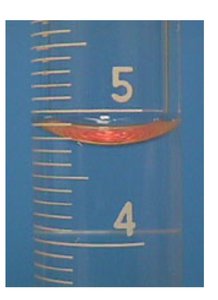
Example: Reading a graduated cylinder requires estimating the value at the meniscus.
Significant Figures in Calculations
Addition/Subtraction: The answer should have the least number of decimal places.
Multiplication/Division: The answer should have the least number of significant figures.
Exact Numbers: Numbers from definitions or counting have infinite significant figures and do not affect calculations.
Units and Dimensional Analysis
Units are essential for meaningful measurements. Dimensional analysis is used to convert between units using conversion factors.
Base Units: Common physical properties use base units such as meters (m), grams (g), liters (L).
Conversion Factor: Used to convert from one unit to another.
Example:
Intensive vs. Extensive Properties
Intensive Properties: Do not depend on the amount of substance (e.g., color, density).
Extensive Properties: Depend on the amount of substance (e.g., mass, volume).
Density: An intensive property calculated as
Example: Oil floats on water because it is less dense.
Chapter 3: Matter and Energy
Classification of Matter
Matter can be classified as elements, compounds, or mixtures. Elements consist of one type of atom, while compounds are composed of two or more elements in a specific ratio.
Element: Pure substance made of one type of atom.
Compound: Substance made of two or more elements chemically bonded.
Chemical Formula: Represents the composition of a compound (e.g., H2O).
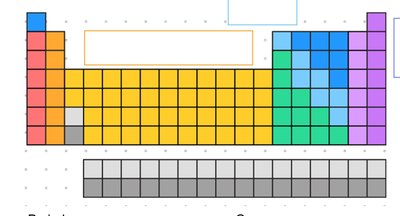
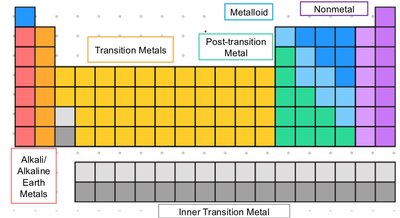
Chapter 4: Atoms and Elements
Atomic Theory and Structure
Atomic theory explains the nature of atoms as tiny, indestructible particles. The nucleus contains protons and neutrons, while electrons orbit the nucleus.
Protons: Positively charged, determine atomic number.
Neutrons: Neutral, contribute to atomic mass.
Electrons: Negatively charged, determine atom size and chemical behavior.
Atomic Notation: ;
Isotopes and Atomic Mass
Isotopes are atoms of the same element with different numbers of neutrons. The average atomic mass is calculated based on the abundance and mass of each isotope.
Isotope: Same element, different mass number.
Average Atomic Mass: Weighted average of isotopic masses.
Formula:
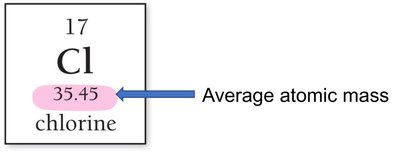
Example: Chlorine has an average atomic mass of 35.45 u.
Mole Concept and Avogadro's Number
The mole is a counting unit used to express amounts of a substance. Avogadro's number () represents the number of particles in one mole.
Mole: Standard unit for amount of substance.
Avogadro's Number: particles per mole.
Example: 1 mole of carbon contains atoms.
Chapter 5: Molecules and Compounds
Chemical Formulas and Types of Compounds
Chemical formulas represent the composition of compounds. Compounds can be molecular (nonmetals) or ionic (metal + nonmetal).
Empirical Formula: Smallest whole-number ratio of elements.
Molecular Formula: Exact number of atoms in a molecule.
Molar Mass: Sum of atomic masses in a compound.
Mole Ratio and Percent Composition
Mole Ratio: Ratio of elements in a compound, used for conversions.
Percent Composition:
Experimental vs. Theoretical: Theoretical percent mass is calculated from formula; experimental is measured.
Calculating Empirical and Molecular Formulas
Convert mass to moles for each element.
Divide by the smallest number of moles.
Convert to whole numbers for empirical formula.
Find molecular formula by multiplying empirical formula by ratio of molar masses.
Chapter 6: Chemical Composition
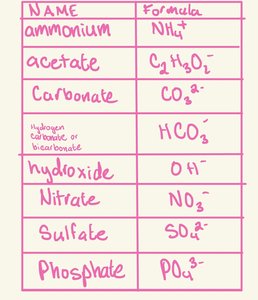
Common Polyatomic Ions
Polyatomic ions are groups of atoms bonded together with a net charge. Memorizing their names and formulas is essential for understanding chemical reactions and compound formation.
Name | Formula |
|---|---|
Ammonium | NH4+ |
Acetate | C2H3O2- |
Carbonate | CO32- |
Hydrogen carbonate (bicarbonate) | HCO3- |
Hydroxide | OH- |
Nitrate | NO3- |
Sulfate | SO42- |
Phosphate | PO43- |
Naming Compounds
Naming compounds depends on their composition. Ionic compounds are named using the cation and anion names, while molecular compounds use prefixes to indicate the number of atoms.
Ionic Compounds: Cation name + anion name (with -ide ending for monoatomic anions).
Molecular Compounds: Prefix + element name + prefix + second element name.
Prefixes: mono-, di-, tri-, tetra-, penta-, hexa-, hepta-, octa-, nona-, deca-.
Example: CO2 is carbon dioxide.
Hydrates and Polyatomic Atoms
Hydrates: Compounds with water molecules attached; named as [compound name] + [prefix] hydrate.
Polyatomic Atoms: Multiple atoms bonded together, not charge neutral.
Criss-Cross Rule: Used to balance charges in ionic compounds.
Additional info:
Some content was inferred for completeness, such as the explanation of the mole concept and Avogadro's number.
Images were included only when directly relevant to the explanation of the adjacent paragraph.
