 Indietro
Introduction to Chemistry: Matter, Energy, Atomic Structure, and the Periodic Table
Guida di studio - Note intelligenti
 Appunti personalizzati basati sui tuoi materiali, ampliati con definizioni chiave, esempi e contesto.
Matter and Energy
Thermodynamics and Energy Conservation
Thermodynamics is the study of energy, work, and heat in chemical systems. It focuses on large-scale observations and is governed by fundamental laws.
Law of Conservation of Energy (First Law of Thermodynamics): Energy cannot be created or destroyed; it can only be converted from one form to another. The total energy of the universe (system + surroundings) is constant.
System: The part of the universe being studied (e.g., a chemical reaction).
Surroundings: Everything else outside the system.
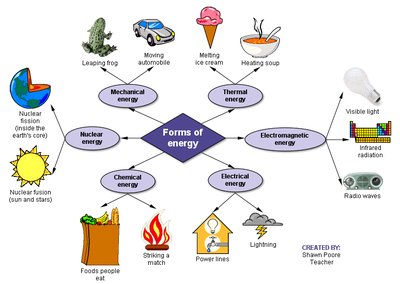
Forms of Energy
Energy exists in various forms, each with unique characteristics and examples.
Kinetic Energy (EK): Energy of motion.
Potential Energy (EP): Stored energy due to position.
Thermal Energy: Kinetic energy of molecular motion, measured by temperature.
Chemical Energy: Potential energy stored in chemical bonds.
Electrical, Nuclear, Mechanical, Electromagnetic Energy: Other forms relevant in chemistry and physics.
Units: Joules (J) and kilojoules (kJ).
Total Energy:
Energy Transfer and Phase Changes
Energy transfer occurs during phase changes and chemical reactions.
Endothermic Process: Heat is absorbed by the system from the surroundings.
Exothermic Process: Heat is released by the system to the surroundings.

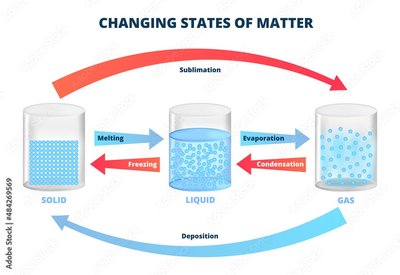
Phase Changes and Energy Flow
Phase changes involve energy transfer and can be classified as endothermic or exothermic.
Exothermic: System loses energy (freezing, condensation, deposition).
Endothermic: System gains energy (melting, vaporization, sublimation).


Classification of Matter
Definition and Properties
Matter is anything that has mass and occupies space. Its properties are determined by the particles (atoms, molecules, ions) that compose it.
Physical Property: Related to appearance or state (e.g., color, melting point).
Chemical Property: Related to changes in composition (e.g., reaction with water).
States of Matter
Matter exists in three primary states:
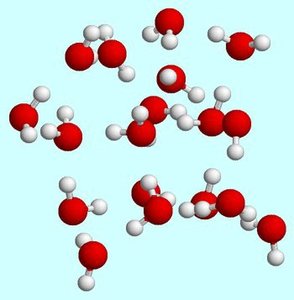
Solid: Defined shape and volume; particles are held in a rigid 3D arrangement.
Liquid: Defined volume but not shape; particles are close together but free to move.
Gas: No defined shape or volume; particles are far apart and independent.

Classification by Composition
Matter can be classified as pure substances or mixtures.
Pure Substances: Only one type of particle; fixed composition.
Element: Made of one kind of atom; cannot be broken down further.
Compound: Made of two or more elements chemically combined in fixed ratios.
Mixtures: Two or more substances physically combined; can be separated by physical means.
Homogeneous Mixture: Uniform composition throughout (e.g., sugar in water).
Heterogeneous Mixture: Non-uniform composition with visibly distinct parts (e.g., oil and water).
Type | Description | Example |
|---|---|---|
Element | Pure substance, one kind of atom | Oxygen (O2) |
Compound | Pure substance, two or more elements | Water (H2O) |
Homogeneous Mixture | Uniform composition | Sugar water |
Heterogeneous Mixture | Non-uniform composition | Sand and salt |
Atomic Structure
Atoms, Ions, and Molecules
Atom: Smallest unit of an element, retains identity in chemical reactions.
Ion: Atom with a net charge due to loss or gain of electrons.
Molecule: Two or more atoms chemically bonded.
Cation: Positively charged ion (loss of electrons).
Anion: Negatively charged ion (gain of electrons).
Atomic Models and Theory
Dalton's Atomic Theory:
Elements are composed of tiny, indestructible particles called atoms.
All atoms of a given element have the same mass and properties (except isotopes).
Atoms combine in simple, whole-number ratios to form compounds.
Atoms of one element cannot change into atoms of another element.
Structure of the Atom:
Nucleus: Contains protons and neutrons; most of the mass.
Electron Cloud: Electrons move in regions defined by quantum mechanics.
Atomic Notation and Isotopes
Atomic Number (Z): Number of protons in the nucleus; unique for each element.
Mass Number (A): Sum of protons and neutrons.
Isotope: Atoms with same atomic number but different mass numbers.
The Periodic Table
Organization and Classification
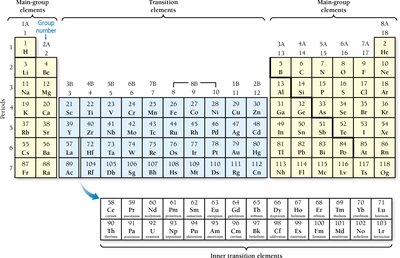
The periodic table organizes elements by increasing atomic number and groups elements with similar properties into columns (groups/families) and rows (periods).
Groups/Families: Columns; elements with similar chemical properties.
Periods: Rows; properties repeat in each period.
Main Group Elements: Groups 1A-8A.
Transition Metals: Middle section.
Inner Transition Metals: Lanthanides and actinides.
Metals, Non-metals, Semi-metals (Metalloids): Classified by physical and chemical properties.
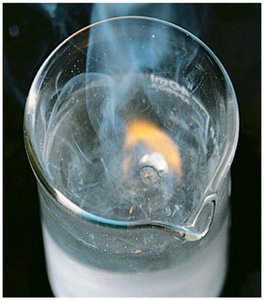
Named Families: Alkali metals, alkaline earth metals, halogens, noble gases, rare earth elements.
Group | Properties |
|---|---|
Alkali Metals | Highly reactive, +1 charge |
Alkaline Earth Metals | Reactive, +2 charge |
Halogens | Very reactive, -1 charge |
Noble Gases | Inert, 0 charge |
Atomic Mass and the Mole
Atomic Mass and Isotopic Abundance
Atomic Mass: Weighted average of the atomic masses of an element’s naturally occurring isotopes.
Isotopic Abundance: Percentage of each isotope in nature.
Calculation:
The Mole and Avogadro’s Number
Mole (mol): SI unit for amount of substance; contains particles (Avogadro’s Number).
Molar Mass: Mass in grams of one mole of a substance; numerically equal to atomic/molecular mass in amu.
Mole Conversions
Grams ↔ Moles:
Moles ↔ Particles:
Conversion | Equation |
|---|---|
Grams to Moles | |
Moles to Particles | |
Particles to Moles |
Summary Table: Key Concepts
Concept | Definition | Example |
|---|---|---|
Law of Conservation of Energy | Energy cannot be created or destroyed | Chemical reactions |
States of Matter | Solid, liquid, gas | Ice, water, steam |
Atomic Number | Number of protons | Carbon: 6 |
Mole | 6.022 x 10²³ particles | 1 mol H2O = 18 g |
Periodic Table | Organizes elements by properties | Groups, periods |
Additional info:
Some diagrams and tables were inferred for clarity and completeness.
Images included only when directly relevant to the explanation.
