 Indietro
Introduction to Chemistry: Matter, Properties, and Changes
Guida di studio - Note intelligenti
 Appunti personalizzati basati sui tuoi materiali, ampliati con definizioni chiave, esempi e contesto.
Matter and Its Composition
Definition and Structure of Matter
Matter is anything that occupies space and has mass. All visible and invisible substances, from air to steel, are forms of matter. The fundamental building blocks of matter are atoms and molecules. Atoms are submicroscopic particles, and molecules are groups of two or more atoms bonded in specific geometric arrangements.
Atoms: Smallest unit of an element retaining its properties.
Molecules: Two or more atoms chemically bonded together.
Example: Water molecules (H2O) and carbon atoms in graphite.
States of Matter
Classification: Solid, Liquid, Gas
Matter exists in three primary states: solid, liquid, and gas. Each state is characterized by the arrangement and movement of its particles.
Solid: Fixed shape and volume; particles are closely packed and vibrate in place.
Liquid: Fixed volume but no fixed shape; particles are close but move freely.
Gas: No fixed shape or volume; particles are far apart and move independently.
Types of Solids: Crystalline vs. Amorphous
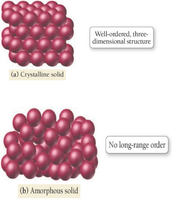
Solids can be further classified as crystalline or amorphous based on their internal structure.
Crystalline Solid: Particles arranged in a regular, repeating pattern.
Amorphous Solid: Particles lack long-range order.
Classification of Matter
Pure Substances vs. Mixtures
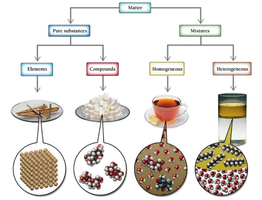
Matter is classified as either a pure substance or a mixture. Pure substances contain only one type of particle, while mixtures contain two or more substances combined physically.
Pure Substance: Constant composition; can be an element or a compound.
Mixture: Variable composition; can be homogeneous (uniform) or heterogeneous (non-uniform).
Examples of Mixtures
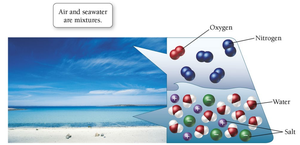
Air and seawater are mixtures containing various substances such as nitrogen, oxygen, water, and salt.
Elements and Compounds
Element: Cannot be broken down into simpler substances; composed of only one type of atom.
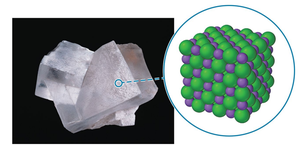
Compound: Composed of two or more elements chemically bonded in fixed proportions.
Properties of Matter
Physical vs. Chemical Properties
Properties of matter are classified as physical or chemical.
Physical Property: Can be observed without changing the substance's composition (e.g., color, density, melting point).
Chemical Property: Can only be observed by changing the substance's composition (e.g., flammability, reactivity).
Changes in Matter
Physical and Chemical Changes
Changes in matter are categorized as physical or chemical changes.
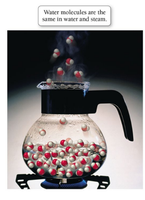
Physical Change: Alters appearance or state but not composition (e.g., melting, boiling).
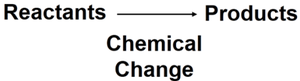
Chemical Change: Alters composition, resulting in new substances (e.g., burning, rusting).
Separation of Mixtures
Physical Methods: Distillation and Filtration
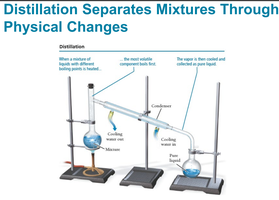
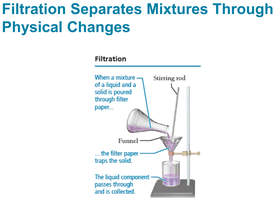
Mixtures can be separated by physical methods such as distillation and filtration.
Distillation: Separates substances based on differences in boiling points.
Filtration: Separates solids from liquids using a filter.
Law of Conservation of Mass
Principle and Example
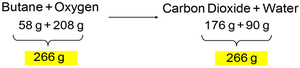
The law of conservation of mass states that mass is neither created nor destroyed in a chemical reaction. The total mass of reactants equals the total mass of products.
Example: Burning butane: 58 g butane + 208 g oxygen → 176 g carbon dioxide + 90 g water; total mass before and after is 266 g.
Key Terms and Concepts
Atom: Smallest unit of an element.
Molecule: Smallest unit of a compound.
Element: Pure substance of one type of atom.
Compound: Pure substance of two or more elements chemically bonded.
Mixture: Physical combination of substances.
Physical Property: Observable without changing composition.
Chemical Property: Observable only by changing composition.
Physical Change: Change in form or state, not composition.
Chemical Change: Change in composition, new substances formed.
Law of Conservation of Mass: Mass is conserved in chemical reactions.
Summary Table: Classification of Matter
Type | Description | Example |
|---|---|---|
Element | One type of atom | Gold (Au), Oxygen (O2) |
Compound | Two or more elements chemically bonded | Water (H2O), Sodium chloride (NaCl) |
Homogeneous Mixture | Uniform composition throughout | Salt water, air |
Heterogeneous Mixture | Non-uniform composition | Oil and water, salad |
