 Indietro
Measurement and Problem Solving in Chemistry: Scientific Notation, Significant Figures, and Unit Conversions
Guida di studio - Note intelligenti
 Appunti personalizzati basati sui tuoi materiali, ampliati con definizioni chiave, esempi e contesto.
Measurement and Problem Solving
Scientific Notation
Scientific notation is a method used to express very large or very small numbers in a concise form. It is commonly used in chemistry to handle measurements that span many orders of magnitude.
Structure: A number in scientific notation has two parts: a decimal part (between 1 and 10) and an exponential part (10 raised to an integer exponent).
Positive exponent: Indicates multiplication by 10 n times (e.g., ).
Negative exponent: Indicates division by 10 n times (e.g., ).
Conversion steps: Move the decimal point to create a number between 1 and 10, then multiply by where n is the number of places moved (left for positive, right for negative).
Example: 0.00056 = ; 123,000 = .
Uncertainty in Measurement
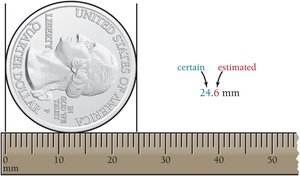
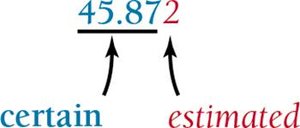
All measurements in science have some degree of uncertainty, which is reflected in how numbers are reported. The last digit in a measured value is always estimated, indicating the uncertainty.
Precision: More digits indicate greater precision; fewer digits indicate less precision.
Reporting: The last reported digit is uncertain.
Example: If a temperature increase is reported as 0.6°C, the actual value could be between 0.5°C and 0.7°C.
Significant Figures
Significant figures (sig figs) are the digits in a measurement that are known with certainty plus one estimated digit. They reflect the precision of a measurement.
Rules for identifying significant figures:
All nonzero digits are significant.
Interior zeros (between nonzero digits) are significant.
Trailing zeros after a decimal point are significant.
Leading zeros (before the first nonzero digit) are not significant.
Trailing zeros before an implied decimal point are ambiguous.
Exact numbers: Have an unlimited number of significant figures (e.g., counted objects, defined quantities).
Example: 0.00450 has three significant figures; 1200 has ambiguous significant figures unless written as 1.2 × 10³ (two sig figs).
Estimating Measurements
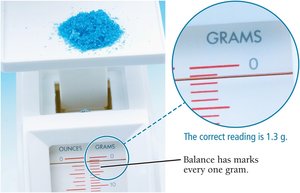
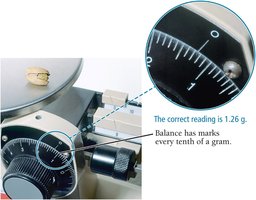
When reading instruments, estimate one digit beyond the smallest marked unit.
Example: If a balance is marked every 1 gram, estimate to the tenths place (e.g., 1.3 g).
Example: If a balance is marked every 0.1 gram, estimate to the hundredths place (e.g., 1.26 g).
Significant Figures in Calculations
Rules for handling significant figures in calculations ensure that results do not imply greater precision than the measurements allow.
Multiplication and Division: The result has the same number of significant figures as the factor with the fewest significant figures.
Addition and Subtraction: The result has the same number of decimal places as the quantity with the fewest decimal places.
Rounding: Round only the final answer, not intermediate steps. If the last digit dropped is 4 or less, round down; if 5 or more, round up.
Example: 2.33 (to two sig figs) rounds to 2.3; 2.37 rounds to 2.4.
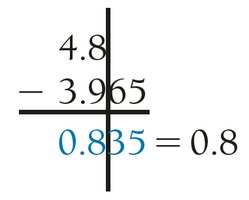
Combined Operations
For calculations involving both multiplication/division and addition/subtraction, follow the order of operations and apply the appropriate significant figure rules at each step, rounding only at the end.
Do steps in parentheses first, determine significant figures for intermediate results, then complete the calculation.
Units and Measurements
SI Units and Prefixes
The International System of Units (SI) is the standard for scientific measurements. It is based on the metric system and uses base units for length (meter), mass (kilogram), and time (second).
Length: Meter (m) – defined as the distance light travels in a vacuum in 1/299,792,458 seconds.
Mass: Kilogram (kg) – defined using Planck’s constant.
Time: Second (s) – defined by the frequency of radiation from cesium-133.
Prefix multipliers: Used to express multiples or fractions of units (e.g., kilo-, milli-, micro-).
Mass vs. Weight
Mass is the measure of the amount of matter in an object, while weight is the force of gravity on that mass. Mass is constant; weight varies with gravity.
Derived Units: Volume
Volume is a derived unit, calculated as length cubed. Common units include cubic meters (m3), cubic centimeters (cm3), and milliliters (mL).
1 mL = 1 cm3
Unit Conversions and Dimensional Analysis
Dimensional Analysis
Dimensional analysis is a systematic approach to problem-solving that uses conversion factors to move from one unit to another.
Always write numbers with their units.
Units are treated algebraically: they can be multiplied, divided, and canceled.
Conversion factors are ratios of equivalent quantities (e.g., 1 in = 2.54 cm).
Conversion factors can be inverted as needed.
Solution Maps
A solution map is a visual outline of the steps needed to solve a problem, focusing on the units involved.
Identify the starting and ending units.
Diagram the conversion steps required.
General Problem-Solving Strategy
Sort: Organize the given information.
Strategize: Create a solution map.
Solve: Perform calculations, applying significant figure rules.
Check: Ensure the answer makes sense physically and the units are correct.
Multistep and Complex Unit Conversions
Some problems require converting both numerator and denominator units, or units raised to a power. Apply conversion factors to each part as needed.
When converting squared or cubed units, raise the conversion factor to the appropriate power.
Density
Definition and Calculation
Density is a physical property defined as the mass of a substance divided by its volume.
Formula:
Units: Commonly g/cm3 or g/mL.
Example: A liquid with mass 27.2 g and volume 22.5 mL has density .
Density as a Conversion Factor
Density can be used to convert between mass and volume.
Example: To find the volume that contains 68.4 g of a liquid with density 1.32 g/cm3:
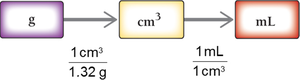
Importance of Units in Chemistry
Consequences of Unit Errors
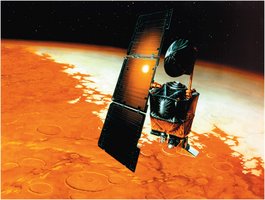
Using incorrect units can lead to significant errors in scientific and engineering contexts. For example, the loss of NASA's Mars Climate Orbiter was due to a failure to properly convert units between teams.
Review and Learning Outcomes
Express numbers in scientific notation.
Report measurements with the correct number of significant figures.
Apply rules for significant figures in calculations.
Convert between units using dimensional analysis.
Calculate and use density as a conversion factor.
