 Indietro
Measurement and Problem Solving in Chemistry: Scientific Notation, Precision, and Significant Figures
Guida di studio - Note intelligenti
 Appunti personalizzati basati sui tuoi materiali, ampliati con definizioni chiave, esempi e contesto.
Measurement and Problem Solving
Scientific Notation
Scientific notation is a method used in chemistry to express very large or very small numbers in a concise and standardized form. It is essential for reporting measurements and calculations with appropriate precision.
Structure: A number in scientific notation consists of a decimal part (between 1 and 10) and an exponential part (10 raised to an integer exponent).
Positive exponent: Indicates multiplication by 10 multiple times (large numbers).
Negative exponent: Indicates division by 10 multiple times (small numbers).
Example:
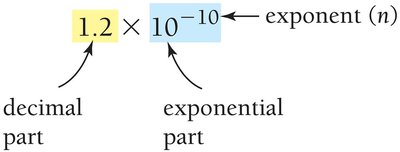
Reading Scientific Notation: For example, means 8.54 multiplied by 10 eight times; means 4.554 divided by 10 four times.
Converting Numbers to Scientific Notation
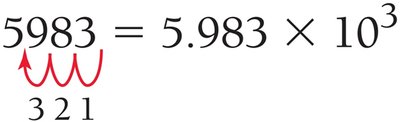
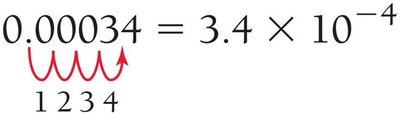
Move the decimal point to create a number between 1 and 10.
Count the number of places the decimal was moved; this becomes the exponent.
If moved left, the exponent is positive; if moved right, the exponent is negative.
Example:
Example:
Application: Scientific notation is widely used in scientific research, such as reporting cell concentrations or chemical quantities.

Uncertainty in Measurement
All measurements in chemistry have some degree of uncertainty, which reflects the limitations of the measuring instrument and the skill of the observer. Reporting measurements with the correct number of digits is crucial for scientific accuracy.
Precision: The more digits reported, the greater the precision.
Uncertainty: The last digit in a measurement is always uncertain and is estimated.
Example: Reporting a temperature increase as 0.6°C means the actual value could be between 0.5°C and 0.7°C.
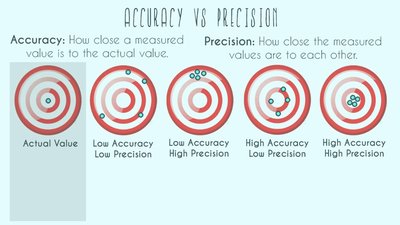
Reporting Scientific Numbers
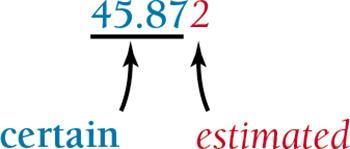
When recording measurements, it is important to distinguish between certain and estimated digits. The last digit is always an estimate, reflecting the uncertainty in the measurement.
Certain digits: All digits known with certainty from the instrument's scale.
Estimated digit: The final digit, which is an educated guess between scale markings.
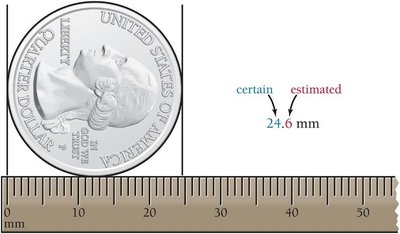
Example: A measurement of 24.6 mm means 24 mm is certain, and 0.6 mm is estimated.
Estimating Measurements
Estimating Tenths of a Gram
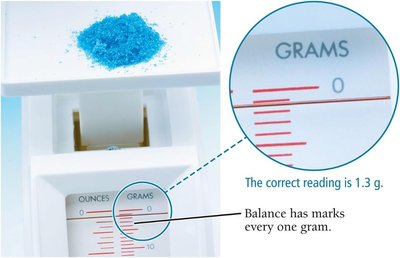
When using a balance with 1-gram markings, estimate to the tenths place by mentally dividing the space between markings into ten equal parts.
Example: The correct reading is 1.3 grams.
Estimating Hundredths of a Gram
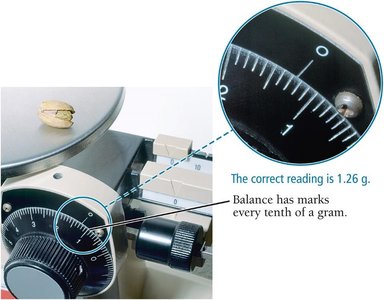
When using a balance with 0.1-gram markings, estimate to the hundredths place.
Example: The correct reading is 1.26 grams.
Significant Figures
Significant figures (sig figs) are the digits in a measurement that are known with certainty plus one estimated digit. They reflect the precision of a measurement and are critical for reporting scientific data accurately.
Rules for Counting Significant Figures:
All nonzero digits are significant.
Interior zeros (between nonzero digits) are significant.
Trailing zeros after a decimal point are significant.
Trailing zeros before a decimal point are significant.
Leading zeros (before the first nonzero digit) are not significant; they only locate the decimal point.
Exact Numbers
Exact numbers have an unlimited number of significant figures. They arise from counting discrete objects, defined quantities, or integral numbers in equations.
Examples:
Counting objects: 10 pencils (exactly 10)
Defined quantities: 1 inch = 2.54 cm (exact)
Integral numbers in equations: radius = diameter / 2 (the 2 is exact)
Laboratory Equipment and Measurement Techniques
Graduated Cylinder
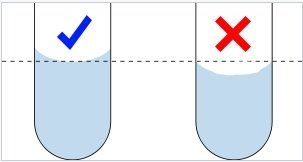
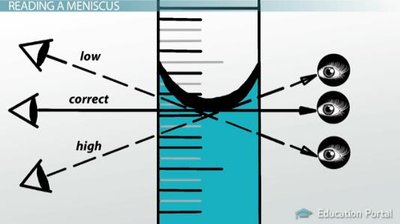
A graduated cylinder is used to measure the volume of liquids accurately. Always read the measurement at the bottom of the meniscus at eye level.

Beaker
A beaker is used for mixing, stirring, and heating chemicals, but is less precise for measuring volume compared to a graduated cylinder.

Reading the Meniscus
When measuring liquid volume, always read the bottom of the meniscus at eye level to avoid parallax error.
Electronic Scales
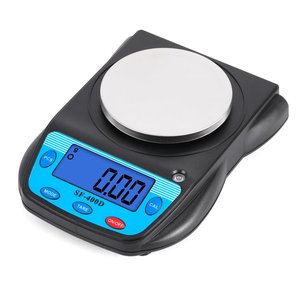
Electronic balances provide digital readings and can measure mass with high precision. The number of decimal places displayed indicates the precision of the instrument.
Summary Table: Rules for Significant Figures
Rule | Significant? | Example |
|---|---|---|
Nonzero digits | Yes | 123 (3 sig figs) |
Interior zeros | Yes | 1002 (4 sig figs) |
Trailing zeros after decimal | Yes | 2.300 (4 sig figs) |
Trailing zeros before decimal | Yes | 100. (3 sig figs) |
Leading zeros | No | 0.0025 (2 sig figs) |
Exact numbers | Unlimited | 1 inch = 2.54 cm (exact) |
