 Indietro
Measurement and Problem Solving: Significant Figures, SI Units, and Dimensional Analysis
Guida di studio - Note intelligenti
 Appunti personalizzati basati sui tuoi materiali, ampliati con definizioni chiave, esempi e contesto.
Measurement and Problem Solving
Significant Figures in Calculations
Significant figures are crucial in chemistry for expressing the precision of measurements and calculations. The rules for handling significant figures ensure that calculated results do not imply greater precision than the measurements allow.
Rounding Rules: Only the last digit being dropped is used to decide rounding direction. Ignore all digits to the right of it.
Round Down: If the last digit dropped is 4 or less.
Round Up: If the last digit dropped is 5 or more.
Multiple Steps: Round only the final answer, not intermediate results.
Example: 2.33 rounds to 2.3 (to two significant figures); 2.37 rounds to 2.4.
Multiplication and Division Rule
When multiplying or dividing, the result should have the same number of significant figures as the factor with the fewest significant figures.
Example: If multiplying 3.22 (3 sig figs) × 0.10 (2 sig figs), the result should have 2 significant figures.
Addition and Subtraction Rule
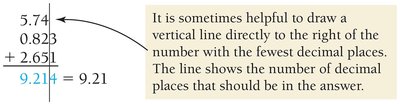
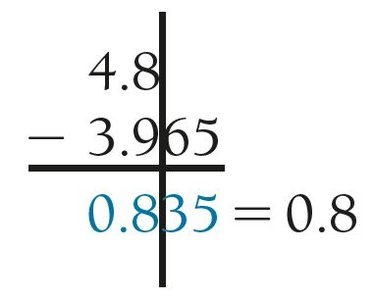
For addition or subtraction, the result should have the same number of decimal places as the quantity with the fewest decimal places.
Example: Adding 5.74, 0.823, and 2.651 gives 9.214, which is rounded to 9.21 (two decimal places).
Example: Subtracting 3.965 from 4.8 gives 0.835, which is rounded to 0.8 (one decimal place).
Mixed Operations
When calculations involve both multiplication/division and addition/subtraction, follow the order of operations. Determine significant figures or decimal places at each step, but only round the final answer.
Do steps in parentheses first.
Underline the least significant figure in intermediate answers as a reminder.
The Basic Units of Measurement
SI Units
The International System of Units (SI) is the standard for scientific measurements. Each physical quantity has a base unit:
Quantity | Unit | Symbol |
|---|---|---|
Length | meter | m |
Mass | kilogram | kg |
Time | second | s |
Temperature | kelvin | K |
Weight vs. Mass
Mass: Measure of the quantity of matter in an object (independent of gravity).
Weight: Measure of the gravitational pull on an object (depends on gravity).
SI Prefix Multipliers
Prefix multipliers are used to express very large or very small quantities conveniently.
Prefix | Symbol | Multiplier | Power of Ten |
|---|---|---|---|
kilo- | k | 1,000 | |
centi- | c | 0.01 | |
milli- | m | 0.001 | |
micro- | \mu | 0.000001 | |
nano- | n | 0.000000001 | |
pico- | p | 0.000000000001 |
Example: A chemical bond length of 120 pm (picometers).
Volume as a Derived Unit
Volume is a derived unit, calculated by cubing a unit of length. Common units include cubic meters (), cubic centimeters (), and milliliters (mL).
Dimensional Analysis and Unit Conversion
Dimensional Analysis
Dimensional analysis is a systematic approach to problem-solving that uses conversion factors to move from one unit to another. Units are treated algebraically, allowing for multiplication, division, and cancellation.
Always write numbers with their units.
Check that final units are correct and the answer makes sense.
Conversion Factors
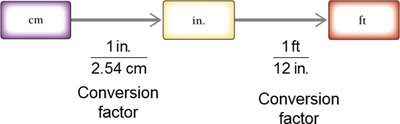
Conversion factors are ratios constructed from two equivalent quantities. For example, 1 inch = 2.54 cm (exact).
Solution Maps
Solution maps visually organize the steps needed to convert from one unit to another, ensuring each step uses the correct conversion factor.
Unit Conversion in Numerator and Denominator
Some problems require converting both the numerator and denominator units, such as converting mi/gal to km/L. Each part must be converted separately using appropriate conversion factors.
Converting Units Raised to a Power
When converting units raised to a power (e.g., to ), the conversion factor must also be raised to that power.
Physical Property: Density
Definition and Calculation
Density is the ratio of mass to volume for a substance. It is calculated as:
Example: A liquid with a mass of 27.2 g and a volume of 22.5 mL has a density of .
Density as a Conversion Factor
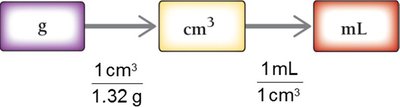
Density can be used to convert between mass and volume. For example, to find the volume that contains a given mass, rearrange the density equation:
Example: To obtain 68.4 g of a liquid with density 1.32 g/cm3, measure (or mL).
Additional info: These concepts are foundational for all subsequent topics in chemistry, including stoichiometry, chemical reactions, and laboratory measurements.
