 Indietro
Measurement and Problem Solving: Structured Study Notes for Introductory Chemistry
Guida di studio - Note intelligenti
 Appunti personalizzati basati sui tuoi materiali, ampliati con definizioni chiave, esempi e contesto.
Measurement and Problem Solving
Measured vs. Exact Numbers
In chemistry, it is crucial to distinguish between measured and exact numbers. Measured numbers are obtained using instruments and always carry some degree of uncertainty. Exact numbers are obtained by counting and have no uncertainty.
Measured numbers: Examples include 5.25 m, 500 L, 75 g. These are approximate and have limited precision.
Exact numbers: Examples include 75 candies in a bowl, 24 students in a class. These are counted and have infinite significant figures.

Example: Writing 3.1 miles (measured) vs. 3 koala bears (exact).
Uncertainty in Measurements
All measurements have a degree of uncertainty due to limitations in the measuring instrument. The last digit in a measurement is always uncertain.
Measurement is a comparison to a unit (e.g., feet, miles/hour, seconds).
Never omit units when reporting measurements.
Example: In 19.257 mL, the digit '7' is uncertain, all others are certain.
Measurement and Units
Scientific measurements use two main systems: the English system and the metric system. The metric system is preferred for its simplicity (powers of ten).
English system: Uses odd conversion factors (e.g., inches, pounds).
Metric system: Uses base units and prefixes (e.g., meter, gram, liter).
Accuracy and Precision
Accuracy refers to how close a measurement is to the true value. Precision refers to how close repeated measurements are to each other.
Accuracy: Example: Measurements of 4.20 cm, 4.25 cm, 4.30 cm for a nail (close to actual value).
Precision: Example: Three measurements of 4.10 cm (consistent, but not necessarily accurate).
Both: Three measurements of 4.25 cm (accurate and precise).
Length Measurements
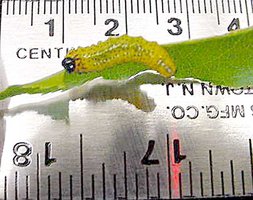
Length is measured using rulers (in meters or centimeters). The degree of uncertainty depends on the ruler's markings.
Ruler with fewer hash marks: more uncertainty, less precision.
Ruler with more hash marks: less uncertainty, more precision.
Mass Measurements
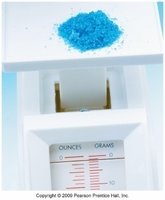
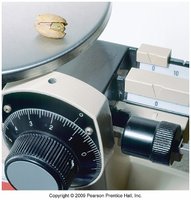
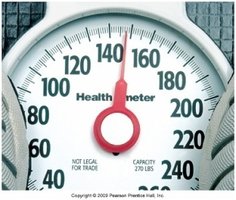
Mass is the amount of matter in a substance, measured in grams (g) using a balance. The uncertainty depends on the balance's sensitivity.
Uncertainty can range from ±0.1 g to ±0.0001 g.
On Earth, weight and mass are often used interchangeably, but weight is the force of gravity on an object.
Volume Measurements
Volume is the space occupied by a substance and is measured in liters (L), milliliters (mL), or cubic centimeters (cm3). Laboratory equipment such as graduated cylinders, pipets, and burets are used.
1 mL = 1 cm3 (interchangeable).
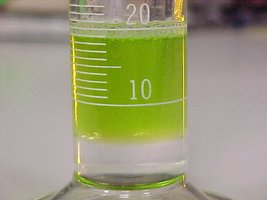
Graduated cylinders: uncertainty range ±0.1 mL to ±0.5 mL.
Record volume at the meniscus, not the highest point.
Volume - Pipets
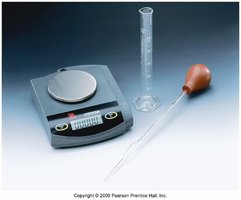
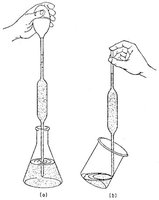
Pipets (or pipettes) are used to deliver fixed volumes of liquid. Types include volumetric and Pasteur pipets.
Liquid is drawn to the calibration mark and then dispensed.
Uncertainty range: ±0.1 mL to ±0.01 mL.
Volume - Buret
A buret is a calibrated glassware with a valve (stopcock) used for titrations. It allows precise regulation of liquid delivery.
Uncertainty range: ±0.1 mL to ±0.01 mL.
Exponential Numbers and Scientific Notation
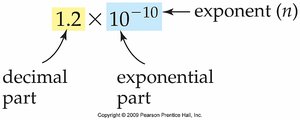
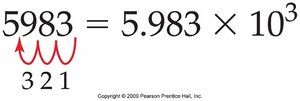
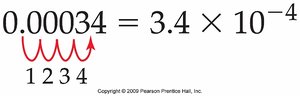
Scientific notation is a convenient way to express very large or small numbers using powers of ten.
Positive exponent: number multiplied by 10 n times (e.g., ).
Negative exponent: number divided by 10 n times (e.g., ).
Significant Digits (Significant Figures)
Significant figures reflect the precision of a measurement. The last digit is always uncertain.
All non-zero digits are significant.
Zeroes between non-zero digits are significant.
Zeroes to the right of a decimal point after a non-zero digit are significant.
Zeroes to the left of the first non-zero digit are not significant.
Zeroes at the end of a number before a decimal point are ambiguous; use scientific notation to clarify.
Rounding and Significant Figures
When rounding, adjust the last significant figure based on the right-most non-significant digit.
If 5 or greater, round up (e.g., 7.426 → 7.43).
If 4 or less, leave unchanged (e.g., 6.932 → 6.93).
Operations with Significant Figures
Rules for addition, subtraction, multiplication, and division with significant figures:
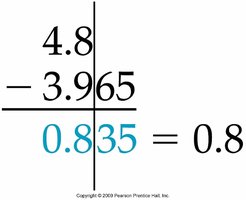
Addition/Subtraction: The answer should have the same number of decimal places as the measurement with the least decimal places.
Multiplication/Division: The answer should have the same number of significant figures as the measurement with the least significant figures.
Unit Equations and Unit Factors
Unit conversion factors (unit factors) are ratios of two equivalent quantities. They are used to convert between units.
Unit equation: 1 dollar = 10 dimes.
Unit factor: or .
Exactly Equivalent Relationships
Some unit relationships are exact equivalents and have infinite significant figures (e.g., 1 foot = 12 inches).
English and metric units are not exact equivalents (e.g., 1 mile = 1.609 km).
Unit Analysis Problem Solving
Unit analysis involves carrying units through calculations to ensure correct final units and prevent mistakes.
Write units for the answer.
Arrange unit factors so all units cancel except the desired unit.
Check for correct units and significant figures in the final answer.
Metric Prefixes and Conversion Factors
Metric prefixes indicate powers of ten and are paired with base units. Conversion factors in the metric system are exact equivalents.
Examples: 1 mm = m, 1 kg = g, 1 GL = L, 1 µs = s.
1 km = m.
Metric-Metric and Metric-English Conversions
Conversions within the metric system use exact equivalents. Metric-English conversions are not exact and require attention to significant figures.
Example: 1 kg = 2.2 pounds (not exact).
Volume Calculations
Volume of a rectangular solid is calculated as length × width × height. Units must be consistent.
1 cm3 = 1 mL.
Volume by displacement is used for irregular solids: .
Density
Density is the amount of mass per unit volume. It is a key property in chemistry.
Formula:
Units: liquids (g/cm3 or g/mL), gases (g/L).
Density of water: 1.00 g/mL.
If an object sinks in water, its density is greater than 1.00 g/mL; if it floats, its density is less.
Example: Platinum has a mass of 224.50 g and a volume of 10.0 cm3. Density = .
The Percent Concept
Percent expresses the amount of a single quantity in relation to the total sample.
Formula:
Example: 1 dime is 10% of a dollar ().
Example: Sterling silver pendant contains 18.5 g silver and 1.5 g copper. Percent silver = .
Practice Problems
Apply the concepts of significant figures, unit conversions, and density calculations to solve chemistry problems.
Exercises: 1-26, 32-40, 50-58, 65-68, 75-76 (refer to textbook for details).
