 Indietro
The Metric System and Measurement in Chemistry
Guida di studio - Note intelligenti
 Appunti personalizzati basati sui tuoi materiali, ampliati con definizioni chiave, esempi e contesto.
The Metric System
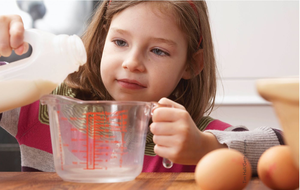
Importance of Accurate Measurement
Accurate measurement is fundamental in both everyday activities, such as cooking, and scientific work in the chemistry laboratory. Precise measurements ensure reliable results and reproducibility in experiments.
Basic Units and Symbols
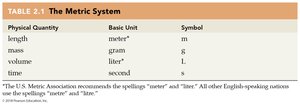
The metric system is based on standard units for each type of physical quantity. These units are related to each other by powers of ten, making conversions straightforward. The base unit is modified by prefixes to indicate multiples or fractions of the unit.
Length: meter (m)
Mass: gram (g)
Volume: liter (L)
Time: second (s)
Metric Prefixes
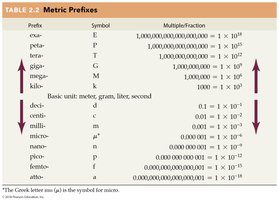
Metric prefixes are used to express quantities that are larger or smaller than the base unit. Each prefix represents a specific power of ten, allowing for easy conversion between units.
Kilo (k): 1,000 (103)
Centi (c): 0.01 (10-2)
Milli (m): 0.001 (10-3)
Nano (n): 0.000000001 (10-9)
Examples of Metric Units
Gigameter (Gm): Measures length, 1 gigameter = 1,000,000,000 meters
Centiliter (cL): Measures volume, 1 centiliter = 0.01 liters
Kilogram (kg): Measures mass, 1 kilogram = 1,000 grams
Microsecond (μs): Measures time, 1 microsecond = 0.000001 seconds
Metric Equivalents and Unit Equations
1 L = 1,000 mL
1 cg = 0.01 g
1 km = 1,000 m
1 nm = 0.000000001 m
Unit Conversion Factors
Unit conversion factors are ratios used to convert from one unit to another. When solving conversion problems, units in the numerator and denominator cancel, leaving the desired unit.
Example: To convert 130 lb to kg, use the conversion factor 1 kg = 2.2046 lb.
Practice: 250 mg to g (1 g = 1,000 mg)
Practice: 500 in2 to cm2 (1 in = 2.54 cm)
Solving Problems with Multiple Conversion Factors
Example: 500 dL to mL (1 dL = 100 mL)
Example: 6250 ft to km (1 ft = 0.3048 m, 1 km = 1,000 m)
Example: Race speed conversion: 133 mi/hr to cm/s
Special Units and Conversions
Example: Horse height measured in hands (1 hand = 4 in.)
Convert 14.2 hands to meters using conversion factors
The Density Concept
Understanding Density
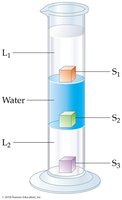
Density is a physical property defined as the mass of a substance per unit volume. It determines whether an object will float or sink in a liquid. Objects with lower density than the liquid will float, while those with higher density will sink.
Formula:
Example: A platinum nugget with mass 224.50 g and volume 10.0 cm3 has a density of
Density Calculation Practice
Example: If the density of ether is 0.714 g/mL, the volume of 14.3 g of ether is
Temperature and Heat
Temperature Scales
Temperature is a measure of how hot or cold an object is. The three main temperature scales are Fahrenheit (°F), Celsius (°C), and Kelvin (K). Each scale has its own reference points for freezing and boiling of water.
Fahrenheit: Water freezes at 32°F, boils at 212°F
Celsius: Water freezes at 0°C, boils at 100°C
Kelvin: Absolute zero is 0 K, water freezes at 273 K, boils at 373 K
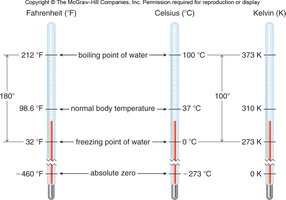
Temperature Conversion Formulas
From Celsius to Fahrenheit:
From Fahrenheit to Celsius:
From Celsius to Kelvin:
From Kelvin to Celsius:
The Heat Concept
Heat is a form of energy transferred between substances due to temperature difference. It is not the same as temperature; heat measures the total energy, while temperature measures the average kinetic energy of particles. Heat depends on the amount of substance, whereas temperature does not.
Units of Energy
Joule (J): SI unit of energy
Calorie (cal): Common unit in chemistry
Nutritional Calorie (Cal): 1 Cal = 1,000 cal = 1 kcal
Conversion: 4.184 J = 1 cal
Specific Heat Capacity
Definition and Calculation
Specific heat capacity is the amount of heat required to raise the temperature of 1 gram of a substance by 1°C. It varies for different substances and is important in understanding how materials respond to heat.
Formula:
Where:
q = heat (J)
m = mass (g)
c = specific heat (J/g°C)
ΔT = change in temperature (°C)
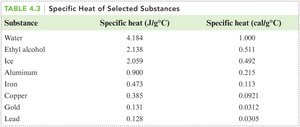
Specific Heat Calculation Practice
Example: To raise the temperature of 200 g of water from 22.5°C to 77.3°C:
Example: If 1638 J raises the temperature of 125 g from 25.0°C to 52.6°C, calculate specific heat:
Comparison of Specific Heat Values
Substances with higher specific heat require more energy to change temperature. Water, for example, has a high specific heat, making it effective for temperature regulation.
Substance | Specific heat (J/g°C) | Specific heat (cal/g°C) |
|---|---|---|
Water | 4.184 | 1.000 |
Ethyl alcohol | 2.385 | 0.571 |
Ice | 2.059 | 0.492 |
Aluminum | 0.900 | 0.215 |
Iron | 0.473 | 0.113 |
Copper | 0.385 | 0.0921 |
Gold | 0.131 | 0.0312 |
Lead | 0.128 | 0.0305 |
