 Indietro
Essential Study Notes: Sets, Venn Diagrams, Number Systems, and Unit Analysis for Liberal Arts Math
Guida di studio - Note intelligenti
 Appunti personalizzati basati sui tuoi materiali, ampliati con definizioni chiave, esempi e contesto.
Sets and Set Notation
Definition of a Set
A set is a collection of objects, called members or elements of the set. Sets are typically written by listing their members within a pair of braces, { }. If there are too many members to list, three dots (...) are used to indicate a continuing pattern.
Example: The set of natural numbers less than 5 is written as {1, 2, 3, 4}.
Notation: If x is a member of set A, we write x ∈ A.
Set Relationships and Venn Diagrams
Basic Set Relationships
Two sets, A and B, can be related in three fundamental ways, often illustrated using Venn diagrams:
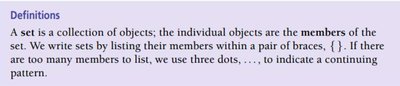
Subset: A is a subset of B if every member of A is also a member of B. The Venn diagram shows A entirely within B.
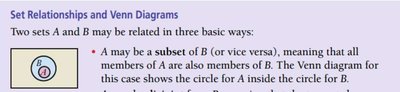
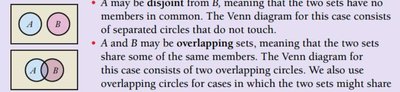
Disjoint: A and B are disjoint if they have no members in common. Their Venn diagram shows two non-overlapping circles.
Overlapping: A and B are overlapping if they share some members. Their Venn diagram shows two circles that intersect.
Venn Diagram Applications
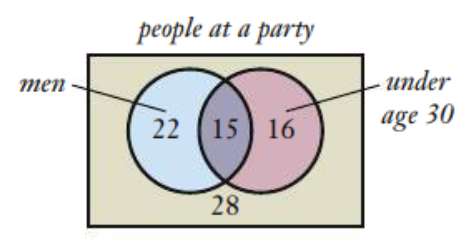
Venn diagrams are used to visually represent relationships between sets and to solve problems involving classification and counting.
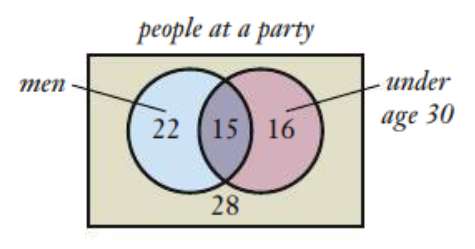
Example: The Venn diagram below shows the distribution of people at a party by gender and age group.
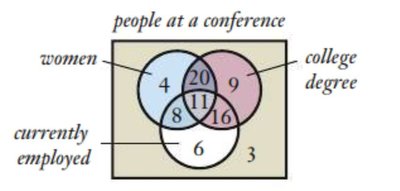
Example: The Venn diagram below shows the distribution of people at a conference by gender, employment status, and education.
The Real Number System
Hierarchy of Number Sets
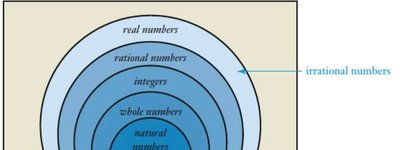
The real number system is organized into several nested subsets:
Natural numbers: {1, 2, 3, ...}
Whole numbers: {0, 1, 2, 3, ...}
Integers: {..., -2, -1, 0, 1, 2, ...}
Rational numbers: Numbers that can be written as a fraction of two integers.
Irrational numbers: Numbers that cannot be written as a fraction of two integers (e.g., √2, π).
Real numbers: All rational and irrational numbers.
Logic and Categorical Propositions
The Four Standard Categorical Propositions
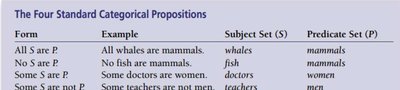
Categorical propositions are statements about the relationship between two sets, typically expressed in four standard forms:
Form | Example | Subject Set (S) | Predicate Set (P) |
|---|---|---|---|
All S are P. | All whales are mammals. | whales | mammals |
No S are P. | No fish are mammals. | fish | mammals |
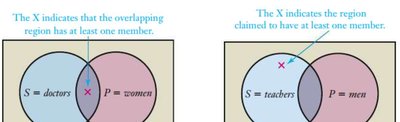
Some S are P. | Some doctors are women. | doctors | women |
Some S are not P. | Some teachers are not men. | teachers | men |

Unit Analysis and Measurement
Definitions and Principles
Unit analysis is the process of working with units to help solve problems. The units of a quantity describe what that quantity measures or counts.
You generally cannot add or subtract numbers with different units.
You can combine different units through multiplication, division, or raising to powers.
Always perform all operations on both the numbers and their associated units.
Key Words and Operations
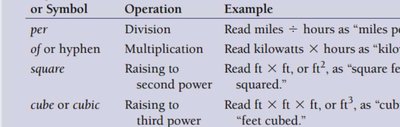
Key Word or Symbol | Operation | Example |
|---|---|---|
per | Division | miles per hour |
of or hyphen | Multiplication | kilowatt-hours |
square | Raising to second power | ft × ft = ft2 |
cube or cubic | Raising to third power | ft × ft × ft = ft3 |
Unit Conversions and Measurement Systems
When converting units, multiply by the appropriate conversion factor.
Check that your final answer has the expected units.
Square and Cubic Units
When converting between square or cubic units, remember to square or cube the conversion factor as appropriate.
Example: 1 yard = 3 feet, so 1 square yard = 9 square feet.

Metric System and Prefixes
The metric system uses base units such as the meter (m), kilogram (kg), second (s), and liter (L).
Prefixes indicate multiples or fractions of these units (e.g., kilo-, centi-, milli-).
Temperature Scales and Conversions
There are three main temperature scales: Fahrenheit (°F), Celsius (°C), and Kelvin (K). Conversion between these scales uses specific formulas:
Celsius to Fahrenheit:
Fahrenheit to Celsius:
Celsius to Kelvin:
Kelvin to Celsius:
Additional info:
Unit analysis is essential for solving real-world problems involving measurement, conversions, and calculations in science and daily life.
Venn diagrams are a powerful tool for visualizing logical relationships and set operations.
