Skip to main content
Macroeconomics
Il mio corso
Impara
Preparazione agli esami
AI Tutor
Guide di studio
Flashcard
Esplora
Prova l'app
Il mio corso
Impara
Preparazione agli esami
AI Tutor
Guide di studio
Flashcard
Esplora
Prova l'app
Indietro
The Demand for Money definitions
Puoi toccare per girare la carta.
Liquidity Preference
Puoi toccare per girare la carta.
👆
Liquidity Preference
A theory explaining how interest rates adjust to balance the desire to hold cash versus investing in interest-earning assets.
Avanzamenti del tracciato
I pulsanti di controllo sono stati cambiati in modalità "navigazione".
1/14
Flashcard correlate
Pratica correlata
Video consigliati
The Demand for Money quiz
The Demand for Money
15 Termini
The Demand for Money
18. Monetary Policy
10 Problemi
Argomento
The Money Supply on the Graph
18. Monetary Policy
10 Problemi
Argomento
19. Monetary Policy
8 Argomenti
14 Problemi
Capitolo
VideoThumbView.guidedCourse
01:51
Money Demand
590
views
13
rank
VideoThumbView.guidedCourse
02:17
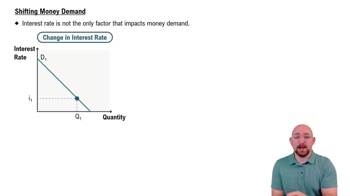
Shifting Money Demand
505
views
15
rank
Termini in questo insieme (14)
Nascondere definizioni
Liquidity Preference
A theory explaining how interest rates adjust to balance the desire to hold cash versus investing in interest-earning assets.
Interest Rate
The cost of borrowing or the return on investments, serving as the 'price' in the money market.
Opportunity Cost
The forgone interest earnings when choosing to hold cash instead of investing in interest-bearing assets.
Money Demand Curve
A graphical representation showing the relationship between the quantity of cash people want to hold and the interest rate.
Price Level
The average of current prices across the entire economy, influencing how much cash people need for transactions.
Real GDP
The total value of all goods and services produced, adjusted for inflation, affecting the need for cash in the economy.
Ceteris Paribus
An assumption holding all other factors constant to isolate the effect of one variable, such as interest rate changes.
Inflation
A general increase in prices, leading to a higher need for cash to maintain purchasing power.
Quantity of Money
The total amount of cash people choose to hold at a given interest rate.
Asset
Any resource, such as cash or investments, that can be held or used to earn a return.
Treasury Security
A government-issued investment that pays interest, offering an alternative to holding cash.
Transaction
An exchange of goods or services, often requiring cash, and influencing the overall demand for money.
Shift
A movement of the entire demand curve due to factors other than the interest rate, such as technology or price changes.
Law of Demand
A principle stating that as the price of holding cash (interest rate) falls, the quantity of cash people want to hold rises.
 IndietroIndietro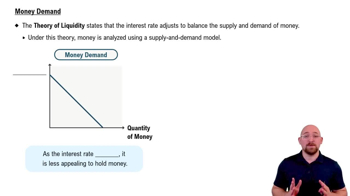
 01:51
01:51