Skip to main content
Macroeconomics
Il mio corso
Impara
Preparazione agli esami
AI Tutor
Guide di studio
Flashcard
Esplora
Prova l'app
Il mio corso
Impara
Preparazione agli esami
AI Tutor
Guide di studio
Flashcard
Esplora
Prova l'app
Indietro
The Demand for Money quiz
Puoi toccare per girare la carta.
What does the theory of liquidity preference state about interest rates?
Puoi toccare per girare la carta.
👆
What does the theory of liquidity preference state about interest rates?
The theory of liquidity preference states that interest rates adjust to balance the supply and demand for money.
Avanzamenti del tracciato
I pulsanti di controllo sono stati cambiati in modalità "navigazione".
1/15
Flashcard correlate
Pratica correlata
Video consigliati
The Demand for Money definitions
The Demand for Money
14 Termini
The Demand for Money
18. Monetary Policy
10 Problemi
Argomento
The Money Supply on the Graph
18. Monetary Policy
10 Problemi
Argomento
19. Monetary Policy
8 Argomenti
14 Problemi
Capitolo
VideoThumbView.guidedCourse
01:51
Money Demand
589
views
13
rank
VideoThumbView.guidedCourse
02:17
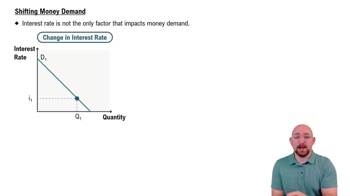
Shifting Money Demand
504
views
15
rank
Termini in questo insieme (15)
Nascondere definizioni
What does the theory of liquidity preference state about interest rates?
The theory of liquidity preference states that interest rates adjust to balance the supply and demand for money.
On a money demand graph, what does the y-axis represent?
The y-axis represents the interest rate, which is the price of borrowing money.
Why does the money demand curve slope downward?
It slopes downward because as interest rates decrease, the quantity of money demanded increases.
What is the opportunity cost of holding money?
The opportunity cost is the interest you forgo by holding cash instead of investing it.
What happens to the quantity of money demanded when interest rates rise?
When interest rates rise, the quantity of money demanded decreases.
What causes movement along the money demand curve?
A change in the interest rate causes movement along the money demand curve.
What causes the money demand curve to shift?
Factors other than the interest rate, such as changes in price level or real GDP, cause the money demand curve to shift.
How does an increase in the price level affect money demand?
An increase in the price level increases the demand for money, shifting the demand curve to the right.
How does a decrease in the price level affect money demand?
A decrease in the price level decreases the demand for money, shifting the demand curve to the left.
What happens to money demand when real GDP increases?
When real GDP increases, money demand increases because more transactions require more cash.
If it becomes easier to invest money (e.g., via a phone app), what happens to money demand?
Money demand decreases, shifting the demand curve to the left, because people prefer to invest rather than hold cash.
What does a rightward shift in the money demand curve indicate?
A rightward shift indicates an increase in the demand for money at every interest rate.
What does a leftward shift in the money demand curve indicate?
A leftward shift indicates a decrease in the demand for money at every interest rate.
Why might someone choose to hold less money when interest rates are high?
Because the opportunity cost of holding money is higher, so they prefer to invest and earn interest.
What is meant by 'ceteris paribus' in the context of money demand?
'Ceteris paribus' means holding all other factors constant except the one being analyzed, such as the interest rate.
 IndietroIndietro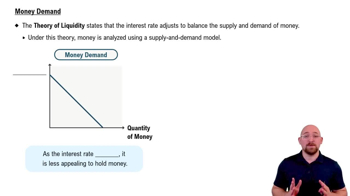
 01:51
01:51