 Indietro
Economic Growth: Concepts, History, and Impacts
Guida di studio - Note intelligenti
 Appunti personalizzati basati sui tuoi materiali, ampliati con definizioni chiave, esempi e contesto.
Economic Growth
Overview of Economic Growth
Economic growth refers to the increase in the value of goods and services produced by an economy over time, typically measured by Gross Domestic Product (GDP) per capita. Understanding how economies grow is central to macroeconomics, as it affects living standards, poverty, and inequality.
Key Point 1: Economic growth is a primary driver of improvements in living standards and reductions in poverty.
Key Point 2: Growth rates can vary significantly across countries and historical periods.
Example: U.S. GDP per capita has increased dramatically since 1820, with notable fluctuations such as the Great Depression.
Growth Rates and Compounding
The growth rate of an economy is the percentage change in real GDP per capita over a given period. Growth is compounding, meaning small annual increases accumulate to large gains over time.
Key Point 1: Annual growth rates are used to compare economic performance across years and countries.
Key Point 2: Compounding leads to exponential increases in wealth over generations.
Formula: The compound growth formula is where is the annual growth rate and is the number of years.
Example: The difference in growth rates between 2007 and 2008 illustrates the impact of economic shocks.
Types of Economic Growth
There are two main types of growth observed in countries: catch-up growth and sustained growth.
Catch-up Growth: Occurs when poorer countries grow rapidly by adopting technologies and practices from richer countries. Examples include South Korea, Taiwan, and Botswana.
Sustained Growth: Refers to steady, long-term growth seen in developed economies like the U.S. and most of the E.U.
Key Point: Sometimes catch-up growth transitions into sustained growth, but not always.
How Does Growth Happen?
Mechanisms of Economic Growth
Economic growth is driven by several interconnected factors, including savings, investment, capital accumulation, and increases in GDP. The process can be summarized as follows:
Savings (S): Households and firms save a portion of their income.
Investment (I): Savings are used to invest in capital goods.
Capital (K): Investment increases the stock of capital, such as machinery and infrastructure.
GDP: Increased capital leads to higher production and GDP.

Factors Contributing to Growth
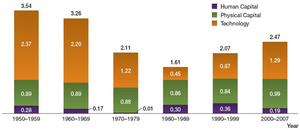
Growth in real GDP per hour worked is influenced by three main factors: human capital, physical capital, and technology. The relative importance of these factors has changed over time in the U.S.
Human Capital: Skills, education, and health of the workforce.
Physical Capital: Machinery, infrastructure, and equipment.
Technology: Innovations and improvements in production processes.
Key Point: Technology has accounted for a large share of U.S. economic growth, especially since 1950.
The History of Growth and Technology
Three Periods of Economic History
The economic history of the world can be divided into three main periods, each characterized by different growth dynamics and technological progress.
Pre-modern times (until 1800): Slow or stagnant growth, limited technological progress.
Industrial Revolution (1800–1820): Rapid technological advances in production and transportation, beginning in the UK. Urbanization and demographic transition broke the "Malthusian cycle" of population and subsistence.
Post-Industrial Revolution (after 1820): Sustained growth and ongoing technological innovation.
Growth, Inequality, and Poverty
The Relationship Between Growth, Inequality, and Poverty
Economic growth generally leads to reductions in poverty and increases in income for lower-income households. However, it can also result in rising inequality, as income gains may be distributed unevenly.
Key Point 1: In the U.S., incomes have risen for the poor, but less than for the rich.
Key Point 2: Inequality has increased, even as poverty rates have fallen (depending on the measure).
Example: China's rapid growth has led to a significant reduction in extreme poverty.
Key Point 3: GDP growth is associated with poverty reduction among lower-income countries.
Additional info: The relationship between growth, inequality, and poverty is complex and depends on policy, initial conditions, and the nature of economic expansion.
