 Indietro
Economic Methods, Causation & Correlation, and Optimization in Macroeconomics
Guida di studio - Note intelligenti
 Appunti personalizzati basati sui tuoi materiali, ampliati con definizioni chiave, esempi e contesto.
Economic Methods and Economic Questions
The Scientific Method in Economics
The scientific method is a foundational approach in economics, involving the development and testing of models to explain real-world phenomena. Economists use simplified representations of reality, called models, to make predictions and analyze data.
Model: A simplified description of reality, used to understand and predict economic behavior.
Step 1: Develop models that explain some part of the world.
Step 2: Test those models using data to see how closely the model matches what we observe.
Models are not exact: They are abstractions and simplifications, but they generate testable predictions.

Example: A paper airplane model is not an exact replica of a real airplane, but it captures essential features for certain purposes.
Assumptions in Economic Models
Economic models rely on assumptions to simplify complex realities. While assumptions may seem restrictive, they are necessary for clarity and tractability.
Assumptions: Simplify the model, making it possible to focus on key relationships.
Assumptions are not inherently bad; they help isolate important variables.

Example: Assuming rational behavior in consumers allows economists to predict market outcomes, even if not all consumers act rationally all the time.
Causation and Correlation
Understanding the difference between causation and correlation is crucial in economic analysis. Correlation indicates a relationship between two variables, while causation implies that one variable directly affects another.
Correlation: When two variables move together, either in the same direction (positive) or opposite directions (negative).
Causation: When one variable directly influences another.
Positive correlation: Both variables increase or decrease together.
Negative correlation: One variable increases while the other decreases.
Example: Shorter skirts are correlated with good economic conditions, but this does not mean one causes the other.

Why Correlation Is Not Causality
Omitted Variables: Ignoring relevant factors can lead to misleading correlations.
Reverse Causality: The direction of cause and effect may be opposite to what is assumed.
Example: Studies may find a positive correlation between police officers and crime rates, but causality may run in the opposite direction or be influenced by omitted variables.
Causality in Macroeconomics
Establishing causality is often more difficult in macroeconomics due to the lack of clear comparison groups and the complexity of aggregate data.
Macroeconomists use time series data, unexpected shocks, and exogenous variation to identify causal relationships.
Example: Analyzing the effect of tariffs on inflation by examining random variation in exposure across goods and time.
Example: A Federal Reserve study found that tariffs contributed 0.8% to core PCE inflation in February 2026, using random variation in exposure to identify causal effects.
Economic Questions and Answers
Good economic questions are relevant, important, and answerable using models and data.
Relevant and Important: The question should address significant economic issues.
Testable Implications: The model should produce predictions that can be tested with available data.
Data Availability: Sufficient data must exist to answer the question.
Optimization: Doing the Best You Can
Optimization Concepts
Optimization is the process of making the best possible choice given constraints. In economics, this involves comparing benefits and costs to maximize net benefit.

Optimization in Levels: Select the option with the highest net benefit (total benefit minus total cost).
Optimization in Differences: Consider the change in benefits and costs from doing a little more or less.
Example: When hiking, you may not see the top of the hill, but by walking uphill until you can't go higher, you optimize your altitude.
Marginal Analysis
Optimization in differences is more practical, focusing on whether the marginal benefit of an action exceeds its marginal cost.
Marginal Benefit (MB): The additional benefit from one more unit of activity.
Marginal Cost (MC): The additional cost from one more unit of activity.
Optimal decision: If MB > MC, do more; if MB < MC, do less.
Example: A firm deciding to hire more workers compares the marginal benefit and marginal cost of each additional worker.
Formula:
Tradeoffs and Opportunity Costs
Scarcity of resources leads to tradeoffs, making opportunity cost a central concept in economics.
Tradeoff: More of one thing means less of another.
Opportunity Cost: The value of the next best alternative forgone.
Opportunity costs include time, income, and potential returns from alternative investments.
Example: Choosing to attend college involves the opportunity cost of foregone income and alternative uses of time.
Frequently Missed Questions on Optimization
Students often misunderstand optimization in economic behavior. Consider the following question:

Optimization describes behavior when individuals choose the option with the highest net benefit, considering opportunity costs.
Not all outcomes (e.g., financial losses) imply non-optimization; sometimes, choices are optimal given available information.
Optimization and Effort
Economists may not agree with the proverb "anything worth doing is worth doing well" because optimization involves weighing marginal benefits and costs, not always maximizing effort.
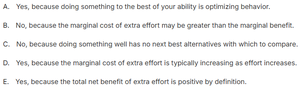
Marginal cost of extra effort may exceed marginal benefit, so doing something "well" is not always optimal.
Optimization requires comparing alternatives and considering opportunity costs.
Example: Spending extra hours perfecting a task may not be optimal if the additional benefit is small compared to the cost.
