 Indietro
Employment and Unemployment: Definitions, Measurement, and Labor Market Dynamics
Guida di studio - Note intelligenti
 Appunti personalizzati basati sui tuoi materiali, ampliati con definizioni chiave, esempi e contesto.
Employment & Unemployment
Introduction
Understanding employment and unemployment is crucial for analyzing the health of an economy. These concepts are frequently discussed in the media, but are often misunderstood. This section clarifies the definitions, measurement, and underlying causes of unemployment, as well as the functioning of the labor market.
Defining and Measuring Employment & Unemployment
Key Definitions
Potential Workers: All individuals in the general population except children under 16, active military personnel, and institutionalized persons.
Employed: Individuals holding a paid full-time or part-time job.
Unemployed: Individuals without a job who are actively searching for work.
Not in the Labor Force: Individuals who do not have a paid job and are not actively searching for one.
Example Classifications:
A university president: Employed
Part-time barista: Employed
Former auto worker seeking work: Unemployed
Retired grandmother: Not in the labor force
Stay-at-home parent: Not in the labor force
Former coal miner who gave up searching: Not in the labor force (discouraged worker)
Measuring Unemployment
Unemployment statistics are estimated monthly by the Bureau of Labor Statistics (BLS) using the Current Population Survey (CPS).
The BLS also uses the Current Employment Statistics (CES) for job estimates.
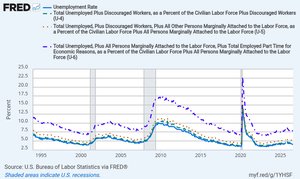
Alternative Measures of Labor Underutilization
U-3: Official unemployment rate (total unemployed as a percent of the labor force).
U-4: U-3 plus discouraged workers.
U-5: U-4 plus other marginally attached workers.
U-6: U-5 plus employed part-time for economic reasons.
These measures track each other closely, but U-6 is always higher as it includes more categories of underutilized labor.
Labor Market Equilibrium
Overview
The labor market determines the equilibrium real wage and the quantity of labor employed. The interaction between labor demand (by firms) and labor supply (by workers) sets this equilibrium.
Labor Demand
Determined by profit-maximizing firms.
Firms hire workers up to the point where the value of the marginal product of labor equals the market wage.
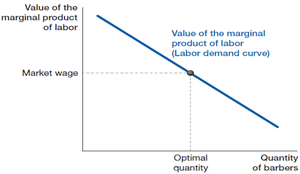
Labor Demand Shifts: Occur due to changes in output prices, technological progress, or prices of other inputs.
Labor Supply
Determined by utility-maximizing individuals.
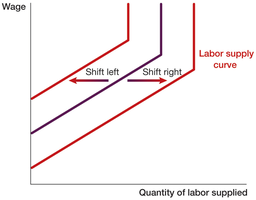
The aggregate labor supply curve generally slopes upward, becoming vertical at the population constraint.
Labor Supply Shifts: Can result from changes in tastes or preferences, opportunity costs of time, or population and demographics.
Labor Market Equilibrium
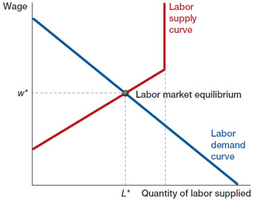
Equilibrium occurs where the labor demand and supply curves intersect, determining the equilibrium wage () and employment level ().
In perfect competition, this would imply zero unemployment, but in reality, unemployment exists due to market imperfections.
Why Is There Unemployment?
Types of Unemployment
Frictional Unemployment: Caused by the time it takes for workers and firms to find suitable matches due to imperfect information.
Structural Unemployment: Results from persistent shocks or features in the economy that prevent labor market adjustment, such as wage rigidity or skill mismatches.
Frictional Unemployment
Occurs when workers are "between jobs" and searching for positions that best match their skills and preferences.
Firms also spend time and resources searching for suitable employees.
Search frictions on both sides of the market create temporary unemployment.
Example: A software engineer leaves a job to find a better position, taking several months to search.
Structural Unemployment
Arises when there is a mismatch between the skills workers possess and those demanded by employers, or when wages are rigid and do not adjust to clear the market.
Skill mismatches can result from technological change or industry decline.
Wage rigidity can be caused by minimum wage laws, labor unions, efficiency wages, or worker aversion to wage cuts.
Example: Coal miners unable to find new jobs after mine closures due to lack of transferable skills.
Causes of Wage Rigidity
Minimum Wage Laws: Set a legal floor for wages, potentially creating unemployment if set above the market-clearing level.
Labor Unions: Negotiate higher wages for members, which can lead to unemployment if above equilibrium.
Efficiency Wages: Firms may pay above-market wages to reduce turnover, attract better applicants, and motivate workers.
Worker Aversion to Wage Cuts: Workers resist wage reductions, so firms may lay off workers instead of cutting wages.
The "Natural" Rate of Unemployment
Definition
The natural rate of unemployment is the level expected in a healthy, well-functioning economy, accounting for frictional and structural unemployment but not cyclical unemployment.
It is sometimes referred to as the flip side of "full employment." The exact value is uncertain and debated among economists.
Quote: Milton Friedman: "I don’t know what the natural rate is…and neither does anyone else."
