Indietro
Financial Management Function: Core Concepts and Applications
Guida di studio - Note intelligenti
 Appunti personalizzati basati sui tuoi materiali, ampliati con definizioni chiave, esempi e contesto.
The Financial Management Function
Introduction to Financial Management
Financial management is a core discipline in business, focusing on the efficient acquisition, allocation, and control of financial resources to achieve organizational objectives. It is distinct from management accounting and financial accounting, primarily in its long-term orientation and strategic decision-making.
Time Value of Money: Money received today is more valuable than money received in the future due to its earning potential. This principle underpins many financial decisions.
Opportunity Cost: The cost of forgoing the next best alternative when making a financial decision.
Key Formulas:
Future Value:
Present Value:
Cash Flow vs. Accounting Profits: Cash flow is the actual movement of money, which drives business value, while accounting profits may not reflect real liquidity.
Incremental Cash Flows: Only the additional cash flows generated by a decision should be considered.
Comparison of Financial Management, Management Accounting, and Financial Accounting
These three functions serve different purposes within an organization:
Financial Management: Focuses on long-term finance, resource allocation, and control.
Management Accounting: Provides information for day-to-day control and decision-making, including budgeting and variance analysis.
Financial Accounting: Reports historical financial results for external stakeholders.
Core Decisions in Financial Management
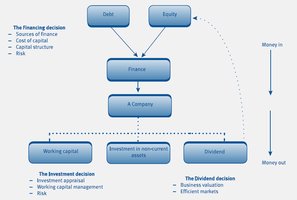
Raising Finance
Before investing, a business must secure appropriate financing. The financial manager identifies suitable sources, considering company needs, investor demands, and available amounts.
Sources of Finance: Debt, equity, short-term, and long-term options.
Considerations: Cost of capital, risk, capital structure.
Investing Funds Raised
Efficient use of finance is crucial for achieving organizational objectives. Investment appraisal and working capital management are key elements.
Investment Appraisal: Evaluates long-term projects, often involving non-current asset purchases.
Working Capital Management: Ensures liquidity by managing receivables, inventory, cash, and payables.
Dividend Policy
Deciding whether to return profits to shareholders or retain them for reinvestment affects business value and future financing ability.
Dividend Decisions: Impact shareholder wealth and company growth.
Retention vs. Distribution: Balances reinvestment opportunities with shareholder returns.
Corporate Strategy and Objectives
Objective of a Firm
The primary objective is to maximize shareholders’ wealth, which differs from profit maximization by considering timing, risk, and uncertainty.
Shareholders’ Wealth Maximization: Focuses on increasing the market value of common stock, emphasizing long-term growth.
Profit Maximization: Prioritizes short-term profits, ignoring time value and risk.
Criteria | Profit Maximization | Shareholders’ Wealth Maximization |
|---|---|---|
Main Objective | Earn large profits | Highest market value of stock |
Time Horizon | Short-term | Long-term |
Time Value of Money | Ignored | Considered |
Risk & Uncertainty | Ignored | Recognized |
Timing of Return | Ignored | Recognized |
Types of Business Organizations
Sole Proprietorship
Owned by an individual, with unlimited liability and direct control over assets and profits. Termination occurs upon death or owner’s decision.
Partnership
Owned by two or more persons. General partners have unlimited liability, while limited partners have liability restricted to their investment and cannot participate in management.
Maximum Number of Partners: Up to 100 under Companies Act 2013.
Corporation
A legal entity separate from its owners, with limited liability, perpetual existence, and transferable ownership. Shareholders influence direction through the board of directors.
Strengths: Outperformance of stocks, easy transferability, voting rights, restricted liabilities.
Weaknesses: Exposure to various risks, unpredictable returns, last payout in liquidation, limited operational involvement.
Agency Theory and Corporate Governance
Agency Theory
Agency relationships arise when principals (owners) employ agents (managers) to act on their behalf. Divergence in objectives can lead to agency problems.
Agency Problem: Managers may not act in shareholders’ best interests due to asymmetric information and separation of ownership/control.
Mitigation Methods:
Corporate governance codes
Management compensation plans (e.g., stock options)
Threat of takeover by other firms
Stakeholders in Financial Management
Stakeholder Groups
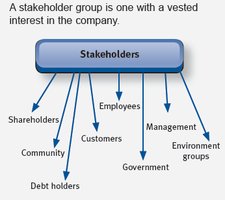
Stakeholders are individuals or groups with a vested interest in the company, including shareholders, employees, customers, management, environment groups, community, government, and debt holders.
Stakeholder Interests: Each group has unique interests and influence on corporate decisions.