 Indietro
Measuring GDP and National Income Accounts
Guida di studio - Note intelligenti
 Appunti personalizzati basati sui tuoi materiali, ampliati con definizioni chiave, esempi e contesto.
Gross Domestic Product (GDP)
Introduction to Macroeconomic Measurement
Macroeconomics addresses broad questions about the overall economy, such as total production, growth rates, income per capita, recessions, inflation, and unemployment. Accurately answering these questions requires precise measurement using appropriate economic indicators.
GDP (Gross Domestic Product): The market value of all final goods and services produced within a country’s borders during a specific period.
National Income Accounts: A framework for measuring aggregate economic activity, with the U.S. system known as the National Income and Product Accounts (NIPA).
Three Approaches to Measuring GDP
Production, Expenditure, and Income Approaches
GDP can be measured in three equivalent ways, each providing a different perspective on economic activity:
Production Approach: Measures the value of what firms produce, focusing on value added at each stage of production.
Expenditure Approach: Sums up what final users pay for goods and services, categorized into consumption, investment, government spending, and net exports.
Income Approach: Adds up all incomes generated by production, including wages, profits, and other earnings.
In theory, all three approaches yield the same GDP value because total production equals total expenditure and total income.
Value Added and Avoiding Double Counting
To prevent double counting, the production approach calculates value added at each stage:
Value Added: A firm’s sales revenue minus its purchases of intermediate inputs.
Example: A coffee shop’s value added is the price of a cup of coffee minus the cost of beans, cups, and lids purchased from suppliers.
The Expenditure Approach in Detail
Components of GDP
The expenditure approach divides GDP into five main categories:
Consumption (C): Household purchases of goods and services.
Investment (I): Purchases of new physical capital, new housing, and inventory investment by households and firms.
Government Expenditure (G): Government purchases of newly produced goods and services.
Exports (X): Goods and services produced domestically and sold abroad.
Imports (M): Goods and services produced abroad and purchased domestically (subtracted from GDP).
The formula for GDP using the expenditure approach is:
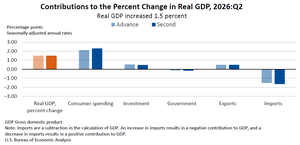
Additional info: The image above illustrates how each expenditure category contributes to changes in real GDP, highlighting the importance of net exports (X - M) in the calculation.
What Counts and What Does Not
Only newly produced goods and services are included.
Transfer payments (e.g., Social Security) and purchases of existing assets (e.g., stocks, bonds, real estate) are excluded.
GDP Measurement at National and State Levels
National vs. State GDP Reporting
National GDP is typically reported using the expenditure approach, while state or local GDP reports often use the production approach, summing value added by industries in each region.
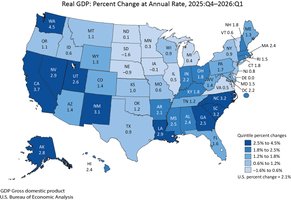
Additional info: The map above shows the variation in real GDP growth rates across U.S. states, reflecting regional economic differences.
Net Exports and Trade
Why Trade is Measured as Net Exports (X - M)
Exports (X): Added to GDP because they represent domestic production sold abroad.
Imports (M): Subtracted from GDP because they are included in C, I, or G but are not produced domestically.
What Is Not Included in GDP?
Limitations of GDP as a Measure
Depreciation of physical capital
Home production (e.g., unpaid household work)
Underground economy transactions
Negative externalities (e.g., pollution, crime)
Stock market fluctuations
Leisure time
Production by U.S. workers or capital abroad (included in GNP, not GDP)
Happiness, quality of life, or life satisfaction
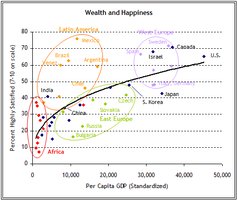
Additional info: The image above demonstrates that while higher per capita GDP is generally associated with higher reported happiness, GDP does not capture all aspects of well-being.
GDP vs. GNP
Key Differences
GDP (Gross Domestic Product): Measures production within a country’s borders, regardless of ownership.
GNP (Gross National Product): Measures production by a country’s citizens and firms, regardless of location.
For example, income earned by U.S. citizens working abroad is included in GNP but not in GDP.
Summary Table: GDP Approaches and Inclusions
Approach | What is Measured | Included in GDP? |
|---|---|---|
Production | Value added at each stage of production | Yes |
Expenditure | C + I + G + (X - M) | Yes |
Income | Wages, profits, rents, interest | Yes |
Transfer Payments | Social Security, unemployment benefits | No |
Used Goods | Resale of existing assets | No |
Home Production | Unpaid household work | No |
