 Indietro
Med Terms Chap 1
Guida di studio - Note intelligenti
 Appunti personalizzati basati sui tuoi materiali, ampliati con definizioni chiave, esempi e contesto.
Chapter 1: Introduction to Medical Terminology
Medical Language: Purpose and Structure
Medical language is essential for clear and precise communication in healthcare. It allows professionals to describe the human body, diseases, procedures, and treatments accurately. Medical words are constructed from distinct word parts, much like assembling pieces of a puzzle to form a complete concept.
Medical words are the tools of the healthcare profession.
Understanding word parts enables comprehension and construction of complex terms.

Medical Language Skills
Effective communication in medical language requires mastery of five core skills:
Reading medical words
Hearing medical words
Thinking, analyzing, and understanding medical words
Writing (or typing) and spelling medical words
Speaking and pronouncing medical words
Origins of Medical Language (Etymology)
The study of word origins, or etymology, reveals that most medical terms are derived from Greek and Latin. Ancient Greeks and Romans named anatomical structures, diseases, and treatments in their languages, many of which persist today. Some terms are identical to their original forms, while others have evolved or come from additional languages.
Greek and Latin roots are foundational in medical terminology.
A minority of terms originate from other languages.
Singular and Plural Forms in Medical Terms
Understanding how to form plurals is crucial for accurate documentation and communication. English, Greek, and Latin each have specific rules:
In English, add -s to form plurals (e.g., gland → glands).
For nouns ending in -y, change to -ies (e.g., artery → arteries).
Greek and Latin plurals follow unique rules (not detailed here).
Word Parts: The Building Blocks of Medical Terms
Types of Word Parts
Medical words are constructed from three main types of word parts:
Combining form: The foundation/root of the word.
Suffix: The ending that modifies the meaning.
Prefix: An optional beginning that further clarifies meaning.
Combining Forms
A combining form consists of a root, a forward slash, a combining vowel (usually 'o'), and a hyphen. Most medical words contain at least one combining form.
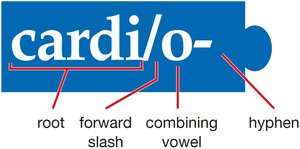
Combining forms can be nearly identical, related, or unrelated to their medical meaning.
Some body parts have both Greek and Latin combining forms (e.g., enter/o- and intestin/o- both mean "intestine").
Suffixes
A suffix is a word part at the end of most medical terms. It modifies or clarifies the meaning of the combining form and is written with a leading hyphen (e.g., -logy).

Suffixes can indicate adjectives, processes, diseases, procedures, or medical specialties/specialists.
Most terms have one suffix, but some may have two.
Suffixes for Medical Procedures and Specialties
-gram: Picture or record (e.g., mammogram)
-ist: Person who specializes in (e.g., therapist)
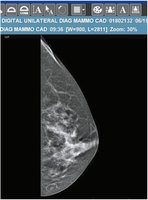

Prefixes
A prefix is an optional word part at the beginning of a medical term. Not all terms have prefixes. Prefixes modify or clarify the meaning of the combining form and are written with a trailing hyphen (e.g., intra-).

Categories include location/direction, amount/number/speed, and degree/quality.
Analyzing and Building Medical Words
Steps to Analyze Medical Words
To analyze a medical word, follow these four steps:
Divide the word into its combining form, suffix, and prefix (if present).
Determine the meaning of each word part.
Put the meanings in order: suffix, prefix (if present), then combining form.
Add connecting words to make a clear definition.
Example: cardiology
Combining form: cardi/o- (heart)
Suffix: -logy (study of)
Definition: Study of the heart


Example: pericardial
Prefix: peri- (around)
Combining form: cardi/o- (heart)
Suffix: -al (pertaining to)
Definition: Pertaining to around the heart


Building Medical Words
Building medical words is the reverse of analyzing them. The process depends on whether the suffix begins with a consonant or vowel, and whether a prefix is present.
Building with a Suffix That Begins with a Consonant
Combine the combining form and suffix, using the combining vowel if the suffix begins with a consonant.
Example: cardi/o- + -logy = cardiology



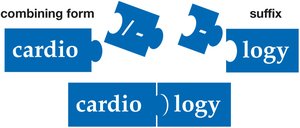
Building with a Suffix That Begins with a Vowel
If the suffix begins with a vowel, the combining vowel is usually dropped.
Example: cardi/o- + -ac = cardiac (pertaining to the heart)



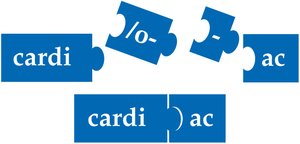
Building with a Prefix
When a prefix is present, it is placed before the combining form and suffix.
Example: intra- + cardi/o- + -ac = intracardiac (pertaining to within the heart)



Spelling and Pronunciation
Correct spelling and pronunciation are essential for clear communication in healthcare. This requires memorizing the spelling of word parts and the rules for joining them, as well as practicing accurate pronunciation. Understanding the definition is most important, but correct pronunciation ensures effective communication among healthcare professionals.
