 Indietro
Medical Terminology: Foundations, Body Structure, and the Integumentary System
Guida di studio - Note intelligenti
 Appunti personalizzati basati sui tuoi materiali, ampliati con definizioni chiave, esempi e contesto.
Chapter 1: Introduction to Medical Terminology
Medical Language and Its Importance
Medical language is a standardized system of terms that enables clear, accurate, and effective communication among healthcare professionals. This reduces errors and improves patient safety.
Listening: Understanding spoken terms and instructions.
Speaking: Pronouncing terms correctly and clearly.
Reading: Interpreting charts, records, and reports.
Writing: Spelling and using terms accurately.
Critical Thinking: Analyzing unfamiliar terms by breaking them into word parts.
Medical Nouns and Plural Rules
A to AE: vertebra → vertebrae
US to I: nucleus → nuclei
IS to ES: diagnosis → diagnoses
ON to A: ganglion → ganglia
Structure of Medical Terms
Root: The foundation, gives the main meaning.
Combining Form: Word root plus a combining vowel (usually 'o').
Combining Vowel: Used to connect word parts; can be a short or long vowel.
Prefix: Added to the beginning of a term to change its meaning, often indicating location, time, or number.
Suffix: Added to the end of a term, usually indicating a procedure, condition, disorder, or disease.
Acronym: Abbreviation formed from the first letter of each word (e.g., MRI).
Common Combining Forms
Cardi/o: Heart
Neur/o: Nerve
Oste/o: Bone
Dermat/o, Cutane/o: Skin
Hemat/o: Blood
Gastr/o: Stomach
My/o: Muscle
Path/o: Disease
Thromb/o: Blood clot
Urin/o: Urine; urinary tract
Combining Forms Indicating Colors
Cyan/o: Blue
Erythr/o: Red
Leuk/o: White
Melan/o: Black
Xanth/o: Yellow
Suffixes
-algia, -dynia: Pain and suffering
-itis: Inflammation
-malacia: Softening
-megaly: Enlargement
-necrosis: Condition of tissue death
-osis: Abnormal condition or disease
-sclerosis: Abnormal hardening
-centesis: Surgical puncture to remove fluid
-ectomy: Surgical removal
-graphy: Process of recording
-plasty: Surgical repair
-scopy: Visual examination
-ology: The study of
-logist: Specialist
-tomy: Incision
Prefixes
Pre-: Before
Peri-: Around
Post-: After
Hyper-: Excessive, above
Hypo-: Deficient, below
Endo-: Within
Epi-: Above, on top of
Sub-: Under, below
Poly-: Many, much
Mono-: One, single
Oligo-: Few, scanty
Trans-: Through
Contra-: Against
Chapter 2: Body Structure
Systemic Approach to the Body
Understanding the structure and function of each body system is essential. Each system is composed of organs that work together to perform specific functions necessary for health and survival.
Example: The digestive system includes the mouth, esophagus, stomach, intestines, liver, and pancreas, which work together to provide nutrition.
The 11 Body Systems
Gastrointestinal
Respiratory
Cardiovascular
Blood & Lymphatic
Integumentary
Skeletal
Muscular
Nervous
Urinary
Reproductive
Endocrine
Anatomic Position and Body Planes
The anatomic position is the standard reference for describing locations and directions in the body:
Standing erect, facing forward, arms at sides, palms facing forward.
Body planes are imaginary lines used to divide the body:
Midsagittal (Midline): Divides body into equal left and right halves.
Sagittal: Parallel to midline, divides into unequal left and right portions.
Coronal (Frontal): Divides into anterior (front) and posterior (back) sections.
Transverse (Horizontal): Divides into superior (upper) and inferior (lower) sections.
Directional Terms
Anterior (Ventral): Toward the front
Posterior (Dorsal): Toward the back
Superior: Toward the head
Inferior: Toward the feet
Medial: Toward the midline
Lateral: Away from the midline
Proximal: Closer to the point of attachment
Distal: Farther from the point of attachment
Bilateral: Both sides
Contralateral: Opposite side
Body Cavities
Cranial: Contains the brain
Spinal: Contains the spinal cord
Thoracic: Contains the heart and lungs
Abdominal: Contains digestive organs
Pelvic: Contains urinary and reproductive organs
Abdominopelvic Quadrants and Regions
RUQ: Right Upper Quadrant
LUQ: Left Upper Quadrant
RLQ: Right Lower Quadrant
LLQ: Left Lower Quadrant
The nine regions provide more precise localization:
Right hypochondriac, Epigastric, Left hypochondriac
Right lumbar, Umbilical, Left lumbar
Right iliac (inguinal), Hypogastric (pubic), Left iliac (inguinal)
Body Organization
Cells: Basic living units
Tissues: Groups of similar cells
Organs: Groups of tissues performing specific functions
Body Systems: Groups of organs working together
Human Organism: All systems functioning together
Medical Specialties and Healthcare Professionals
Cardiology: Cardiovascular system
Neurology: Nervous system
Dermatology: Integumentary system
Gastroenterology: Gastrointestinal system
Endocrinology: Endocrine system
Other specialties focus on diseases, diagnostic services, treatments, or patient populations (e.g., Oncology, Radiology, Pediatrics).
Healthcare Settings
Hospital: For acutely ill patients requiring extended care.
Physician's Office: Routine examinations and treatments.
Ambulatory Surgery Center: Minor surgeries without overnight stay.
Long-Term Care Facility: Residential care for those needing assistance.
Home Health Agency: Care provided in the patient's home.
Hospice: Care for terminally ill patients, focusing on comfort.
History and Physical Examination
Patient History: Includes location, onset, duration, and severity of symptoms, as well as past medical, surgical, family, and social history.
Physical Examination: Observation, palpation, auscultation, and measurement of vital signs (temperature, pulse, respiratory rate, blood pressure).
Electronic Health Records (EHR)
EHR: Computerized record of patient care, accessible by authorized healthcare team members.
Includes histories, examinations, diagnoses, treatments, and preventive care reminders.
Chapter 3: Integumentary System (Dermatology)
Overview and Structure
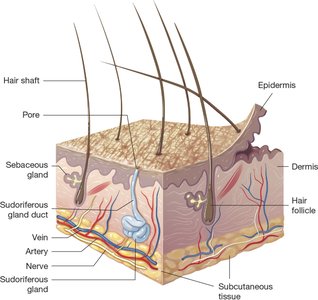
The integumentary system is a large, flexible body system that covers most of the body surface. It includes the skin, nails, hair, and subcutaneous tissue. The skin is composed of two main layers: the epidermis and the dermis, with subcutaneous tissue beneath.
Layers of the Skin
Epidermis: Thin, outermost layer made of epithelial tissue. Contains melanocytes (produce melanin) and is avascular (no blood vessels). The superficial layer contains dead, keratin-filled cells; the basal layer contains living, dividing cells.
Dermis: Thick layer beneath the epidermis, composed of connective tissue. Contains collagen (firmness), elastin (flexibility), blood vessels, nerves, sebaceous glands, sudoriferous glands, and hair follicles.
Subcutaneous Tissue: Lies beneath the dermis, stores fat, and helps conserve body heat.
Glands of the Skin
Sebaceous Glands: Oil glands that secrete sebum into hair follicles, moisturizing hair and skin.
Sudoriferous Glands: Sweat glands that secrete sweat (water, sodium, wastes) through pores. Sweat is odorless, but bacterial breakdown produces odor. The process of sweating is called diaphoresis.
Hair
Formed within hair follicles, filled with keratin for strength.
Color is determined by melanin; dark hair has more melanin, while blonde/red hair contains more sulfur.
Piloerection is when hair stands up due to cold or emotional stimuli.
Lanugo is the fine hair present in the fetus.
Nails
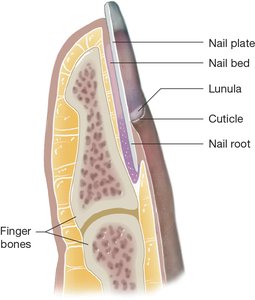
Nail Plate: Dead, keratinized cells forming the visible nail.
Nail Root: Beneath the skin, produces nail cells.
Lunula: Visible white, half-moon area at the nail base.
Cuticle: Layer of dead cells at the base of the nail.
Nail Bed (Quick): Contains nerves and blood vessels, giving the nail its color.
Functions of the Integumentary System
Protection: First line of defense against injury and infection. Keratin makes skin waterproof; oil and sweat contain antibacterial substances; normal flora inhibit pathogens.
Repair: Skin heals itself through cell migration and scab formation.
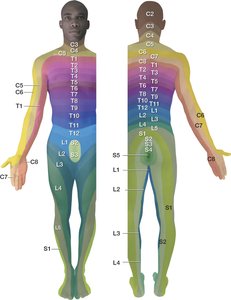
Sensation: Sensory receptors in the dermis detect touch, pressure, pain, and temperature. Dermatome refers to skin areas supplied by specific spinal nerves.
Vitamin D Synthesis: Sunlight converts cholesterol to vitamin D, which is stored in fat and aids calcium absorption.
Thermoregulation: Fat insulates; sweat cools; piloerection generates heat.
Homeostasis: Maintains internal balance; abnormal skin color may indicate systemic disease.
Dermatomes
A dermatome is a specific area of skin supplied by sensory fibers from a single spinal nerve. Mapping dermatomes is important for diagnosing nerve injuries and diseases.
Key Abbreviations
Abbreviation | Meaning |
|---|---|
MD | Doctor of Medicine |
DO | Doctor of Osteopathic Medicine |
PCP | Primary Care Provider |
PA | Physician Assistant |
NP | Nurse Practitioner |
RN | Registered Nurse |
LPN | Licensed Practical Nurse |
LVN | Licensed Vocational Nurse |
ICU | Intensive Care Unit |
ED | Emergency Department |
PT | Physical Therapy |
ASC | Ambulatory Surgery Center |
SNF | Skilled Nursing Facility |
H&P | History and Physical Examination |
TPR | Temperature, Pulse, Respirations |
BP | Blood Pressure |
R/O | Rule Out |
CAM | Complementary and Alternative Medicine |
EHR | Electronic Health Record |
Additional info: This guide provides foundational knowledge for understanding medical terminology, body structure, and the integumentary system, suitable for exam preparation in a Medical Terminology college course.
