 Indietro
Chapter 7: The Control of Microbial Growth – Study Notes
Guida di studio - Note intelligenti
 Appunti personalizzati basati sui tuoi materiali, ampliati con definizioni chiave, esempi e contesto.
Chapter 7: The Control of Microbial Growth
Introduction
The control of microbial growth is essential in healthcare, food safety, and laboratory settings. This chapter explores the terminology, mechanisms, and methods used to control or eliminate microorganisms, including both physical and chemical approaches.
Terminology Relating to Microbial Control
Key Terms and Definitions
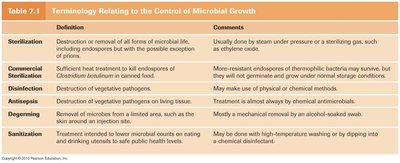
Sterilization: Destruction or removal of all forms of microbial life, including endospores.
Commercial Sterilization: Sufficient heat treatment to kill endospores of Clostridium botulinum in canned food.
Disinfection: Destruction of vegetative pathogens on inanimate objects.
Antisepsis: Destruction of vegetative pathogens on living tissue.
Degerming: Removal of microbes from a limited area, such as skin around an injection site.
Sanitization: Treatment to lower microbial counts on eating and drinking utensils to safe public health levels.
Biocide/Germicide: Agents that kill microorganisms (not necessarily endospores).
Bacteriostasis: Inhibition of bacterial growth and multiplication without killing.
Sepsis: Indicates bacterial contamination.
Asepsis: Absence of pathogens from an object or area; critical in surgical procedures.
Term | Definition | Comments |
|---|---|---|
Sterilization | Destruction or removal of all forms of microbial life, including endospores but with the possible exception of prions | Usually done by steam under pressure or a sterilizing gas, such as ethylene oxide. |
Commercial Sterilization | Sufficient heat treatment to kill endospores of Clostridium botulinum in canned food. | More-resistant endospores of thermophilic bacteria may survive, but they will not germinate and grow under normal storage conditions. |
Disinfection | Destruction of vegetative pathogens. | May make use of physical or chemical methods. |
Antisepsis | Destruction of vegetative pathogens on living tissue. | Treatment is almost always by chemical antimicrobials. |
Degerming | Removal of microbes from a limited area, such as the skin around an injection site. | Mostly a mechanical removal by an alcohol-soaked swab. |
Sanitization | Treatment intended to lower microbial counts on eating and drinking utensils to safe public health levels. | May be done with high-temperature washing or by dipping into a chemical disinfectant. |
Microbial Death Rate
Understanding Microbial Death
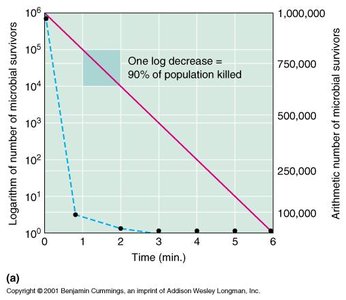
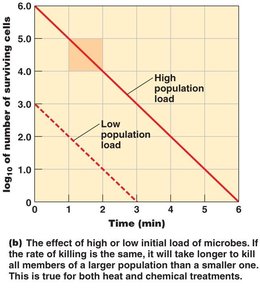
When populations of microorganisms are subjected to antimicrobial treatment, they die at a constant rate. This rate can be plotted as a straight line on a logarithmic scale, indicating that a fixed percentage of the population is killed per unit time.
One log decrease: Represents a 90% reduction in the microbial population.
Death curve: Used to determine the effectiveness of antimicrobial agents.
Conditions Influencing Microbial Control
Factors Affecting Microbial Death
Types and Numbers of Microbes: Some microbes (e.g., Pseudomonas, TB bacillus, endospores, viruses) are more resistant. Larger populations require longer treatment times.
Temperature: Disinfectants are generally more effective at higher temperatures.
Physiological State: Actively growing cells are more susceptible to antimicrobials than dormant forms.
Environment: Organic matter (blood, feces, vomit) can inhibit disinfectants; biofilms protect microbes from exposure.
Time of Exposure: Longer exposure increases effectiveness.
Cellular Effects of Antimicrobials
Targets of Antimicrobial Agents
Plasma Membrane: Disruption of membrane permeability leads to leakage of cellular contents.
Nucleic Acids and Proteins: Some agents break bonds or interfere with synthesis, inhibiting cell function and replication.
Physical Methods of Microbial Control
Heat
Dry Heat: Incineration and hot air sterilization (170°C for 2 hours).
Moist Heat: Boiling (kills most microbes in 10 min, but not all spores/viruses), autoclaving (steam under pressure: 15 psi, 121°C, 15 min), pasteurization (72°C for 15s for HTST; UHT for longer shelf life).
Filtration
Used for heat-sensitive liquids; membrane filters with pore sizes of 0.22μm or 0.45μm remove bacteria.
HEPA filters (0.33μm) remove microbes from air.
Low Temperatures
Refrigeration (4°C) slows metabolism (bacteriostatic); freezing (-20°C) renders most microbes dormant.
Dessication
Removal of water inhibits growth; lyophilization (freeze-drying) preserves microbes by rapid freezing and vacuum drying.
Osmotic Pressure
High salt or sugar concentrations create hypertonic environments, inhibiting bacterial growth; molds and yeasts are more resistant.
Radiation
Ionizing Radiation: X-rays, gamma rays; cause DNA strand breaks, used for sterilizing pharmaceuticals and medical supplies.
Non-ionizing Radiation: UV light; causes DNA mutations (thymine dimers), used in germicidal lamps.
Microwaves: Kill indirectly by heating food.
Chemical Methods of Microbial Control
General Principles
Few chemical agents achieve sterilization; most reduce microbial numbers to safe levels.
Antiseptics are for living tissue; disinfectants are for inanimate objects.
No single disinfectant is universally effective; selection depends on the application.
Types of Disinfectants
Phenol and Phenolics: Disrupt plasma membranes and inactivate enzymes. Phenol is rarely used due to irritation; phenolics (e.g., o-phenylphenol in Lysol, triclosan) are more common but resistance is increasing.
Halogens: Iodine (tincture, iodophor) and chlorine (bleach, chloramines) are effective against a broad range of microbes by inhibiting protein function and damaging membranes.
Alcohols: Ethanol and isopropanol (60-95%) denature proteins and disrupt membranes; not effective against spores or non-enveloped viruses.
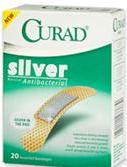
Heavy Metals: Silver, copper, and zinc denature proteins; silver nitrate prevents neonatal eye infections, copper sulfate controls algae, zinc compounds are used in mouthwashes and paints.
Surface-Active Agents (Surfactants): Lower surface tension, disrupt membranes, and inactivate enzymes. Quaternary ammonium compounds (quats) are effective against Gram-positive bacteria, fungi, and some viruses.
Chemical Food Preservatives: Organic acids (sorbic, benzoic, propionic) inhibit metabolism and are used in foods and cosmetics.
Aldehydes: Inactivate proteins; formaldehyde and glutaraldehyde are used for preserving specimens and disinfecting equipment.
Gaseous Chemosterilizers: Ethylene oxide and related gases sterilize heat-sensitive items but are carcinogenic and require long exposure times.
Oxidizing Agents (Peroxygens): Oxidize cellular components; hydrogen peroxide, ozone, and peracetic acid are used for disinfecting surfaces and medical equipment.
Assessing Effectiveness of Antimicrobial Agents
MIC and MBC
MIC (Minimum Inhibitory Concentration): Lowest concentration of an agent that prevents visible growth of a microorganism.
MBC (Minimum Bactericidal Concentration): Lowest concentration that kills the test organism.
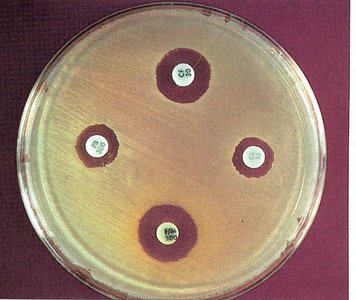
Disk Diffusion Method
Chemical or antimicrobial agents diffuse from a disk into agar inoculated with bacteria. The zone of inhibition is measured and compared to standards to assess effectiveness.
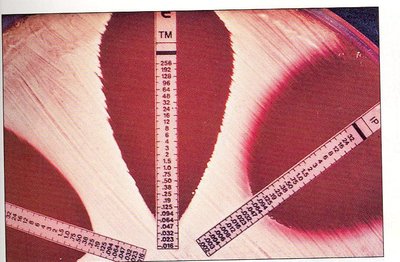
E Test
The E test uses a plastic strip impregnated with a gradient of antimicrobial concentration to determine MIC directly on an agar plate.
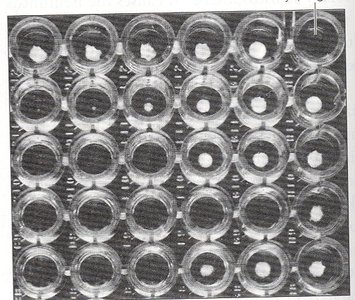
Broth Dilution Method
Serial dilutions of antimicrobial agents are prepared in broth; the lowest concentration preventing growth is the MIC, and the lowest concentration that kills is the MBC. Widely used in antimicrobial resistance monitoring.
Summary
Defined key terms related to microbial control.
Described factors influencing the effectiveness of microbial control methods.
Explained physical and chemical methods of microbial control.
Discussed mechanisms of action and uses of various chemical disinfectants.
Reviewed methods for assessing antimicrobial effectiveness.
