 Indietro
Fermentation and Its Role in Microbial Metabolism
Guida di studio - Note intelligenti
 Appunti personalizzati basati sui tuoi materiali, ampliati con definizioni chiave, esempi e contesto.
Microbial Metabolism
Fermentation
Fermentation is a metabolic process that allows cells to generate energy in the absence of a final electron acceptor such as oxygen. When the electron transport chain (ETC) cannot function due to the lack of oxygen or other terminal electron acceptors, fermentation provides an alternative pathway for regenerating NAD+ and FAD, which are essential for glycolysis and other metabolic reactions.
Definition: Fermentation is the partial oxidation of sugars or other organic molecules (such as amino acids, organic acids, purines, or pyrimidines) to release energy.
Oxygen Requirement: Fermentation does not require oxygen.
Pathway Usage: Fermentation does not use the Krebs cycle or the electron transport chain.
Electron Acceptor: An organic molecule synthesized by the cell (often pyruvate or a derivative) serves as the final electron acceptor.
ATP Yield: Only small amounts of ATP are produced, as substrates are only partially oxidized.
Key Steps:
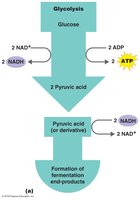
Glycolysis yields 2 pyruvate, 2 ATP, and 2 NADH per glucose molecule.
In fermentation, electrons from NADH are transferred to pyruvate or its derivatives, regenerating NAD+ and allowing glycolysis to continue.
Without NAD+ and FAD, the Krebs cycle cannot function, and some organisms (e.g., humans) cannot survive without oxygen.
Types of Fermentation
There are several types of fermentation, with lactic acid and alcohol fermentation being the most common in microorganisms.
Lactic Acid Fermentation:
Glucose is converted to 2 lactic acid molecules and 2 ATP.
Homolactic fermentation: Produces only lactic acid (e.g., Streptococcus, Lactobacillus).
Heterolactic fermentation: Produces lactic acid and other compounds.
Alcohol Fermentation:
Occurs in bacteria and yeast (e.g., Saccharomyces).
Glucose is oxidized to pyruvic acid, which is then converted to acetaldehyde and CO2.
NADH reduces acetaldehyde to ethanol.
Overall, glucose is converted to 2 ethanol, 2 CO2, and 2 ATP.
Comparison of Respiration and Fermentation
Key Differences Between Aerobic Respiration, Anaerobic Respiration, and Fermentation
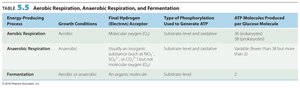
The following table summarizes the main differences between these energy-producing processes in microorganisms:
Energy-Producing Process | Growth Conditions | Final Hydrogen (Electron) Acceptor | Type of Phosphorylation Used to Generate ATP | ATP Molecules Produced per Glucose Molecule |
|---|---|---|---|---|
Aerobic Respiration | Aerobic | Molecular oxygen (O2) | Substrate-level and oxidative | 38 (in prokaryotes) |
Anaerobic Respiration | Anaerobic | Usually an inorganic molecule other than O2 (e.g., NO3-, SO42-, CO32-) | Substrate-level and oxidative | Varies; fewer than 38 but more than 2 |
Fermentation | Anaerobic or aerobic | Organic molecule | Substrate-level | 2 |
Summary
Fermentation is essential for energy production in the absence of oxygen or other terminal electron acceptors.
It allows regeneration of NAD+ so glycolysis can continue, but yields much less ATP than respiration.
Different types of fermentation produce different end products, which are important in food production, industry, and microbial ecology.
