 Indietro
Infection, Infectious Diseases, and Epidemiology – Study Notes
Guida di studio - Note intelligenti
 Appunti personalizzati basati sui tuoi materiali, ampliati con definizioni chiave, esempi e contesto.
Symbiotic Relationships Between Microbes and Their Hosts
Types of Symbiosis
Symbiosis refers to the close association between two different biological species. In microbiology, humans maintain various symbiotic relationships with microorganisms, which can be classified as follows:
Mutualism: Both organisms benefit from the relationship.
Commensalism: One organism benefits, while the other is neither helped nor harmed.
Amensalism: One organism is harmed, while the other is unaffected.
Parasitism: One organism (the parasite) benefits at the expense of the other (the host).
Microbiome of Humans
The microbiome consists of all the microorganisms that colonize the body's surfaces without causing disease under normal conditions. These are also known as normal microbiota, normal flora, or indigenous microbiota.
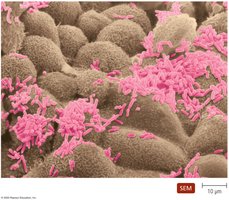
Acquisition of the Microbiome
Humans are born without microorganisms; colonization begins during the birthing process and continues in the first months of life. The composition of the microbiome is influenced by factors such as delivery method, diet, and environment.
Opportunistic Pathogens
Some normal microbiota can become opportunistic pathogens and cause disease under certain conditions, such as:
Introduction into unusual sites in the body
Immune suppression
Changes in the normal microbiota (e.g., antibiotic use)
Reservoirs of Infectious Diseases of Humans
Types of Reservoirs
Reservoirs of infection are sites where pathogens are maintained as a source of infection. There are three main types:
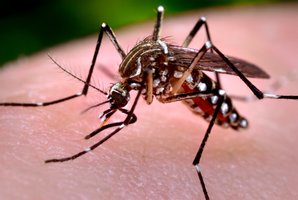
Animal reservoirs: Diseases that naturally spread from animal hosts to humans are called zoonoses. Transmission can occur through direct contact, consumption of animal products, or vectors such as arthropods.
Human carriers: Infected individuals who are asymptomatic but can transmit pathogens to others.
Nonliving reservoirs: Soil, water, and food contaminated with infectious agents.

The Invasion and Establishment of Microbes in Hosts: Infection
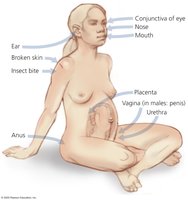
Portals of Entry
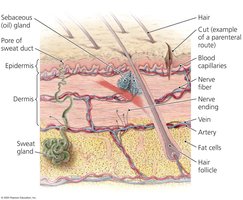
Pathogens enter the body through specific portals of entry:
Skin: Through cuts, abrasions, or by burrowing/digesting outer layers.
Mucous membranes: Most common route, including respiratory and gastrointestinal tracts.
Placenta: Some pathogens can cross the placenta to infect the fetus.
Parenteral route: Circumvents normal barriers by direct deposition into tissues (e.g., via needles or insect bites).
The Role of Adhesion in Infection
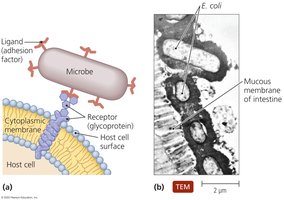
Adhesion is the process by which microorganisms attach to host cells, a critical step for colonization and infection. Microbes use adhesion factors such as ligands (on viruses and bacteria) that bind to specific receptors on host cells. Blocking these interactions can prevent infection.
The Nature of Infectious Disease
Definitions
Infection: Invasion of the host by a pathogen.
Disease (Morbidity): Results when infection alters normal body functions.
Symptoms: Subjective effects felt only by the patient (e.g., pain, fatigue).
Signs: Objective, measurable changes observed by others (e.g., fever, rash).
Syndrome: A group of symptoms and signs that characterize a disease.
Causation of Disease: Etiology
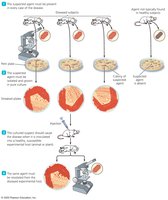
The germ theory of disease states that infections by pathogenic microorganisms cause disease. Koch’s postulates are a set of criteria used to prove that a specific pathogen causes a specific disease:
The suspected agent must be present in every case of the disease.
The agent must be isolated and grown in pure culture.
The cultured agent must cause the disease when inoculated into a healthy host.
The same agent must be reisolated from the diseased experimental host.
Virulence Factors of Infectious Agents
Pathogenicity and Virulence
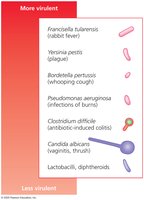
Pathogenicity: The ability of a microorganism to cause disease.
Virulence: The degree of pathogenicity, often determined by specific virulence factors.
Major virulence factors include:
Adhesion factors
Biofilms
Extracellular enzymes
Toxins
Antiphagocytic factors
Extracellular Enzymes
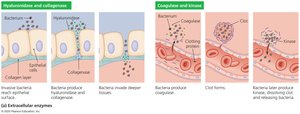
Pathogens secrete enzymes that dissolve host tissues, aiding in invasion and evasion of defenses. Examples include hyaluronidase, collagenase, coagulase, and kinase.
Toxins
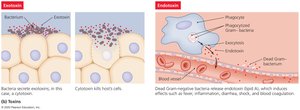
Toxins are chemicals that damage host tissues or trigger damaging immune responses. They are classified as:
Exotoxins: Secreted by bacteria, causing direct damage to host cells.
Endotoxins: Components of Gram-negative bacterial cell walls (lipid A of LPS), released upon cell death.
Antiphagocytic Factors
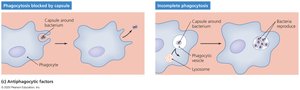
Some pathogens evade phagocytosis by the host's immune cells using:
Bacterial capsules: Prevent recognition and engulfment by phagocytes.
Antiphagocytic chemicals: Inhibit phagocyte function or destroy phagocytes.
The Stages of Infectious Disease
Stages of Disease Progression
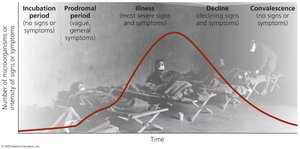
After infection, diseases typically progress through five stages:
Incubation period: Time between infection and appearance of symptoms.
Prodromal period: Short period of vague symptoms.
Illness: Most severe signs and symptoms.
Decline: Symptoms subside as immune response or treatment reduces pathogen numbers.
Convalescence: Recovery and return to normal function.
The Movement of Pathogens Out of Hosts: Portals of Exit
Pathogens exit the host through specific portals, often the same as entry points. They are commonly shed in secretions or excretions such as saliva, feces, urine, or blood.
Modes of Infectious Disease Transmission
Contact Transmission
Direct contact: Physical interaction between hosts (e.g., touching, kissing).
Indirect contact: Transmission via fomites (inanimate objects).
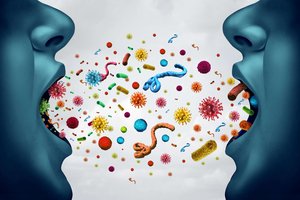
Droplet transmission: Spread via droplets expelled by coughing, sneezing, or talking.
Vehicle Transmission
Airborne: Pathogens carried on dust or droplets suspended in air.
Waterborne: Spread via contaminated water.
Foodborne: Spread via contaminated food.
Bodily fluid transmission: Spread via blood, urine, saliva, etc.

Vector Transmission
Vectors are animals (often arthropods) that transmit pathogens between hosts. Transmission can be:
Biological: Pathogen develops within the vector (e.g., malaria in mosquitoes).
Mechanical: Pathogen is passively carried on the vector's body.
Epidemiology of Infectious Diseases
Frequency of Disease
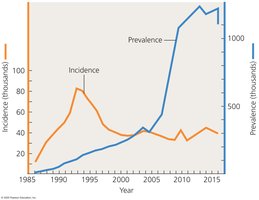
Incidence: Number of new cases in a given area during a specific period.
Prevalence: Total number of cases (new and existing) in a given area during a specific period.
Occurrence of Disease
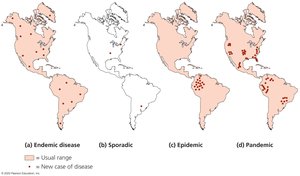
Terms used to describe disease occurrence:
Endemic: Disease constantly present in a population.
Sporadic: Disease occurs occasionally.
Epidemic: Disease occurs at a higher than normal frequency.
Pandemic: Epidemic that occurs on more than one continent.
Epidemiological Studies
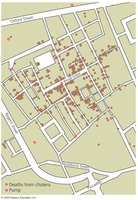
Descriptive epidemiology: Involves careful tabulation of data, including location, time, and patient information.
Analytical epidemiology: Seeks to determine the cause, mode of transmission, and prevention methods, often retrospectively after an outbreak.
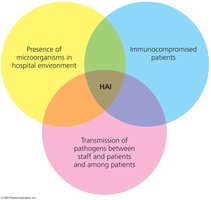
Hospital Epidemiology: Healthcare-Associated (Nosocomial) Infections
Exogenous: Pathogen acquired from the healthcare environment.
Endogenous: Pathogen arises from the patient's own microbiota.
Iatrogenic: Results from medical procedures.
Superinfections: Occur when antimicrobial drugs disrupt normal microbiota, allowing other microbes to thrive.
Epidemiology and Public Health
Public health agencies at local, national, and global levels (e.g., CDC, WHO) coordinate efforts to monitor, control, and prevent infectious diseases through data sharing and public health initiatives.
