 Indietro
Microbial Genetics: Structure, Function, and Regulation
Guida di studio - Note intelligenti
 Appunti personalizzati basati sui tuoi materiali, ampliati con definizioni chiave, esempi e contesto.
Microbial Genetics
Introduction to Microbial Genetics
Microbial genetics is the study of how microorganisms inherit traits, how their genetic information is organized, expressed, and altered. This field is foundational for understanding microbial physiology, evolution, and biotechnology applications.
Structure and Function of Genetic Material
Key Definitions
Genetics: The study of genes, how they carry information, how information is expressed, and how genes are replicated.
Genome: All the genetic information in a cell.
Chromosome: Structures containing DNA that physically carry hereditary information; chromosomes contain genes.
Gene: Segments of DNA that encode functional products, usually proteins.
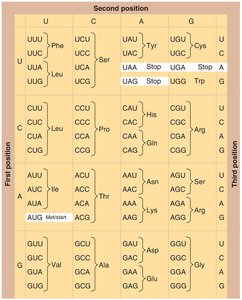
Genetic code: Set of rules that determines how a nucleotide sequence is converted to an amino acid sequence of a protein.
Genotype: The genetic makeup of an organism.
Phenotype: The expression of the genes; the observable characteristics.
Genomics: Sequencing and molecular characterization of genomes.
Organization of Genetic Material in Bacteria
Bacteria typically have a single circular chromosome located in the nucleoid region.
They may also contain plasmids: small, circular, extrachromosomal DNA molecules.
Both chromosomal and plasmid DNA are duplicated and passed to daughter cells during binary fission.
Genomes include protein-coding genes and noncoding regions such as short tandem repeats (STRs).
Central Dogma of Molecular Biology
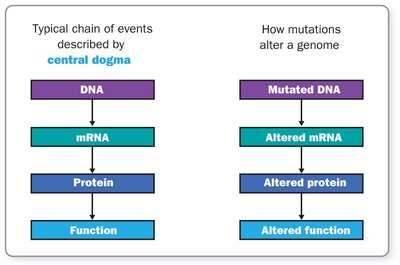
The central dogma describes the flow of genetic information: DNA is transcribed into RNA, which is then translated into protein. Mutations in DNA can alter the resulting protein and its function.
DNA Structure and Replication
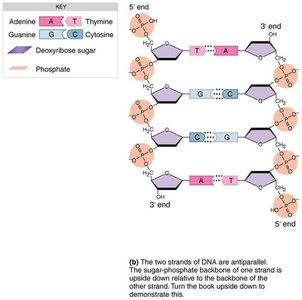
DNA forms a double helix with antiparallel strands held together by hydrogen bonds (A-T, C-G).
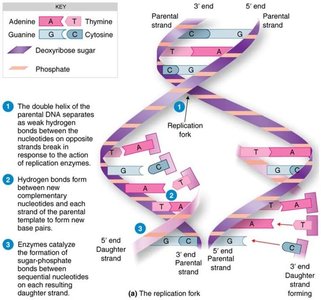
During replication, each strand serves as a template for a new strand.
Key enzymes include DNA polymerase (synthesizes new DNA), helicase (unwinds DNA), gyrase/topoisomerase (relieves supercoiling), and ligase (joins fragments).
Replication is semiconservative: each new DNA molecule contains one old and one new strand.

Enzyme | Function |
|---|---|
DNA Gyrase/Topoisomerase | Relaxes supercoiling ahead of the replication fork |
Helicase | Unwinds double-stranded DNA |
DNA Polymerase | Synthesizes DNA, proofreads, and repairs |
Primase | Makes RNA primers |
DNA Ligase | Joins Okazaki fragments |
Endonucleases/Exonucleases | Cut DNA for repair |
Gene Expression: Transcription and Translation
Transcription (DNA to RNA)
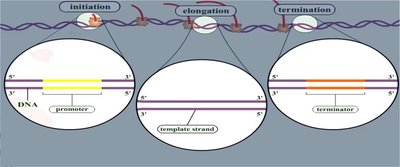
RNA polymerase synthesizes a complementary mRNA strand from a DNA template.
Initiation: RNA polymerase binds to the promoter region.
Elongation: RNA is synthesized in the 5' to 3' direction.
Termination: Transcription ends at the terminator sequence.

Translation (RNA to Protein)
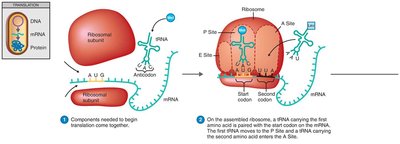
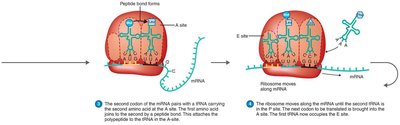
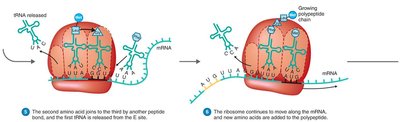
mRNA is read in codons (three-nucleotide sequences) by ribosomes.
tRNA molecules bring amino acids to the ribosome, matching codons with anticodons.
Peptide bonds form between amino acids, creating a polypeptide chain.
Translation begins at the start codon (AUG) and ends at a stop codon (UAA, UAG, UGA).
The genetic code is degenerate: multiple codons can code for the same amino acid.
Gene Expression in Prokaryotes vs. Eukaryotes
In prokaryotes, transcription and translation occur simultaneously in the cytoplasm.
In eukaryotes, transcription occurs in the nucleus and translation in the cytoplasm.
Eukaryotic genes contain introns (noncoding regions) and exons (coding regions); introns are removed during RNA processing.
Regulation of Gene Expression
Operons
Operon: A group of genes regulated together, including structural genes and control regions (promoter and operator).
Inducible operon: Genes are off unless an inducer is present (e.g., lac operon).
Repressible operon: Genes are on unless a corepressor is present (e.g., trp operon).
Positive and Epigenetic Regulation
Catabolite repression: Inhibits use of alternative carbon sources when glucose is present; cAMP and CAP regulate the lac operon.
Epigenetic control: Methylation of DNA can turn genes off; this modification can be inherited but is reversible.
Post-transcriptional control: Mechanisms such as riboswitches and microRNAs can prevent translation of mRNA.
Mutations and Genetic Variation
Types of Mutations
Mutation: A permanent change in the DNA sequence.
Silent mutation: No effect on protein function.
Missense mutation: Changes one amino acid in the protein.
Nonsense mutation: Creates a stop codon, truncating the protein.
Frameshift mutation: Insertion or deletion shifts the reading frame, altering downstream amino acids.
Mutagenesis and DNA Repair
Mutagens: Agents that increase mutation rate (e.g., chemicals, radiation).
DNA repair mechanisms: Photolyase (light repair), nucleotide excision repair.
Ames test: Detects mutagenic potential of chemicals using bacterial reversion assays.
Genetic Transfer and Recombination
Horizontal vs. Vertical Gene Transfer
Vertical gene transfer: Genes passed from parent to offspring.
Horizontal gene transfer: Genes transferred between cells of the same generation.

Mechanisms of Genetic Recombination in Bacteria
Transformation: Uptake of naked DNA from the environment.
Conjugation: Transfer of DNA via direct cell-to-cell contact, often involving plasmids.
Transduction: Transfer of DNA by bacteriophages (viruses that infect bacteria).
Plasmids and Transposons
Plasmids: Self-replicating, extrachromosomal DNA molecules; may carry genes for antibiotic resistance, toxin production, or metabolism of unusual substances.
Transposons: Segments of DNA that can move from one location to another within a genome, potentially disrupting genes or spreading antibiotic resistance.
Summary Table: Types of Mutations
Type | Description | Effect |
|---|---|---|
Silent | Base change does not alter amino acid | No effect on protein |
Missense | Base change alters one amino acid | May alter protein function |
Nonsense | Base change creates stop codon | Truncated, nonfunctional protein |
Frameshift | Insertion/deletion shifts reading frame | Multiple amino acids changed |
Conclusion
Microbial genetics provides the foundation for understanding how microorganisms inherit, express, and alter their genetic information. These processes are central to microbial physiology, adaptation, and evolution, and have profound implications for medicine, biotechnology, and environmental science.
