Ch. 1 - A Brief History of Microbiology
Bauman - Microbiology with Diseases by Taxonomy 6th Edition
Bauman6th EditionMicrobiology with Diseases by TaxonomyISBN: 9780134832302Non è quello che usi tu?Cambia libro di testo
Capitolo 1, Problema 2

Show where microbes ended up in Pasteur’s experiment.
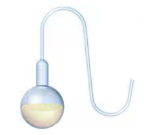
Diagram of a swan-neck flask showing microbes trapped in the bend, preventing contamination of the broth.

Guida verificata passo dopo passo
1
Observe the swan-neck flask in Pasteur's experiment, which contains broth inside the round bottom part of the flask.
Note that the unique curved neck of the flask allows air to enter but traps dust and microbes in the bend of the neck, preventing them from reaching the broth.
Identify that microbes end up trapped in the lower part of the curved neck, where gravity and the shape of the neck cause particles to settle.
Understand that because microbes cannot reach the broth, the broth remains sterile and free from microbial growth.
Conclude that this experiment demonstrated that microbes come from the environment (dust and air) and do not spontaneously generate in the broth.

Risposta video verificata per un problema simile:

Questa soluzione video è stata consigliata dai nostri tutor come utile per risolvere questo problema.
Durata del video:
2m

Concetti chiave

Ecco i concetti essenziali che devi comprendere per rispondere correttamente alla domanda.

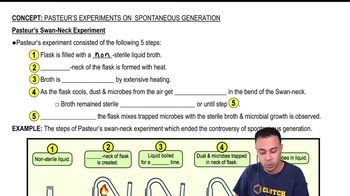
Pasteur's Swan-Neck Flask Experiment

This experiment used a flask with a curved neck to demonstrate that microbes in the air are responsible for contamination. The design allowed air to enter but trapped dust and microbes in the bend, preventing them from reaching the sterile broth inside.
Video consigliato:
05:58
Pasteur’s Swan-Neck Experiment

Microbial Contamination and Sterility

Microbial contamination occurs when microorganisms enter a sterile environment, causing growth and spoilage. Pasteur's experiment showed that without direct contact with microbes trapped in the flask's neck, the broth remained sterile, disproving spontaneous generation.
Video consigliato:
07:36
Terminology of Microbial Growth Control

Role of Airborne Microbes in Microbial Growth

Air contains microbes attached to dust particles that can cause microbial growth when they settle in nutrient-rich environments. Pasteur's experiment demonstrated that microbes do not spontaneously arise but come from the environment, specifically airborne particles.
Video consigliato:
07:24
Types of Microbes (Microbial Characteristics)