Ch. 12 - Characterizing and Classifying Eukaryotes
Bauman - Microbiology with Diseases by Taxonomy 6th Edition
Bauman6th EditionMicrobiology with Diseases by TaxonomyISBN: 9780134832302Non è quello che usi tu?Cambia libro di testo
Capitolo 12, Problema 11

Which of the following features characterizes diatoms?
a. Laminarin and oils as food reserves
b. Protective plates of cellulose within their cells
c. Chlorophylls a and c and carotene
d. Paramylon as a food storage molecule

Guida verificata passo dopo passo
1
Step 1: Understand that diatoms are a group of algae known for their unique cell walls made of silica, and they have specific pigments and storage compounds that distinguish them from other algae.
Step 2: Recall that diatoms store food primarily as laminarin and oils, which serve as energy reserves, rather than paramylon or other polysaccharides.
Step 3: Recognize that diatoms contain chlorophyll a and c, along with carotenoids such as fucoxanthin, which give them their characteristic golden-brown color; carotene is also a type of carotenoid pigment.
Step 4: Note that diatoms do not have protective plates of cellulose; instead, their cell walls are made of silica (glass-like material), which is a key identifying feature.
Step 5: Based on these characteristics, identify the correct option by matching the features of diatoms with the choices given, focusing on their pigments and food reserves.

Risposta video verificata per un problema simile:

Questa soluzione video è stata consigliata dai nostri tutor come utile per risolvere questo problema.
Durata del video:
2m

Concetti chiave

Ecco i concetti essenziali che devi comprendere per rispondere correttamente alla domanda.

Diatom Cell Wall Composition

Diatoms have unique cell walls made of silica, forming intricate and rigid frustules. Unlike cellulose-based walls found in some algae, their silica plates provide protection and structural support.
Video consigliato:
03:44
Introduction to Bacterial Cell Walls

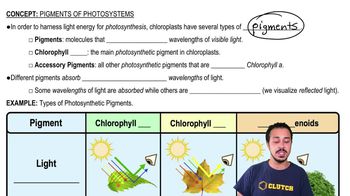
Photosynthetic Pigments in Diatoms

Diatoms contain chlorophylls a and c, along with carotenoids like fucoxanthin, which give them a golden-brown color. These pigments enable efficient photosynthesis adapted to aquatic environments.
Video consigliato:
05:58
Pigments of Photosynthesis

Food Storage Molecules in Diatoms

Diatoms store energy primarily as laminarin, a polysaccharide, and oils. This differs from other protists that may use paramylon or starch, reflecting their unique metabolic adaptations.
Video consigliato:
02:58
Adhesion Molecules