
Ch. 14 - Infection, Infectious Diseases, and Epidemiology
Bauman - Microbiology with Diseases by Taxonomy 6th Edition
Bauman6th EditionMicrobiology with Diseases by TaxonomyISBN: 9780134832302Non è quello che usi tu?Cambia libro di testo
Capitolo 14, Problema 10

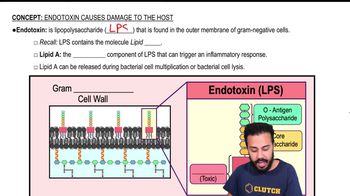
Endotoxin, also known as ___________, is part of the outer (wall) membrane of Gram-negative bacteria.

Guida verificata passo dopo passo
1
Understand that endotoxins are toxic components associated with the outer membrane of Gram-negative bacteria.
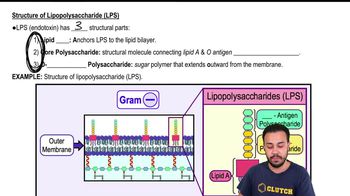
Recall that the outer membrane of Gram-negative bacteria contains lipopolysaccharides (LPS), which are large molecules consisting of a lipid and a polysaccharide.
Recognize that the toxic part of the lipopolysaccharide is called lipid A, which is responsible for the endotoxin activity.
Therefore, the term 'endotoxin' refers specifically to the lipopolysaccharide (LPS) complex found in the outer membrane of Gram-negative bacteria.
Summarize that endotoxin = lipopolysaccharide (LPS), a key structural and toxic component of the Gram-negative bacterial outer membrane.

Risposta video verificata per un problema simile:

Questa soluzione video è stata consigliata dai nostri tutor come utile per risolvere questo problema.
Durata del video:
2m

Concetti chiave

Ecco i concetti essenziali che devi comprendere per rispondere correttamente alla domanda.

Endotoxin

Endotoxins are toxic components found in the outer membrane of Gram-negative bacteria. They are released when the bacteria die or their cell walls break down, triggering strong immune responses in the host.
Video consigliato:
02:46
Endotoxin

Lipopolysaccharide (LPS)

Lipopolysaccharide (LPS) is the chemical structure that constitutes endotoxin. It consists of lipid A, a core polysaccharide, and an O antigen, and is responsible for the toxic effects associated with endotoxins.
Video consigliato:
03:59
Structure of Lipopolysaccharide (LPS)

Gram-negative Bacterial Cell Wall

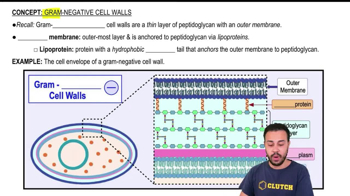
Gram-negative bacteria have a unique cell wall structure with an outer membrane containing LPS, a thin peptidoglycan layer, and an inner membrane. This structure differentiates them from Gram-positive bacteria and is key to endotoxin presence.
Video consigliato:
3:04
Gram-Negative Cell Walls
Pratica correlata
Domanda del libro di testo

Consider the following case. An animal was infected with a virus. A mosquito bit the animal, was contaminated with the virus, and proceeded to bite and infect a person. Which was the vector?

a. Animal

b. Virus

c. Mosquito

d. Person

1120
views
Domanda del libro di testo

Which of the following types of epidemiologists is most like a detective?

a. Descriptive epidemiologist

b. Analytical epidemiologist

c. Experimental epidemiologist

d. Reservoir epidemiologist

1109
views
Domanda del libro di testo

Which of the following statements is the best definition of a pandemic disease?

a. It normally occurs in a given geographic area.

b, It is a disease that occurs more frequently than usual for a geographical area or group of people.

c. It occurs infrequently at no predictable time scattered over a large area or population.

d. It is an epidemic that occurs on more than one continent at the same time.

1089
views
Domanda del libro di testo

A disease in which a pathogen remains inactive for a long period of time before becoming active is termed a(n) :

a. Subacute disease

b. Acute disease

c. Chronic disease

d. Latent disease

1204
views
Domanda del libro di testo

An animal that carries a pathogen and also serves as host for the pathogen is a ___________ vector.

988
views
Domanda del libro di testo

When pathogenic bacterial cells lose the ability to make adhesins, they typically                  .

a. Become avirulent

b. Produce endotoxin

c. Absorb endotoxin

d. Increase in virulence

1231
views