Ch. 15 - Innate Immunity
Bauman - Microbiology with Diseases by Taxonomy 6th Edition
Bauman6th EditionMicrobiology with Diseases by TaxonomyISBN: 9780134832302Non è quello che usi tu?Cambia libro di testo
Capitolo 15, Problema 5

Describe the classical complement cascade pathway from C1 to the MAC.

Guida verificata passo dopo passo
1
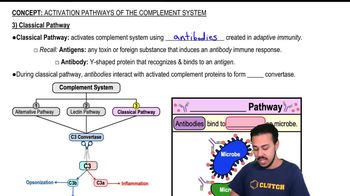
Begin by explaining that the classical complement pathway is initiated when the C1 complex binds to antibodies (IgG or IgM) that are attached to antigens on the surface of a pathogen.
Describe that the C1 complex is composed of C1q, C1r, and C1s subunits; upon binding, C1r activates C1s, which then cleaves C4 into C4a and C4b, and C2 into C2a and C2b.
Explain that C4b and C2a combine to form the C3 convertase (C4b2a), which cleaves C3 into C3a and C3b; C3b then binds to the C3 convertase to form the C5 convertase (C4b2a3b).
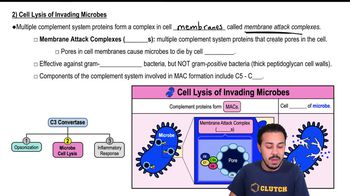
Detail that the C5 convertase cleaves C5 into C5a and C5b; C5b initiates the assembly of the membrane attack complex (MAC) by sequentially binding C6, C7, C8, and multiple C9 molecules.
Conclude by describing that the MAC forms a pore in the pathogen's membrane, leading to cell lysis and death, thus completing the classical complement cascade.

Risposta video verificata per un problema simile:

Questa soluzione video è stata consigliata dai nostri tutor come utile per risolvere questo problema.
Durata del video:
1m

Concetti chiave

Ecco i concetti essenziali che devi comprendere per rispondere correttamente alla domanda.

Classical Complement Pathway Initiation

The classical pathway begins when the C1 complex (composed of C1q, C1r, and C1s) binds to antibodies attached to antigens on a pathogen surface. This binding activates C1r and C1s, which then cleave the next components, C4 and C2, initiating the cascade.
Video consigliato:
03:42
3) Classical Pathway

Formation of C3 Convertase and C5 Convertase

Activated C4b and C2a combine to form the C3 convertase (C4b2a), which cleaves C3 into C3a and C3b. C3b binds to C3 convertase to form C5 convertase (C4b2a3b), which cleaves C5 into C5a and C5b, progressing the cascade toward membrane attack complex formation.
Video consigliato:
03:18
2) Cell Lysis of Invading Microbes

Membrane Attack Complex (MAC) Assembly

C5b initiates MAC formation by sequentially binding C6, C7, C8, and multiple C9 molecules. This complex inserts into the pathogen membrane, creating pores that disrupt membrane integrity, leading to cell lysis and death.
Video consigliato:
02:59
Complex Media