Ch. 2 - The Chemistry of Microbiology
Bauman - Microbiology with Diseases by Taxonomy 6th Edition
Bauman6th EditionMicrobiology with Diseases by TaxonomyISBN: 9780134832302Non è quello che usi tu?Cambia libro di testo
Capitolo 2, Problema 3

The principal short-term energy storage molecule in cells is __________ .

Guida verificata passo dopo passo
1
Understand that the question is asking for the main molecule cells use to store energy for short-term use.
Recall that cells store energy in different forms, but the principal short-term energy storage molecule is a high-energy compound that can be quickly mobilized.
Consider common energy storage molecules such as ATP (adenosine triphosphate), glycogen, and fats, and identify which one is primarily used for immediate energy needs.
Recognize that ATP is the molecule that stores and transfers energy in cells for short-term use because it can release energy quickly by breaking its high-energy phosphate bonds.
Conclude that the answer is ATP, which stands for adenosine triphosphate, the principal short-term energy storage molecule in cells.

Risposta video verificata per un problema simile:

Questa soluzione video è stata consigliata dai nostri tutor come utile per risolvere questo problema.
Durata del video:
2m

Concetti chiave

Ecco i concetti essenziali che devi comprendere per rispondere correttamente alla domanda.

ATP as the Primary Energy Currency

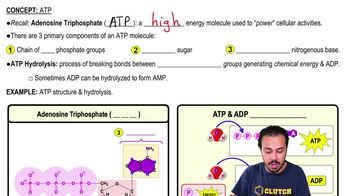
Adenosine triphosphate (ATP) is the main molecule cells use to store and transfer energy in the short term. It releases energy when its high-energy phosphate bonds are broken, powering various cellular processes.
Video consigliato:

Energy Storage and Transfer in Cells

Cells require molecules that can quickly store and release energy to support metabolism. Short-term energy storage molecules like ATP provide immediate energy, unlike long-term storage molecules such as fats or glycogen.
Video consigliato:
04:58
Introduction to Energy

Phosphorylation and Energy Release

The process of phosphorylation involves adding or removing phosphate groups from molecules like ATP. Breaking the bond between phosphate groups in ATP releases energy that cells harness for activities like muscle contraction and biosynthesis.
Video consigliato:
01:06
Types of Phosphorylation