Ch. 2 - The Chemistry of Microbiology
Bauman - Microbiology with Diseases by Taxonomy 6th Edition
Bauman6th EditionMicrobiology with Diseases by TaxonomyISBN: 9780134832302Non è quello che usi tu?Cambia libro di testo
Capitolo 2, Problema 10

Which of the following are hydrophobic organic molecules?
a. Proteins
b. Carbohydrates
c. Lipids
d. Nucleic acids

Guida verificata passo dopo passo
1
Understand the meaning of 'hydrophobic organic molecules': these are molecules that do not mix well with water due to their nonpolar nature.
Recall the general properties of each molecule type: Proteins are made of amino acids and have both hydrophilic and hydrophobic regions; Carbohydrates are generally polar and hydrophilic; Lipids are mostly nonpolar and hydrophobic; Nucleic acids have polar phosphate backbones and are hydrophilic.
Analyze each option based on their chemical structure and polarity: Proteins have mixed properties, Carbohydrates are hydrophilic, Lipids are hydrophobic, and Nucleic acids are hydrophilic.
Identify which molecules are primarily hydrophobic by focusing on their nonpolar characteristics, which repel water.
Conclude that lipids are the main class of hydrophobic organic molecules among the options given.

Risposta video verificata per un problema simile:

Questa soluzione video è stata consigliata dai nostri tutor come utile per risolvere questo problema.
Durata del video:
2m

Concetti chiave

Ecco i concetti essenziali che devi comprendere per rispondere correttamente alla domanda.

Hydrophobicity in Organic Molecules

Hydrophobic molecules repel water and do not dissolve easily in it. This property is due to nonpolar bonds that prevent interaction with polar water molecules. Understanding hydrophobicity helps distinguish which biomolecules tend to aggregate away from water.
Video consigliato:
05:22
Scientific Naming of Organisms

Structure and Properties of Lipids

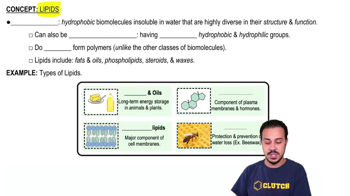
Lipids are primarily composed of long hydrocarbon chains or rings, making them largely nonpolar and hydrophobic. This characteristic allows lipids to form cell membranes and store energy, distinguishing them from other biomolecules that are more hydrophilic.
Video consigliato:
04:19
Lipids

Comparison of Biomolecule Classes

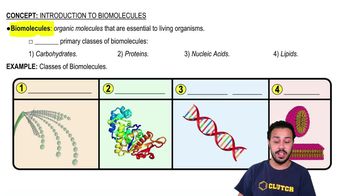
Proteins, carbohydrates, and nucleic acids generally contain polar groups, making them hydrophilic or amphipathic. In contrast, lipids are mostly hydrophobic. Recognizing these differences is essential for identifying which molecules repel water.
Video consigliato:
01:17
Introduction to Biomolecules