Ch. 20 - Pathogenic Gram-Negative Cocci and Bacilli
Bauman - Microbiology with Diseases by Taxonomy 6th Edition
Bauman6th EditionMicrobiology with Diseases by TaxonomyISBN: 9780134832302Non è quello che usi tu?Cambia libro di testo
Capitolo 20, Problema 3

Which of the following bacterial cells is most likely to be virulent?
a. A cell with fimbriae and LOS
b. A cell with a polysaccharide capsule and lipooligosaccharide
c. A cell with fimbriae, lipooligosaccharide, and a polysaccharide capsule
d. A cell with fimbriae but no capsule

Guida verificata passo dopo passo
1
Step 1: Understand the key virulence factors mentioned in the options: fimbriae, lipooligosaccharide (LOS), and polysaccharide capsule. Each of these contributes differently to bacterial pathogenicity.
Step 2: Recall that fimbriae help bacteria adhere to host cells, which is important for colonization but alone may not confer high virulence.
Step 3: Recognize that lipooligosaccharide (LOS) is an endotoxin found in the outer membrane of some Gram-negative bacteria, contributing to immune evasion and inflammation.
Step 4: Know that a polysaccharide capsule protects bacteria from phagocytosis by host immune cells, significantly enhancing virulence.
Step 5: Compare the options by combining these factors: the most virulent bacterial cell is likely the one possessing fimbriae (for adhesion), LOS (for immune interaction), and a polysaccharide capsule (for protection), which corresponds to option c.

Risposta video verificata per un problema simile:

Questa soluzione video è stata consigliata dai nostri tutor come utile per risolvere questo problema.
Durata del video:
2m

Concetti chiave

Ecco i concetti essenziali che devi comprendere per rispondere correttamente alla domanda.

Virulence Factors in Bacteria

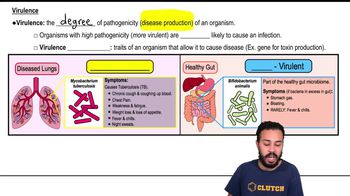
Virulence factors are molecules produced by bacteria that enhance their ability to cause disease. These include structures like fimbriae for attachment, capsules for evading immune responses, and components like lipooligosaccharide that trigger inflammation. Understanding these factors helps determine which bacterial cells are more likely to be virulent.
Video consigliato:
03:05
Virulence

Polysaccharide Capsule

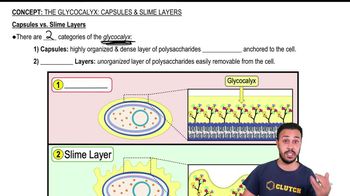
A polysaccharide capsule is a protective layer surrounding some bacterial cells that helps them evade phagocytosis by host immune cells. This capsule increases bacterial survival in the host and is often associated with increased virulence, making bacteria more resistant to immune defenses.
Video consigliato:
01:53
Capsules vs. Slime Layers

Lipooligosaccharide (LOS)

Lipooligosaccharide is a component of the outer membrane of certain Gram-negative bacteria, similar to lipopolysaccharide but with a shorter polysaccharide chain. LOS can trigger strong immune responses and contribute to bacterial pathogenicity by inducing inflammation and damaging host tissues.