
Ch. 26 - Applied and Industrial Microbiology
Bauman - Microbiology with Diseases by Taxonomy 6th Edition
Bauman6th EditionMicrobiology with Diseases by TaxonomyISBN: 9780134832302Non è quello che usi tu?Cambia libro di testo
Capitolo 26, Problema 2

Commercially produced beers and wines are usually fermented with the aid of _______.
a. Naturally occurring bacteria
b. Naturally occurring yeast
c. Specific cultured bacteria
d. Specific cultured yeast

Guida verificata passo dopo passo
1
Understand the fermentation process in beer and wine production, which involves converting sugars into alcohol and carbon dioxide.
Recognize that fermentation is primarily carried out by microorganisms called yeast, which metabolize sugars to produce alcohol.
Differentiate between naturally occurring yeast and specific cultured yeast: naturally occurring yeast are wild strains present in the environment, while specific cultured yeast are selected strains cultivated for consistent fermentation.
Consider the commercial production context, where consistency and control over fermentation are important, leading producers to use specific cultured yeast to ensure predictable results.
Conclude that commercially produced beers and wines are usually fermented with the aid of specific cultured yeast, which is option d.

Risposta video verificata per un problema simile:

Questa soluzione video è stata consigliata dai nostri tutor come utile per risolvere questo problema.
Durata del video:
1m

Concetti chiave

Ecco i concetti essenziali che devi comprendere per rispondere correttamente alla domanda.

Fermentation in Alcohol Production

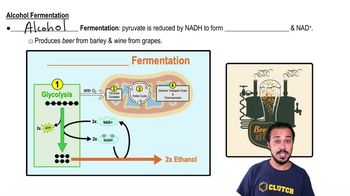
Fermentation is a metabolic process where microorganisms convert sugars into alcohol and other byproducts. In beer and wine production, fermentation is essential for producing ethanol, which gives these beverages their alcoholic content.
Video consigliato:
01:59
Alcohol Fermentation

Role of Yeast in Fermentation

Yeast, a type of fungus, is the primary microorganism responsible for alcoholic fermentation. Specific strains of yeast metabolize sugars in the wort or grape juice, producing alcohol and carbon dioxide, which are crucial for beer and wine characteristics.
Video consigliato:
01:59
Alcohol Fermentation

Use of Specific Cultured Microorganisms

Commercial brewing and winemaking typically use specific cultured yeast strains to ensure consistent fermentation, flavor, and quality. These controlled cultures prevent contamination and variability that might occur with naturally occurring microbes.
Video consigliato:
01:25
Importance of Microorganisms
Pratica correlata
Domanda del libro di testo

Match each term with its correct definition.


1._______ Organisms whose presence in water indicates contamination from feces

2._______Refers to water that is fit to drink

3._______Used in the processing of animal wastes; mimics primary and secondary wastewater treatment

4._______Water that is not bound by solutes

5._______Undesirable fermentation reactions in food, leading to poor taste, smell, or appearance

6._______Brief heating of foods during processing

7._______Descriptor of the level of organic material present in wastewater

8._______Fermentative products produced by microorganisms during stationary phase


A. Spoilage

B. Water activity

C. Coliforms

D. Pasteurization

E. Secondary metabolites

F. Potable

G. BOD

H. Oxidation lagoon

946
views
Domanda del libro di testo

Indicate whether the following statement is true or false. Rewrite the underlined phrase to make a false statement true.

______ The fermentation of dairy products relies on mixed acid fermentation.

675
views
Domanda del libro di testo

Indicate whether the following statement is true or false. Rewrite the underlined phrase to make a false statement true.

______ Sauerkraut production involves the alcoholic fermentation of cabbage.

665
views
Domanda del libro di testo

Label the steps in the wine-making process.

<IMAGE>

1282
views
Domanda del libro di testo

Leaving foods out at room temperature ________the likelihood of food spoilage.

930
views
Domanda del libro di testo

Which of the following lists foods in order, from perishable to nonperishable?

a. Dried pasta, cheese, fruit, uncooked ground beef

b. Dried pasta, fruit, uncooked ground beef, cheese

c. Uncooked ground beef, fruit, cheese, dried pasta

d. Uncooked ground beef, fruit, dried pasta, cheese

881
views