Ch. 3 - Cell Structure and Function
Bauman - Microbiology with Diseases by Taxonomy 6th Edition
Bauman6th EditionMicrobiology with Diseases by TaxonomyISBN: 9780134832302Non è quello che usi tu?Cambia libro di testo
Capitolo 3, Problema 18

Describe the endosymbiotic theory. What evidence supports the theory? Which features of eukaryotic cells are not explained by the theory?

Guida verificata passo dopo passo
1
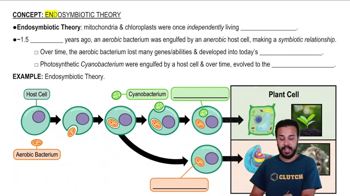
Begin by defining the endosymbiotic theory: it proposes that certain organelles in eukaryotic cells, such as mitochondria and chloroplasts, originated from free-living prokaryotic cells that were engulfed by ancestral eukaryotic cells, forming a symbiotic relationship.
Explain the key evidence supporting the theory, including: (a) mitochondria and chloroplasts have their own circular DNA similar to prokaryotes; (b) these organelles have double membranes consistent with engulfment; (c) they reproduce independently within the cell by a process similar to binary fission; (d) their ribosomes resemble those of prokaryotes in size and sensitivity to antibiotics.
Discuss how molecular evidence, such as similarities in gene sequences between mitochondrial/chloroplast DNA and certain bacteria, further supports the theory.
Identify features of eukaryotic cells that the endosymbiotic theory does not fully explain, such as the origin of the nucleus, the endomembrane system (including the Golgi apparatus and endoplasmic reticulum), and the cytoskeleton.
Summarize by noting that while the endosymbiotic theory explains the origin of some organelles, it is part of a broader understanding of eukaryotic cell evolution that involves multiple processes.

Risposta video verificata per un problema simile:

Questa soluzione video è stata consigliata dai nostri tutor come utile per risolvere questo problema.
Durata del video:
3m

Concetti chiave

Ecco i concetti essenziali che devi comprendere per rispondere correttamente alla domanda.

Endosymbiotic Theory

The endosymbiotic theory proposes that certain organelles in eukaryotic cells, such as mitochondria and chloroplasts, originated from free-living prokaryotes that were engulfed by ancestral host cells. This symbiotic relationship became permanent, leading to the evolution of complex eukaryotic cells.
Video consigliato:
07:29
Endosymbiotic Theory

Evidence Supporting Endosymbiotic Theory

Evidence includes the presence of double membranes around mitochondria and chloroplasts, their own circular DNA similar to bacteria, and their ability to replicate independently within the cell. Additionally, these organelles have ribosomes resembling those of prokaryotes, supporting their bacterial origin.
Video consigliato:
07:29
Endosymbiotic Theory

Limitations of the Endosymbiotic Theory

While the theory explains the origin of mitochondria and chloroplasts, it does not account for other eukaryotic features like the nucleus, endoplasmic reticulum, or cytoskeleton. These structures likely evolved through different mechanisms, indicating the theory covers only part of eukaryotic cell evolution.
Video consigliato:
07:29
Endosymbiotic Theory