Ch. 3 - Cell Structure and Function
Bauman - Microbiology with Diseases by Taxonomy 6th Edition
Bauman6th EditionMicrobiology with Diseases by TaxonomyISBN: 9780134832302Non è quello che usi tu?Cambia libro di testo
Capitolo 3, Problema 11

How do archaeal flagella differ from bacterial flagella and eukaryotic flagella?

Guida verificata passo dopo passo
1
Step 1: Understand the basic structure and function of flagella in all three domains: bacteria, archaea, and eukaryotes. Flagella are appendages used for motility, but their composition and mechanism differ.
Step 2: Compare archaeal flagella to bacterial flagella by focusing on their protein composition. Archaeal flagella are made of different proteins called archaellins, whereas bacterial flagella are primarily composed of flagellin proteins.
Step 3: Examine the assembly process. Archaeal flagella are assembled from the base by adding subunits at the base, similar to bacterial flagella, but the machinery involved is more closely related to type IV pili assembly systems rather than the bacterial flagellar motor.
Step 4: Contrast archaeal flagella with eukaryotic flagella. Eukaryotic flagella have a complex '9+2' arrangement of microtubules inside, powered by dynein motor proteins, whereas archaeal flagella lack microtubules and have a simpler structure.
Step 5: Summarize the key differences: archaeal flagella are structurally and genetically distinct from bacterial flagella and eukaryotic flagella, with unique protein composition, assembly mechanisms, and motility functions.

Risposta video verificata per un problema simile:

Questa soluzione video è stata consigliata dai nostri tutor come utile per risolvere questo problema.
Durata del video:
1m

Concetti chiave

Ecco i concetti essenziali che devi comprendere per rispondere correttamente alla domanda.

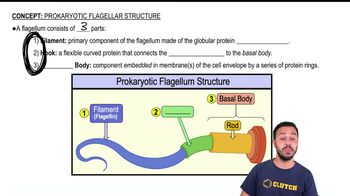
Structure and Composition of Flagella

Archaeal flagella, called archaella, are structurally distinct from bacterial and eukaryotic flagella. Unlike bacterial flagella made of flagellin, archaella are composed of glycosylated proteins and are thinner. Eukaryotic flagella have a complex microtubule-based structure called the axoneme.
Video consigliato:
02:53
Prokaryotic Flagellar Structure

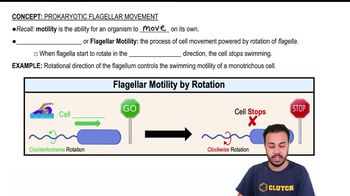
Mechanism of Movement

Bacterial flagella rotate like a propeller powered by a proton or sodium motive force, while archaeal flagella also rotate but are powered by ATP hydrolysis. Eukaryotic flagella move with a whip-like motion driven by dynein motor proteins along microtubules.
Video consigliato:
02:43
Prokaryotic Flagellar Movement

Evolutionary and Functional Differences

Archaeal flagella are evolutionarily unrelated to bacterial flagella despite similar functions, reflecting convergent evolution. Eukaryotic flagella evolved from different cellular components and serve diverse roles including locomotion and sensory functions.
Video consigliato:
06:04
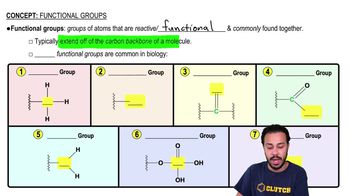
Functional Groups