Ch. 3 - Cell Structure and Function
Bauman - Microbiology with Diseases by Taxonomy 6th Edition
Bauman6th EditionMicrobiology with Diseases by TaxonomyISBN: 9780134832302Non è quello che usi tu?Cambia libro di testo
Capitolo 3, Problema 4

The term fluid mosaic has been used in describing the cytoplasmic membrane. How does each word of that phrase accurately describe our current understanding of a cell membrane?

Guida verificata passo dopo passo
1
Understand the term 'fluid mosaic' by breaking it into two parts: 'fluid' and 'mosaic'.
The word 'fluid' refers to the dynamic and flexible nature of the membrane, meaning that the lipid bilayer is not rigid but allows lateral movement of lipids and proteins within the layer.
The word 'mosaic' describes the membrane's composition, which is made up of various molecules such as phospholipids, proteins, and carbohydrates arranged in a patchwork or mosaic pattern.
Explain how the fluidity allows the membrane to adapt, self-heal, and enable the movement of membrane proteins that perform different functions like transport, signaling, and enzymatic activity.
Describe how the mosaic nature reflects the diversity of components embedded in or attached to the membrane, contributing to its selective permeability and functional complexity.

Risposta video verificata per un problema simile:

Questa soluzione video è stata consigliata dai nostri tutor come utile per risolvere questo problema.
Durata del video:
3m

Concetti chiave

Ecco i concetti essenziali che devi comprendere per rispondere correttamente alla domanda.

Fluidity of the Membrane

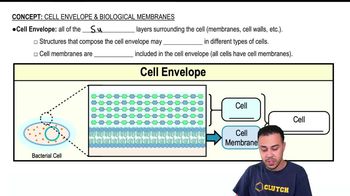
The term 'fluid' refers to the dynamic nature of the lipid bilayer, where phospholipids and proteins can move laterally within the layer. This fluidity allows the membrane to be flexible, self-healing, and enables the movement of membrane proteins essential for cell function.
Video consigliato:
02:10
Biological Membranes

Mosaic Structure

'Mosaic' describes the patchwork arrangement of various proteins embedded in or attached to the lipid bilayer. These proteins serve diverse roles such as transport, signaling, and structural support, creating a complex and heterogeneous membrane composition.
Video consigliato:
04:41
Discovering the Structure of DNA

Phospholipid Bilayer Composition

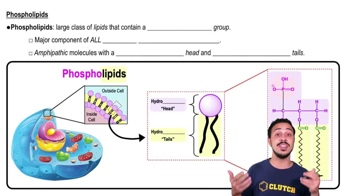
The cytoplasmic membrane is primarily composed of a bilayer of phospholipids, with hydrophilic heads facing outward and hydrophobic tails inward. This arrangement forms a selective barrier that regulates the passage of substances in and out of the cell.
Video consigliato:
04:05
Phospholipids
Pratica correlata
Domanda del libro di testo

A "9 + 2" arrangement of microtubules is seen in __________ .


a. archaeal flagella

b. bacterial flagella

c. eukaryotic flagella

d. all prokaryotic flagella

1558
views

Domanda del libro di testo

Which of the following is not a function of a glycocalyx?


a. It forms pseudopods for faster mobility of an organism.

b. It can protect a bacterial cell from drying out.

c. It hides a bacterial cell from other cells.

d. It allows a bacterium to stick to a host.

1268
views
Domanda del libro di testo

A scientist who is studying passive movement of chemicals across the cytoplasmic membrane of Salmonella enterica serotype Typhi measures the rate at which two chemicals diffuse into a cell as a function of external concentration. The results are shown in the following figure. Chemical A diffuses into the cell more rapidly than does B at lower external concentrations, but the rate levels off as the external concentration increases. The rate of diffusion of chemical B continues to increase as the external concentration increases.


a. How can you explain the differences in the diffusion rates of chemicals A and B?

b. Why does the diffusion rate of chemical A taper off?

c. How could the cell increase the diffusion rate of chemical A?

d. How could the cell increase the diffusion rate of chemical B?

1311
views
Domanda del libro di testo

Which of the following is most associated with diffusion?


a. Symports

b. Antiports

c. Carrier proteins

d. Endocytosis

1298
views
Domanda del libro di testo

Which of the following is not associated with prokaryotic organisms?


a. Nucleoid

b. Glycocalyx

c. Cilia

d. Circular DNA

914
views
Domanda del libro di testo

A local newspaper writer has contacted you, an educated microbiology student from a respected college. He wants to obtain scientific information for an article he is writing about “life” and poses the following query: “What is the difference between a living thing and a nonliving thing?” Knowing that he will edit your material to fit the article, give an intelligent, scientific response.

1351
views